


IP PBX SIP trunking is a voice-over-IP method that connects your IP-based PBX to a carrier's telephone network using the Session Initiation Protocol over the internet, replacing legacy PRI or analog lines. It enables elastic call capacity, per-minute pricing, and global DID provisioning without physical hardware per channel. VideoSDK extends this model with built-in SIP integration that bridges traditional telephony into WebRTC rooms for AI agents and live communication apps, which you can explore in the VideoSDK Telephony documentation.
Businesses are abandoning legacy PRI circuits and analog phone lines at an accelerating pace. The reason is straightforward: traditional telephony locks you into fixed channel counts, physical hardware, and pricing models that penalize growth. IP PBX SIP trunking flips that model by routing voice calls over the internet through a carrier-grade SIP trunk, giving you elastic capacity and granular per-minute pricing.
For developers and solution architects building communication infrastructure, understanding how SIP trunking works at the protocol level is essential. You need to know how signaling flows, how media is negotiated, and what security controls are non-negotiable in 2026. This guide walks through the full stack from architecture to provider selection to implementation, with a focus on production-grade deployments.
What Is IP PBX SIP Trunking?
IP PBX SIP trunking is defined as the method of connecting an IP-based Private Branch Exchange to a public telephone network using SIP trunks provisioned by an ITSP (Internet Telephony Service Provider). The IP PBX handles internal call routing, extension management, and feature delivery, while the SIP trunk serves as the virtual phone line carrying calls to and from the outside world.
A SIP trunk works by establishing a logical connection between your PBX and the carrier's session border controller over IP. Unlike a traditional PRI circuit that delivers 23 channels on a physical T1 line, a SIP trunk is software-defined. You can scale concurrent calls up or down without truck rolls or hardware changes. The trunk carries both signaling (call setup, teardown, feature negotiation) and media (the actual voice audio) as IP packets.
The distinction between carrier-grade and reseller-grade SIP trunking matters more than most buyers realize. Carrier-grade providers operate their own session border controllers, maintain direct PSTN interconnects, and publish SLA guarantees with measurable latency and post-dial-delay metrics. Reseller-grade providers white-label someone else's infrastructure, often with opaque routing and no direct control over quality. For production deployments where call quality and uptime are non-negotiable, carrier-grade is the only defensible choice.
VideoSDK provides SIP integration that bridges traditional telephony infrastructure with modern WebRTC-based rooms, enabling developers to route inbound SIP calls into application-controlled environments. You can learn more about this capability in the VideoSDK Telephony introduction.
How the Technology Works
SIP trunking operates on a separation between signaling and media. Signaling uses the Session Initiation Protocol to negotiate call parameters, while media flows as RTP packets carrying the actual audio. Understanding this separation is the foundation for troubleshooting any SIP trunk deployment.
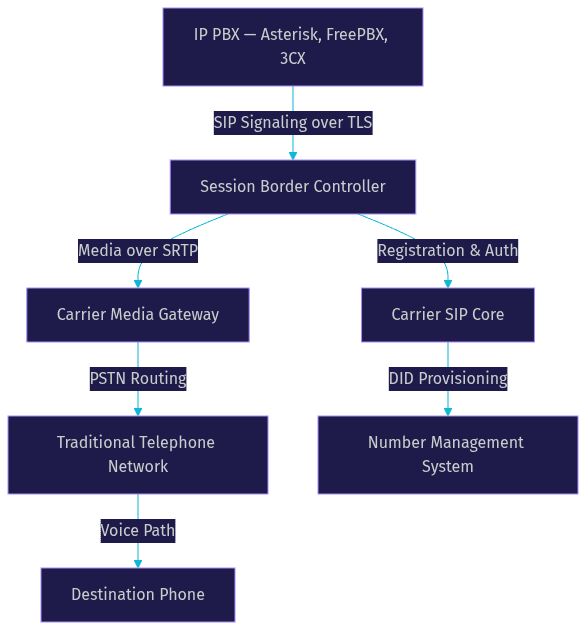
When a user dials an external number from an IP PBX extension, the PBX constructs a SIP INVITE message containing the caller and callee URIs, supported codecs, and media capabilities. This INVITE travels over UDP, TCP, or TLS to the carrier's session border controller. The carrier processes the request, routes it toward the destination, and returns progress responses. Once the far end answers, a 200 OK message confirms the session, the PBX acknowledges with a SIP ACK, and bidirectional media flows directly between endpoints or through a media proxy.
The diagram below illustrates the architectural flow from an IP PBX through a SIP trunk to the carrier gateway and onward to the PSTN:
Core Components
Every IP PBX SIP trunking deployment relies on four core components. The IP PBX itself (such as Asterisk, FreePBX, 3CX, or FreeSWITCH) manages internal extensions, dial plans, and call routing logic. The SIP trunk credentials define how your PBX authenticates with the carrier, either through IP allowlisting or username and password authentication. DID numbers (Direct Inward Dial) are the public phone numbers provisioned on the trunk for inbound calling. Media gateways or session border controllers handle the translation between IP-based SIP signaling and traditional PSTN protocols, managing NAT traversal, firewall pinholes, and codec transcoding where needed.
Call Setup Sequence
The call setup sequence follows a deterministic SIP message flow. First, the PBX registers with the carrier if credential-based authentication is used, sending a REGISTER message that the carrier confirms with a 200 OK. For outbound calls, the PBX sends an INVITE to the carrier's SBC. The carrier responds with 100 Trying, followed by 180 Ringing when the destination phone alerts. When the call connects, a 200 OK travels back, and the PBX sends a final ACK to complete the three-way handshake. Media then flows as RTP packets. Call teardown occurs when either side sends a BYE message, confirmed by a final 200 OK.
Key Benefits for Businesses
IP PBX SIP trunking delivers measurable advantages over legacy telephony across cost, scalability, reach, and feature richness.
Cost savings are the most immediate driver. Traditional PRI circuits charge per channel regardless of usage, meaning you pay for 23 simultaneous call paths even if your average utilization is 8. SIP trunking uses per-minute pricing or bundled concurrent-channel packages that scale with actual usage. Organizations routinely cut telephony costs by 40 to 60 percent after migrating from PRI to SIP.
Scalability is elastic by design. You can increase concurrent channel capacity by adjusting a configuration value or contacting your provider, not by installing a new T1 card. This matters for seasonal businesses, call centers with variable volume, and growing companies that need to add capacity without procurement delays.
Global reach comes through DID provisioning. A carrier-grade SIP trunk provider can assign local phone numbers in dozens of countries, toll-free numbers, and even port existing numbers from other carriers. This lets a single PBX serve a global footprint without physical presence in each market.
Enhanced features in 2026 include STIR/SHAKEN A-level attestation for caller-ID verification, TLS for signaling encryption and SRTP for media encryption, and SIP REFER support for call transfers. These capabilities are table stakes for any production deployment and are increasingly mandated by regulatory frameworks.
Choosing the Right SIP Trunk Provider
Provider selection is the single highest-impact decision in any SIP trunking deployment. A poor choice compounds across every call your business makes for years.
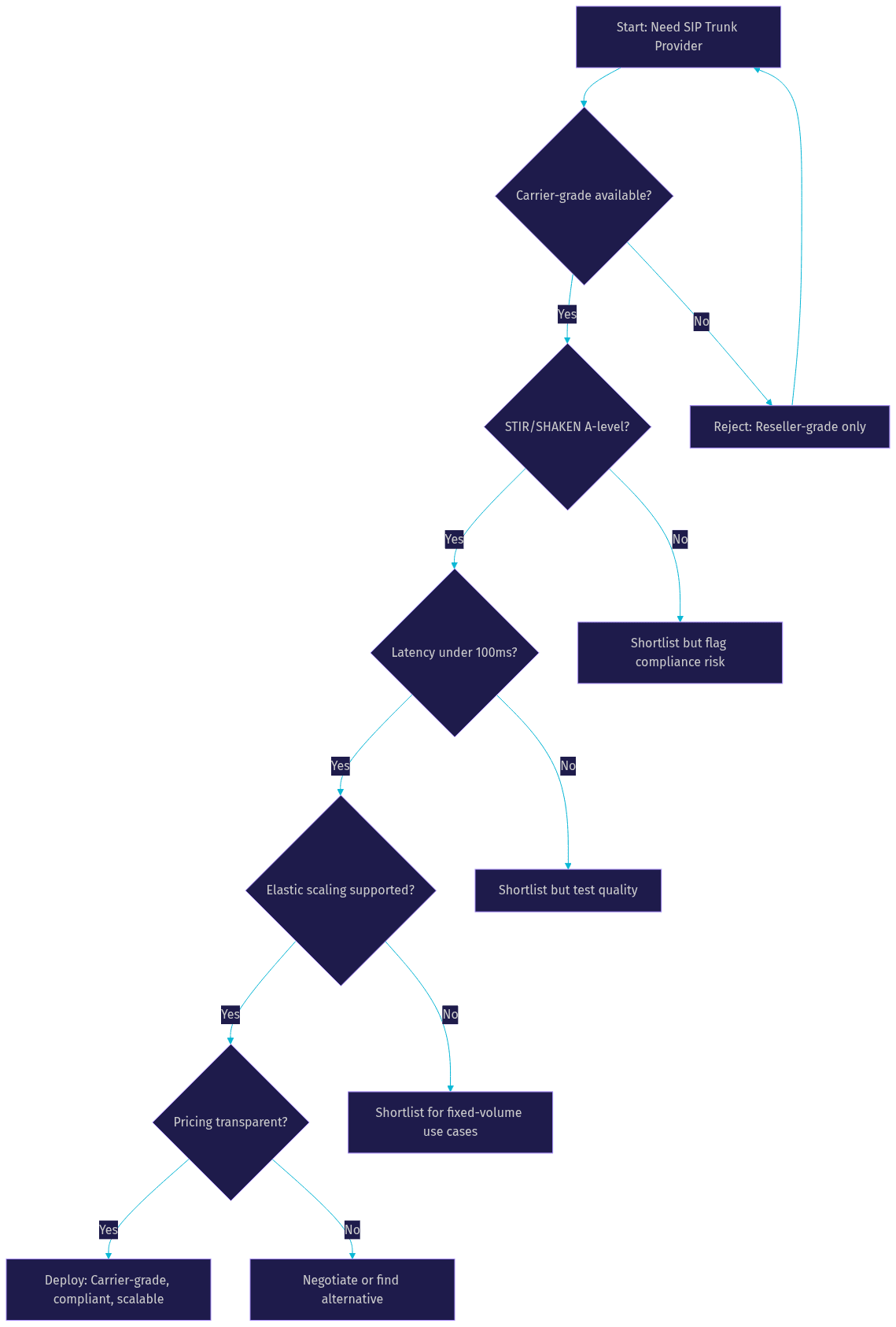
Start by distinguishing carrier-grade from reseller-grade providers. Carrier-grade providers own their session border controllers, maintain direct PSTN interconnects, and publish measurable quality metrics. Reseller-grade providers aggregate traffic across third-party networks with limited visibility into routing or quality. For production workloads, carrier-grade is the baseline.
Evaluate providers against a structured criteria checklist. Measure latency and post-dial-delay (PDD) from your PBX to the carrier's SBC, targeting sub-100ms latency and PDD under two seconds. Verify STIR/SHAKEN attestation level, with A-level being the gold standard for originating calls. Check concurrent channel limits and whether the provider supports elastic scaling without contract amendments. Assess DID provisioning speed, targeting same-day activation for new numbers. Review pricing transparency, looking for published per-minute rates with no hidden fees. Confirm SLA guarantees with measurable uptime targets and remediation timelines. Evaluate the support model, prioritizing providers with 24/7 technical support and direct access to SIP engineers rather than tier-one ticket queues.
The decision tree below maps the provider selection process:
Provider Comparison Matrix
A side-by-side comparison table is the most effective tool for evaluating multiple providers. Structure the table with columns for provider name, grade (carrier vs reseller), STIR/SHAKEN level, concurrent channel limit, DID provisioning speed, per-minute pricing, SLA percentage, and support tier. Add a final column for a weighted verdict that accounts for your specific priorities, whether that is cost optimization, call quality, or global reach. This matrix becomes a decision artifact you can share with stakeholders and revisit during contract renewals.
Practical Implementation Steps
Implementing IP PBX SIP trunking requires careful attention to compatibility, authentication, codecs, security, and testing. Each step builds on the previous one, and skipping any step creates production risk.
Step 1: Verify PBX Compatibility
Confirm that your IP PBX platform supports SIP trunking with your chosen carrier. Major platforms including Asterisk, FreePBX, 3CX, and FreeSWITCH all support SIP trunks, but configuration surfaces differ. Check the carrier's compatibility documentation for tested platform versions and known configuration templates. Verify that your PBX version supports TLS transport for signaling and SRTP for media if encryption is required.
Step 2: Configure Authentication
SIP trunks authenticate using one of two methods. IP allowlisting restricts trunk access to specific source IP addresses, requiring no credentials but demanding a static public IP on your PBX. Credential-based authentication uses a username and password exchanged during SIP REGISTER messages, offering more flexibility for dynamic IP environments. Choose the method that matches your network topology and security posture.
Step 3: Set Up Codecs and Transport Security
Codec selection directly impacts call quality and bandwidth consumption. G.711 (ulaw/alaw) delivers toll-quality audio at 64 kbps per channel and is universally supported. G.729 compresses audio to 8 kbps but requires licensing and delivers lower fidelity. Opus is the modern choice for variable-bitrate voice, adapting to network conditions and delivering excellent quality at low bandwidth. Configure your PBX to offer codecs in priority order, with the carrier's preferred codec listed first.
For transport security, enable TLS for SIP signaling to encrypt call setup messages and prevent interception. Enable SRTP for media to encrypt the voice payload. Both require certificate management on your PBX and coordination with the carrier's SBC configuration.
Step 4: Provision DIDs and Map Inbound Routes
Request DID numbers from your carrier and map each number to an internal destination in your PBX dial plan. For inbound calls, the carrier sends a SIP INVITE with the DID as the called number. Your PBX matches that number against inbound route rules and directs the call to the appropriate extension, queue, or IVR. Test each DID immediately after provisioning to confirm that inbound routing works as expected.
Step 5: Test Call Flow and Monitor Quality
Place test calls in both directions and monitor quality metrics. Key metrics include Mean Opinion Score (MOS), jitter, packet loss, and round-trip time. A MOS above 4.0 indicates good quality, while anything below 3.5 signals a problem requiring investigation. Use your PBX's built-in monitoring tools or a third-party SIP analyzer to capture and inspect signaling and media flows.
Common Pitfalls and Troubleshooting
One-way audio is the most common SIP trunking problem, typically caused by NAT traversal issues or firewall rules blocking RTP media ports. Ensure that your firewall allows UDP traffic on the RTP port range configured by your carrier. Registration failures usually stem from incorrect credentials, IP allowlist mismatches, or TLS certificate problems. Bandwidth limits cause audio degradation when concurrent calls exceed available capacity, so calculate your bandwidth headroom using the codec's per-channel bitrate multiplied by expected peak concurrency.
Security and Compliance Considerations
Security in SIP trunking spans encryption, network access control, and regulatory compliance. Treating any of these as optional creates exposure that attackers actively exploit.
TLS encryption for SIP signaling protects call setup messages from interception and tampering. SRTP encryption for media protects the voice payload itself. Both should be enabled on every production trunk. Coordinate certificate provisioning with your carrier, as both ends must trust the same certificate authority or exchange fingerprints directly.
Firewall and NAT traversal requires careful configuration. SIP-ALG (Application Layer Gateway) is a feature present on many consumer and SMB routers that modifies SIP packets in transit, frequently breaking trunk registrations and causing one-way audio. Disable SIP-ALG on all routers in the voice path. Configure your firewall to allow SIP signaling traffic only from your carrier's SBC IP addresses, and open the RTP media port range specified by your carrier.
STIR/SHAKEN compliance is now mandatory in the United States for originating calls. A-level attestation confirms that the calling party has a direct relationship with the trunk provider, which is the highest trust level. Verify that your carrier supports A-level attestation for your DIDs and that caller-ID information is accurately propagated through the signing process.
E911 compliance requires that emergency calls from your SIP trunk transmit accurate location information to the public safety answering point. Ensure your carrier supports E911 and that you maintain current dispatchable location data for each DID. Number-porting compliance involves adhering to regulatory timelines and authorization requirements when transferring numbers between carriers.
Scaling and Future-Proofing
Scaling SIP trunking infrastructure requires proactive capacity planning and an architecture that adapts to growth without reengineering.
Elastic capacity planning starts with monitoring concurrent channel usage over time. Track peak concurrency, average concurrency, and growth trends. Most carrier-grade providers support elastic scaling where you can increase channel limits on demand, but you should establish a baseline growth rate and trigger capacity reviews before you hit 80 percent utilization.
SIP REFER support enables call transfers without hairpinning media through your PBX, reducing latency and bandwidth consumption. This matters for call centers and any workflow involving transfers. SIP REFER is also relevant for AI-agent integration, where calls are transferred between automated agents and human operators. VideoSDK's telephony integration supports SIP REFER for call transfers, enabling seamless handoffs between AI voice agents and human agents within VideoSDK rooms.
Multi-regional gateway architecture improves resilience and reduces latency for distributed teams. By deploying SIP trunks through geographically distributed carrier points of presence, you can route calls through the nearest gateway, reducing round-trip time and improving call quality. This architecture also provides failover, where traffic automatically shifts to an alternate region if the primary gateway becomes unavailable.
For developers building AI-powered voice applications, VideoSDK's AI Voice Agent platform integrates with SIP telephony to enable inbound and outbound AI phone agents, combining the reliability of SIP trunking with the flexibility of programmable voice infrastructure.
Definitions Glossary
SIP Trunk: A virtual connection between an IP PBX and a carrier's telephone network using the Session Initiation Protocol, replacing physical PRI or analog lines with internet-based voice transport.
IP PBX: A software-based phone system that manages internal extensions, call routing, and telephony features over an IP network, serving as the control point for SIP trunk connections.
DID (Direct Inward Dial): A public telephone number provisioned on a SIP trunk that maps to an internal PBX destination, enabling inbound calls from the PSTN to reach specific extensions or queues.
STIR/SHAKEN: A framework of protocols used to verify caller identity and prevent caller-ID spoofing, with A-level attestation indicating the highest trust relationship between caller and provider.
SIP REFER: A SIP method that requests a recipient to transfer a call to a different URI, enabling call transfers without routing media back through the originating PBX.
Session Border Controller (SBC): A network element that protects and manages SIP traffic at the boundary between the PBX and the carrier network, handling NAT traversal, firewall traversal, and codec transcoding.
Key Takeaways
- IP PBX SIP trunking replaces legacy PRI and analog lines with internet-based voice transport, delivering 40 to 60 percent cost savings and elastic scaling without hardware changes.
- Carrier-grade providers with direct PSTN interconnects, STIR/SHAKEN A-level attestation, and published SLA guarantees are the only defensible choice for production deployments.
- Security requires TLS for signaling, SRTP for media, SIP-ALG disabled on all routers, and firewall rules restricting SIP traffic to carrier SBC IP addresses.
- Codec selection directly impacts call quality and bandwidth, with G.711 for universal compatibility and Opus for adaptive quality at low bandwidth.
- VideoSDK extends SIP trunking into programmable voice infrastructure by bridging traditional telephony into WebRTC rooms for AI agents and live communication applications.
Conclusion
IP PBX SIP trunking is the foundation of modern business voice infrastructure. It replaces rigid, expensive PRI circuits with elastic, internet-based voice transport that scales with your business and integrates with modern communication platforms. The key to a successful deployment is choosing a carrier-grade provider, implementing security controls from day one, and building an architecture that supports growth without reengineering. For developers looking to extend SIP trunking into AI-powered voice applications, VideoSDK's telephony integration bridges traditional phone networks with programmable WebRTC rooms. Start your free trial at app.videosdk.live/login and explore how SIP and AI voice agents work together.
What are you building with SIP trunking? Drop a comment, I'd love to hear about your voice infrastructure use case.
Free $20 Balance for AI Voice Agents & Video Calls
FAQ