


The Telecom Revolution is Here
Telecom companies are facing a pivotal moment, with customer expectations and digital demands at an all-time high. The rise of the ai voice agent for telecom is revolutionizing how top providers deliver support, resolve technical issues, and engage subscribers. For telecom leaders and product managers, this is a defining opportunity: leverage advanced AI voice solutions to transform service and efficiency, or risk being left behind. In today’s hyper-competitive landscape, speed, scalability, and personalized service are non-negotiable. The urgency to act is clear, and the ai voice agent for telecom is at the forefront of this transformation.
A modern ai voice agent for telecom is an intelligent, automated system that handles customer calls, provides 24/7 multilingual support, automates billing and troubleshooting, and integrates with core telecom systems. By deploying these AI-powered voice solutions, telecoms can deliver instant, consistent, and human-like service at scale, reducing costs and elevating customer satisfaction.
Why Telecom Needs AI Voice Agents NOW
Telecom operators are inundated with relentless call volumes, frequent service requests, and the constant pressure of customer churn. Traditional call centers, reliant on human agents, often fall short of 24/7 expectations, leading to long wait times, high operational costs, and inconsistent service quality. The impact is clear: frustrated customers, escalating expenses, and lost market share.
The ai voice agent for telecom offers a transformative solution. By automating repetitive interactions, these AI agents allow human staff to focus on complex issues, while ensuring every customer receives immediate, reliable support. This shift is about more than just cost reduction, it is about future-proofing telecom operations and staying ahead in a rapidly evolving industry.
| Feature | Traditional Call Center | AI Voice Agent for Telecom |
|---|---|---|
| Availability | Business hours, limited | 24/7, always-on |
| Languages | Limited multilingual | Scalable, multilingual support |
| Call Handling Capacity | Fixed, staff-dependent | Virtually unlimited |
| Consistency | Varies by agent | Uniform, reliable |
| Cost per Interaction | High | Significantly lower |
| Data-Driven Insights | Minimal, manual | Real-time analytics |
Core Capabilities and Use Cases of AI Voice Agents in Telecom
A robust ai voice agent for telecom unlocks a spectrum of capabilities that directly address industry challenges. Harnessing advanced tools like Voice SDK, telecoms can embed real-time audio features into support systems, driving both scalability and efficiency.
24/7 Multilingual Support
Customers today expect support at any time, in any language. AI voice agents provide uninterrupted assistance, seamlessly switching between languages and regional dialects to serve global user bases. For telecoms, integrating a phone call api ensures high call volume management and reliable connectivity, no matter the hour or location.
Automated Billing, Account Management, and Troubleshooting
AI voice agents streamline complex workflows, from checking balances and processing payments to resolving technical issues. These agents authenticate users, access account data, and guide customers through troubleshooting, reducing friction and freeing human experts for escalated cases. Developers can leverage webrtc android to enable seamless, real-time communication on Android devices, ensuring instant support wherever customers are.
Lead Generation, Appointment Scheduling, and Call Handling
AI voice agents excel in both inbound and outbound scenarios. They qualify leads, schedule appointments, and manage follow-ups with precision, boosting conversion rates and minimizing manual workloads. For cross-platform consistency, flutter webrtc empowers telecoms to deliver high-quality voice interactions across Android and iOS.
Personalized, Human-Like Interactions
Modern AI voice agents are not limited to scripts. Using advanced NLP and contextual memory, they deliver conversations that feel natural and individualized, increasing customer satisfaction and loyalty. Integrating a Video Calling API enables seamless escalation from voice to video support, further enhancing customer engagement.
CRM and System Integrations
Seamless integration with CRMs, billing platforms, and internal databases ensures every interaction is informed by real-time data, creating a unified and frictionless customer journey. Teams can accelerate deployment by embedding a video calling sdk into existing workflows, reducing development cycles and boosting agility.
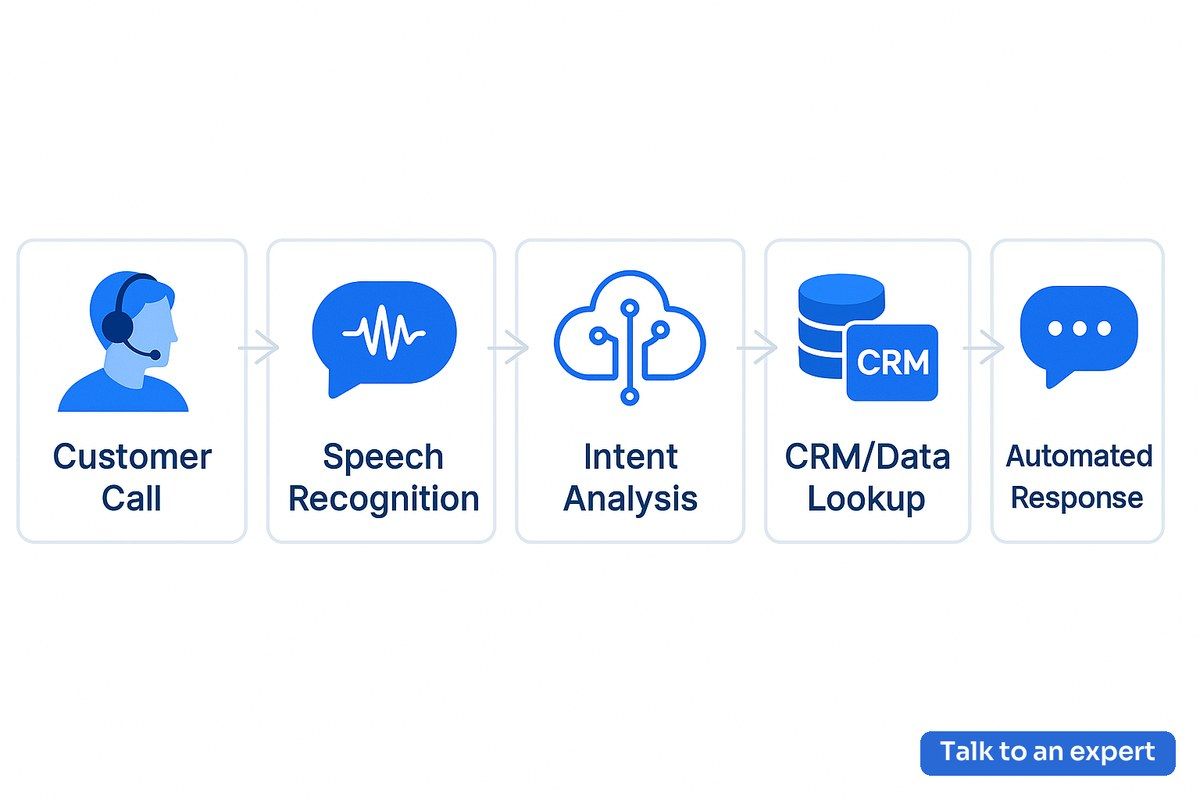
Here’s a visual representation of a simple AI voice agent workflow in a telecom environment:
Tangible Benefits: ROI, Customer Satisfaction, and Operational Excellence
The business impact of deploying an ai voice agent for telecom is substantial and measurable.
- Cost Reduction: Automating high-volume, routine calls allows telecoms to reduce staffing needs, lower training expenses, and achieve a dramatically lower cost per interaction.
- Enhanced Customer Satisfaction: Immediate responses, zero hold times, and personalized service drive up Net Promoter Scores (NPS) and foster strong loyalty.
- Scalable, Consistent Service Delivery: AI voice agents can manage thousands of simultaneous conversations, delivering uniform quality and compliance with every customer interaction.
- Data-Driven Decision Making: Real-time analytics empower telecom leaders to identify trends, optimize workflows, and proactively address pain points.
For example, a leading telecom provider implemented AI voice agents to automate 60% of tier-1 support calls. The outcome: annual operating costs dropped by 30%, average resolution times fell from 8 minutes to just 2, and customer satisfaction scores rose by 25%. These results are echoed across the industry, as documented in Gartner and McKinsey research, which highlight the growing ROI and operational excellence enabled by AI-powered automation in telecom.
Overcoming Implementation Challenges
While the benefits are clear, realizing the full value of an ai voice agent for telecom requires addressing several common challenges:
- Integration Complexity: Connecting with legacy CRMs, billing, and IVR systems can be daunting, especially for established telecoms. Using a Voice SDK simplifies integration with pre-built modules for real-time audio.
- Natural Conversation Quality: Achieving fluid, context-aware dialogue is essential to avoid robotic or unsatisfying customer experiences. Continuous training and testing of AI models is key.
- Multilingual and Dialect Support: Telecoms serve diverse regions. Supporting local dialects and languages at scale requires advanced AI models and rigorous validation.
- Security and Compliance: Handling sensitive customer information demands robust security protocols and strict regulatory adherence. AI voice agents must be designed with privacy and compliance in mind, following best practices from Google Cloud Research and Microsoft Research.
Implementation timelines and costs vary by project scope, but with the right framework and technology partners, many telecoms achieve ROI within 6-12 months.
The Builder’s Blueprint: How to Build a Telecom-Grade AI Voice Agent
For decision-makers ready to deploy an ai voice agent for telecom, success depends on assembling the right components and orchestrating them for real-time performance.
The Core Components You’ll Need
- Speech-to-Text and Text-to-Speech Engines: Convert spoken language to text and vice versa, enabling natural conversations.
- NLP/NLU for Intent Recognition: Natural Language Processing (NLP) and Understanding (NLU) extract meaning from speech, allowing the AI voice agent to comprehend queries, detect intent, and respond intelligently.
- Real-Time Telephony Integration (SIP, WebRTC, etc.): Seamless integration with telecom infrastructure, via SIP or WebRTC, ensures calls can be initiated, routed, and managed at scale. Implementing a phone call api is crucial for reliable, scalable call handling.
- Backend Orchestration and Database Integrations: Connecting to CRMs, billing systems, and customer databases provides context-rich, personalized service. Integrating a Voice SDK helps manage live audio rooms and orchestrate backend operations efficiently.
The Critical Challenge: Real-Time Orchestration
Telecom success relies on orchestrating live conversations flawlessly. This means:
- Managing multiple simultaneous calls without lag or dropped sessions
- Handling live handoffs between AI and human agents
- Ensuring secure, instantaneous data flow across platforms
- Maintaining high reliability and ultra-low latency
These are not just technical requirements, they are business imperatives. Even a single dropped call or delayed response can erode customer trust and increase churn.
The Solution: The VideoSDK Agents Framework
The VideoSDK Agents Framework is purpose-built for real-time, telecom-grade deployments. It enables developers and product teams to:
- Accelerate Deployment: Pre-built modules and APIs reduce development time, enabling launches in weeks instead of months.
- Scale with Confidence: Handle thousands of concurrent calls with enterprise-grade reliability and security.
- Integrate Seamlessly: Out-of-the-box support for SIP, WebRTC, and major CRM systems ensures smooth transitions from legacy to AI-first operations.
- Orchestrate Effortlessly: VideoSDK’s orchestration layer manages live conversations, agent handoffs, and real-time data synchronization.
By leveraging VideoSDK, telecoms unlock rapid innovation, measurable ROI, and superior customer experiences. The path from vision to value is clear and achievable.
Ready to future-proof your telecom service? Explore the VideoSDK Agents Framework and discover how to build, deploy, and scale ai voice agent for telecom solutions with confidence. Try it for free to see the benefits firsthand.
Future-Proofing Your Telecom Business with AI
The competitive advantage in telecom now belongs to those who embrace intelligent automation. Deploying an ai voice agent for telecom is no longer a distant vision, it is a strategic necessity. With scalable, human-like AI, your business can deliver faster service, lower costs, and exceptional customer experiences.
Adoption is within reach, and the rewards are immediate. The journey begins with the right framework, and VideoSDK is your trusted partner at every step. Lead the telecom revolution and build your AI advantage now.
FAQ