


Revolutionizing Government Services with AI Voice Agents
Across the globe, public sector leaders are embracing the AI voice agent for government as a pivotal tool for transforming citizen services. This technology is reshaping how agencies interact with the public by automating routine inquiries, providing 24/7 multilingual support, and making services more accessible to every citizen. With an AI voice agent for government, agencies can deliver efficient, responsive, and inclusive experiences while reducing operational strain and costs. For government product managers and decision-makers, adopting AI voice agents means unlocking operational agility, measurable cost savings, and higher citizen satisfaction.
By integrating AI voice agents, governments can address persistent challenges such as long wait times, limited access for diverse populations, and inconsistent service quality. These agents enable instant, voice-driven self-service, allowing citizens to access government services at any time and in any language. Leveraging a robust Voice SDK ensures seamless integration and high-quality voice interactions, further elevating the citizen experience.
Current Challenges in Government Services
Government agencies today face mounting pressures: high call volumes, diverse and multilingual populations, and the expectation for seamless, always-available support. Traditional service delivery often falls short, leading to:
- Limited Accessibility: Citizens with disabilities or language barriers encounter obstacles when accessing services.
- Operational Inefficiencies: High demand and resource constraints result in long queues and slow responses.
- Inconsistent Service Quality: Variability in agent training and availability can frustrate citizens.
An AI voice agent for government can help overcome these obstacles by scaling support and improving consistency. For example, in linguistically diverse regions, AI voice agents provide real-time translation, ensuring citizens can communicate in their preferred language. This fosters equity and inclusivity, as all citizens receive the same quality of service regardless of background.
Moreover, integrating AI voice agents with assistive technologies helps governments meet accessibility standards, supporting citizens with disabilities and ensuring compliance with legal requirements. During peak demand, AI voice agents efficiently manage high volumes, reducing pressure on human staff and maintaining reliable service quality. According to Gartner Insights, such digital solutions are essential for modernizing public sector operations and meeting evolving citizen expectations.
How AI Voice Agents Work in Government
An AI voice agent for government leverages advanced Natural Language Processing (NLP) and machine learning to understand and respond to citizen requests in real time. The typical workflow involves:
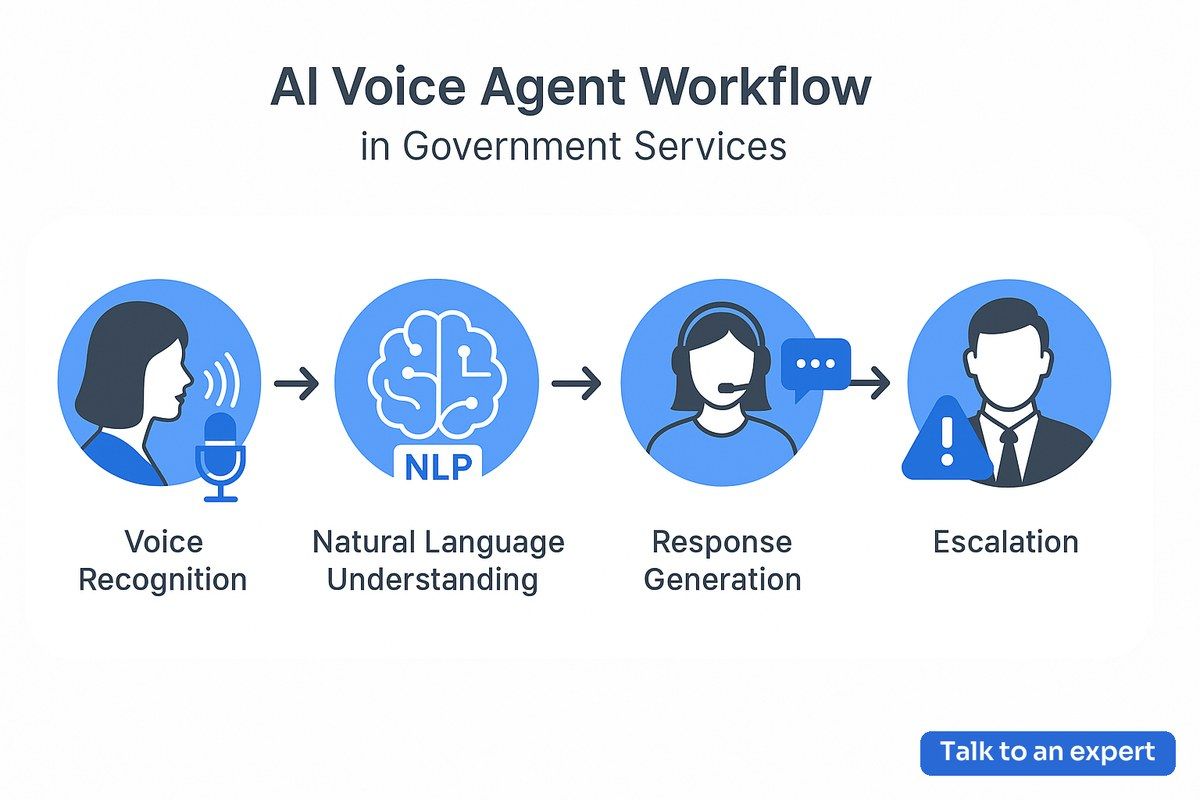
- Voice Recognition: Captures and transcribes speech with high accuracy.
- Natural Language Understanding: Determines the intent behind each citizen's request.
- Response Generation: Delivers policy-compliant, relevant answers.
- Escalation: Transfers complex or sensitive issues to human agents when needed.
Critical to success is the integration of AI voice agents with government databases and legacy systems. This ensures responses are current and accurate, as agents can access real-time data for everything from benefits eligibility to permit status. Over time, AI voice agents learn from interactions, refining their understanding and improving service quality. For a deeper dive into system architecture, see the AI voice Agent core components overview.
Real-World Applications
AI voice agents are already making a measurable impact across government sectors. In healthcare, they streamline appointment scheduling and provide health guidance. Tax agencies deploy them to answer filing questions and clarify regulations. Social services use AI voice agents to manage benefits applications, reducing administrative backlogs. Education departments leverage them to support student inquiries and enrollment, while transportation agencies automate route and schedule inquiries. For effective deployment strategies, explore AI voice Agent deployment.
These practical applications demonstrate the flexibility and scalability of AI voice agents in meeting the diverse needs of public sector organizations. By automating routine queries, governments can free up staff to focus on more complex, value-added tasks that require human judgment and empathy.
Key Benefits and Outcomes
Adopting an AI voice agent for government unlocks a host of benefits:
- Enhanced Accessibility: All citizens, regardless of language or ability, can access services easily.
- Operational Efficiency: Automation of repetitive tasks enables human agents to handle complex cases.
- Cost Reduction: Lower operational costs by handling high-volume inquiries automatically.
- Boosted Citizen Satisfaction: Fast, accurate responses foster trust and improve public perception.
AI voice agents also drive transparency by delivering consistent, accurate information, which builds public trust. They enable governments to collect and analyze service usage data, supporting data-driven decision-making and resource optimization. As highlighted by Microsoft Research, these outcomes are critical for governments aiming to modernize and deliver citizen-centric services.
Case Study: Enhancing Public Safety
A metropolitan city integrated an AI voice agent into its emergency response system. Automating initial call intake allowed dispatchers to prioritize urgent cases quickly, reducing response times and saving lives. In another example, a regional transit authority used AI voice agents to handle passenger inquiries, resulting in improved route efficiency and higher satisfaction scores. These cases underscore the transformative role of AI voice agents in public safety and urban management.
AI voice agents have also proven invaluable in disaster management, where rapid, accurate information dissemination is vital. By automating updates and instructions, governments can keep citizens informed and safe during emergencies, as noted by Google Cloud Research.
Implementation Path for Government Teams
To realize the full potential of an AI voice agent for government, agencies should:
- Define Objectives: Pinpoint service areas where AI can drive improvement.
- Select the Right Platform: Opt for a scalable, secure solution like VideoSDK for smooth integration.
- Build a Knowledge Base: Ensure AI responses are accurate, up-to-date, and policy-compliant.
- Pilot and Iterate: Launch a pilot, gather user feedback, and refine the system before scaling.
Stakeholder engagement is vital throughout implementation. Regular communication with staff, citizens, and technology partners ensures the AI solution aligns with both operational goals and user needs. Ongoing training and support help staff adapt to new workflows and maximize the value of AI voice agents. For best practices in managing AI sessions, see AI voice Agent Sessions.
Overcoming Implementation Challenges
Common hurdles include data privacy concerns and integrating with existing legacy systems. Governments should establish robust data governance policies and partner with vendors experienced in public sector deployments. Ensuring compliance with legal and ethical standards is paramount. Collaboration with stakeholders, including IT, legal, and citizen advocacy groups, helps ensure a smooth rollout and broad acceptance. For a technical quick start, refer to the AI voice agent guide.
Feedback mechanisms are also essential. By soliciting citizen input, agencies can fine-tune AI voice agents to better address evolving needs. Establishing a dedicated implementation team ensures accountability and drives project success from pilot to full deployment.
ROI and Operational Impact
The return on investment for an AI voice agent for government is both immediate and long-term. Automating routine tasks dramatically reduces operational costs, freeing staff to focus on high-impact activities. For example, a city deploying a multilingual AI agent saw call abandonment rates drop and citizen satisfaction scores rise, highlighting the tangible benefits of automation.
AI voice agents also provide valuable analytics. By tracking interaction patterns, agencies can identify service bottlenecks and optimize resource allocation. This data-driven approach supports strategic planning and continuous improvement. For system monitoring and optimization, explore AI voice Agent tracing and observability.
Long-Term Benefits
Beyond cost savings, AI voice agents offer enduring advantages. Improved data management, enhanced public trust, and adaptability to changing citizen needs ensure government services remain effective and relevant. As AI capabilities advance, these systems will continue to evolve, supporting new use cases and expanding their impact.
AI voice agents also contribute to sustainability by reducing reliance on physical infrastructure, lowering energy consumption, and supporting digital transformation initiatives. Governments embracing these technologies position themselves as forward-thinking, responsive, and environmentally conscious.
Builder's Blueprint: VideoSDK Agents Framework for Government
The VideoSDK Agents Framework empowers government teams to design, deploy, and scale AI voice agents with confidence. Key features include:
- Real-Time Voice Handling: Delivers seamless, natural conversations.
- Workflow Orchestration: Simplifies management of complex service flows and escalations.
- Security and Compliance: Ensures data privacy and secure system integrations.
To implement an AI voice agent for government, follow these steps:
- Define Service Workflows: Map out processes and compliance requirements.
- Integrate with Government Systems: Connect to databases and legacy platforms for real-time data access.
- Configure Multilingual and Accessibility Features: Ensure inclusivity for all citizens.
- Monitor and Optimize: Use analytics to refine performance and enhance citizen experience.
For those new to AI voice agents, the Voice Agent Quick Start Guide provides a step-by-step introduction to setup and deployment.
With VideoSDK, government teams can focus on delivering citizen-first services, while the platform handles technical complexity and scalability. Start your transformation journey and see how AI voice agents can elevate your agency's impact. Try it for free and experience the future of public service delivery.
Comparison of AI Voice Agent Capabilities
| Feature | Description | Benefit to Government |
|---|---|---|
| Voice Recognition | Captures and transcribes speech | Ensures accurate data capture |
| NLP | Understands intent and context | Provides relevant responses |
| Multilingual Support | Handles multiple languages | Serves diverse populations |
| Escalation | Routes complex queries | Ensures human oversight when needed |
For more on the evolution of AI in government, consult Google Cloud Research, Microsoft Research, and Gartner Insights.
Advanced features like the AI voice Agent Wake-Up Call Feature further enhance reliability, ensuring your AI voice agent for government is always ready to serve citizens and maintain high service standards.
FAQ