


The best AI voice GitHub repositories in 2026 are OpenVoice, VibeVoice, NeuTTS, MetaVoice-1B, and Dia. Each offers open-source text-to-speech or voice cloning under permissive licenses, with strengths ranging from zero-shot multilingual cloning to real-time edge inference. VideoSDK complements these models by letting you connect generated voice into real-time rooms, AI voice agents, and telephony pipelines without building the transport layer yourself. Start by matching your project's language coverage, latency budget, and license constraints to the right repository on GitHub, then integrate it through a managed real-time communication layer.
Developers searching for "ai voice github" are usually trying to solve one of three problems: they need a text-to-speech engine they can self-host, a voice cloning model they can customize, or a real-time voice pipeline they can afford to run. The open-source speech ecosystem has matured dramatically, and GitHub has become the primary distribution channel for production-grade voice models that once required vendor contracts.
The shift matters commercially too. Permissive licenses like MIT and Apache 2.0 mean startups can ship voice features without per-character API fees, and researchers can fine-tune models on domain data. But the volume of repositories also creates a selection problem: thousands of speech projects exist on GitHub, and star counts alone tell you little about inference speed, licensing traps, or whether the project is still alive.
This guide covers the five most consequential open-source AI voice repositories on GitHub as of 2026, the evaluation criteria that actually matter when choosing one, and how to integrate a chosen model into a real-time application using a communication layer like VideoSDK's AI voice agent infrastructure.
Why AI Voice on GitHub Matters
Open-source AI voice development on GitHub matters because it removes the three biggest barriers in commercial speech work: cost opacity, vendor lock-in, and lack of control. When a voice model lives on GitHub under a transparent license, you can audit its architecture, inspect its training data claims, and run it on your own hardware or cloud account.
Community-driven innovation also accelerates faster than any single vendor's roadmap. Quantization variants, new language support, and inference optimizations frequently land as community pull requests weeks before a commercial API ships the equivalent feature. For teams building voice products, that translates directly into shorter iteration cycles and lower unit economics at scale.
Top Open-Source AI Voice Repositories
Choosing an AI voice repository on GitHub starts with knowing which projects have real production traction. The five below represent the strongest options in 2026 across cloning, real-time synthesis, edge deployment, expressive speech, and dialogue generation.
OpenVoice (MIT)
OpenVoice is defined as an open-source voice cloning framework that reproduces a reference speaker's tone color onto generated speech using a zero-shot approach, meaning it requires no fine-tuning on the target voice. It works by separating tone color cloning from the base speech generation process, which lets it pair with any underlying TTS engine while applying a cloned voice profile on top.
Its multilingual support spans English, Spanish, French, Chinese, and Japanese, making it a frequent choice for localization-heavy products. The MIT license is among the most permissive available, allowing commercial use, modification, and redistribution with minimal obligations. Typical use cases include dubbing pipelines, accessibility tools, and personalized assistant voices where you have a short reference clip of the target speaker.
VibeVoice (Microsoft)
VibeVoice, released by Microsoft on GitHub, targets real-time bidirectional voice: both text-to-speech and speech recognition in a single stack, with inference fast enough to run on edge CPUs rather than GPUs. That constraint alone changes deployment economics, since CPU-only inference opens the door to low-cost cloud instances and on-device scenarios.
Its multilingual coverage and recent release cadence have made it one of the fastest-growing AI voice GitHub projects of the past year. For developers building interactive voice applications where round-trip latency matters more than peak naturalness, VibeVoice is a serious contender, particularly when paired with a real-time transport layer.
NeuTTS (Neuphonic)
NeuTTS from Neuphonic focuses on on-device AI voice synthesis, using GGUF-style quantization to shrink model footprints so they run on consumer hardware. Instant voice cloning is supported, but the headline constraint is hardware: the project documents the memory and compute budgets needed for each quantization tier, which helps you plan deployments realistically.
For mobile or embedded voice features where sending audio to a cloud endpoint is undesirable for privacy or latency reasons, NeuTTS is one of the few AI voice GitHub projects designed around that constraint from the start.
MetaVoice-1B (MetaVoice.io)
MetaVoice-1B is a 1.2-billion-parameter expressive TTS model with emotional control, released under Apache 2.0. Its strength is naturalness and prosody: the model produces speech with emotional coloring that sounds closer to human delivery than flatter concatenative-style outputs.
Apache 2.0 licensing includes an explicit patent grant, which matters for commercial teams wanting legal clarity. The trade-off is scale: a 1B-parameter model demands more VRAM and inference time than the lighter alternatives above, so it fits server-side generation workloads rather than real-time edge scenarios.
Dia (Nari Labs)
Dia from Nari Labs is a dialogue-centric TTS system: it generates multi-speaker conversational audio from tagged text, where speaker labels in the input script control who says what. This makes it unusually well suited to podcast generation, narrative content, and conversational demo material.
Its Hugging Face integration means the model weights and inference tooling are accessible through the standard model hub workflow, lowering the barrier for developers already in that ecosystem. For any application where two or more synthetic voices must interact naturally, Dia occupies a niche the other repositories do not.
The typical AI voice pipeline on GitHub follows a shared architecture, and each repository occupies a different position within it:
Key Features to Evaluate When Choosing a Repo
Evaluating an AI voice GitHub repository requires looking past the README's demo samples. Five dimensions separate projects that will serve you in production from those that will stall your roadmap.
Model Quality & Naturalness
Naturalness is subjective until you measure it. Listen to the repository's published samples, but also generate your own test sentences covering your actual domain vocabulary, since most demos use clean, short, generic text. Mean Opinion Score (MOS) ratings, where published, give a rough cross-model comparison, but treat them as directional rather than definitive.
Multilingual & Zero-Shot Capabilities
If your product ships beyond English, verify language support at the phoneme level, not just the README claim. Zero-shot cloning capability, meaning the ability to reproduce a voice from a short reference clip without fine-tuning, is a significant differentiator for personalization features. OpenVoice and NeuTTS lead here.
Licensing & Commercial Use Terms
License choice on GitHub ranges from MIT and Apache 2.0 to research-only and non-commercial terms that can block a product launch. Read the actual license file, not the badge, and check whether model weights carry a separate license from the code. MetaVoice-1B's Apache 2.0 and OpenVoice's MIT are the safest commercial foundations among the projects above.
Resource Requirements (GPU/CPU, VRAM)
Match the model to your deployment target. MetaVoice-1B needs a GPU with substantial VRAM for comfortable inference. VibeVoice and NeuTTS are engineered for CPU and quantized on-device execution respectively. Underestimating this dimension is the most common reason AI voice GitHub projects fail to reach production.
Community Activity (Stars, Forks, Issue Response Time)
A repository's health shows in its issue tracker more than its star count. Check the date of the last commit, median issue response time, and whether maintainers merge community pull requests. A 5,000-star project with unanswered issues from six months ago is a weaker foundation than a 1,000-star project with weekly releases.
How to Choose the Right Repository for Your Project
Selecting the right AI voice GitHub repository is a constraint-matching exercise. Start with your latency budget: if you need sub-second conversational response, real-time projects like VibeVoice or NeuTTS fit, while MetaVoice-1B suits offline or asynchronous generation. Next, apply your licensing constraint: anything commercial-facing should filter out research-only licenses immediately.
Then evaluate language coverage against your user base, and hardware availability against your infrastructure budget. If your product needs multi-speaker dialogue output, Dia is the natural fit. If personalized cloned voices are the feature, OpenVoice leads. Finally, weigh community health: a responsive maintainer community will save you weeks when you hit an inference edge case.
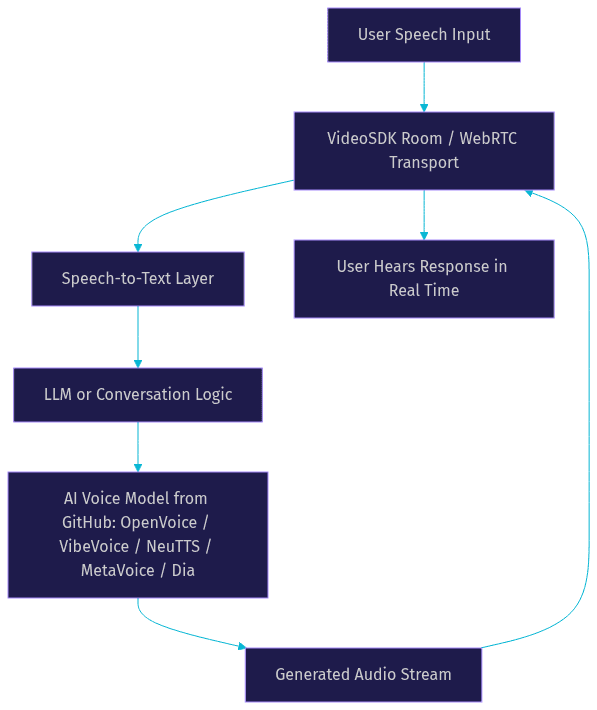
In practice, teams building conversational products often pair a GitHub voice model with a managed real-time layer. VideoSDK's AI voice agent infrastructure handles the room, transport, and session management around your chosen model, so the GitHub repository handles speech generation while VideoSDK handles delivery to users over web, mobile, or phone.
Integration Considerations
Integrating an AI voice GitHub model into a working product involves four planning areas that tutorials frequently skip.
Environment Setup (Python Version, Dependencies)
Most AI voice repositories on GitHub target a specific Python version range and pinned dependency set. Before committing, confirm the supported Python version, whether the project maintains a lockfile, and whether GPU acceleration requires a specific driver and runtime combination. Divergence here is the top source of "works on the contributor's machine" failures.
Hardware & Performance Planning
Plan capacity around your target concurrency, not single-request benchmarks. A model that generates comfortably on one GPU stream may collapse under ten parallel requests. Estimate your real-time factor (generation time divided by audio duration) at expected load, and provision headroom of at least 30 percent before you consider the deployment production-ready.
API Design (REST vs Local Inference)
Decide early whether the model runs in-process with your application or behind a service boundary. Local inference minimizes latency but couples your application to the model's runtime. A service boundary adds a network hop but lets you scale, version, and swap models independently. For real-time conversational products, the service boundary pattern pairs naturally with a communication layer like VideoSDK's real-time APIs, which manage rooms and participants around your inference service.
Security & License Compliance
Self-hosting a voice model shifts security responsibility to you: validate all text inputs, rate-limit generation endpoints, and never expose raw model endpoints publicly. On compliance, keep a record of each repository's license and attribution requirements, and re-verify when you pull major version updates, since open-source projects occasionally relicense between releases.
The integration architecture for a production AI voice product typically looks like this:
Performance Benchmarking Tips
Benchmarking an AI voice GitHub model should follow a reproducible workflow, or your numbers will not survive a model update. Use three core metrics: real-time factor (RTF), which measures generation speed relative to audio length; latency to first audio chunk, which determines perceived responsiveness in conversational use; and mean opinion score or a comparative naturalness rating, gathered from multiple listeners on a fixed test set.
Fix your test corpus before testing: a set of 50 to 100 sentences covering short commands, long paragraphs, numbers, and domain-specific vocabulary gives stable comparisons across models. Record the exact model version, hardware, and runtime for every run, and re-run the full suite whenever you upgrade a dependency.
Log results where others can benefit. Publishing your benchmark results in the repository's discussions or an issue thread contributes back to the community and often surfaces optimizations from maintainers. For cross-model comparisons, independent sources like Artificial Analysis provide structured speech model evaluations that complement your own testing.
Contributing and Community Engagement
The AI voice GitHub ecosystem runs on reciprocity. Filing a well-structured issue, including your environment details, input text, and expected versus actual behavior, is the single highest-value contribution most developers can make. If you solve a quantization or inference problem locally, submitting it as a pull request often gets it merged and maintained for you.
Beyond the repository itself, most major AI voice projects maintain Discord servers or discussion forums where design decisions and roadmap items surface before they reach the README. VideoSDK also runs an active developer community on Discord where developers building real-time voice applications share integration patterns and troubleshooting help.
Future Trends in Open-Source AI Voice
Three trends are shaping where AI voice on GitHub goes next. First, multimodal speech models that unify recognition, generation, and understanding in a single architecture are replacing separate STT and TTS stacks, reducing pipeline complexity and latency. Second, model compression through quantization and distillation is pushing high-quality synthesis onto phones and edge devices, expanding the on-device category NeuTTS pioneered. Third, GitHub itself continues to accelerate research diffusion: a state-of-the-art voice paper typically has a public repository within weeks of publication, compressing the gap between research and shippable product.
For developers, the practical implication is that model selection is no longer a one-time decision. Architect your voice pipeline so the synthesis layer is swappable, because the best AI voice GitHub repository in 2026 will likely be superseded within a year.
Definitions Glossary
Zero-Shot Voice Cloning: Reproducing a target speaker's voice from a short reference clip without any fine-tuning on that voice. OpenVoice popularized this approach on GitHub under an MIT license.
Real-Time Factor (RTF): The ratio of time taken to generate audio to the duration of that audio. An RTF below 1.0 means the model generates speech faster than it plays, which is required for real-time conversational use.
GGUF Quantization: A compressed model file format that reduces precision to shrink memory footprint, enabling large AI voice models to run on consumer or edge hardware, as used by NeuTTS.
Vocoder: The component of a TTS pipeline that converts intermediate acoustic representations into the final audio waveform every listener actually hears.
AI Voice Agent: An application that chains speech-to-text, an LLM, and text-to-speech to hold real-time voice conversations. VideoSDK provides the room, transport, and session infrastructure for deploying these agents over web, mobile, and telephony.
Key Takeaways
- The strongest AI voice GitHub repositories in 2026 are OpenVoice for zero-shot multilingual cloning, VibeVoice for real-time CPU inference, NeuTTS for on-device deployment, MetaVoice-1B for expressive large-scale synthesis, and Dia for multi-speaker dialogue generation.
- License files, not star counts, determine whether a repository is commercially viable; MIT and Apache 2.0 projects like OpenVoice and MetaVoice-1B are the safest foundations.
- Hardware fit is the most underestimated selection criterion: match the model's GPU, VRAM, or CPU requirements to your actual deployment target before committing.
- Benchmark with fixed test corpora and the RTF, latency, and naturalness metrics so your comparisons survive model updates.
- For real-time products, pair a GitHub voice model with a managed communication layer; VideoSDK's AI voice agent infrastructure handles rooms, transport, and telephony so your model only has to handle speech.
Conclusion
The open-source AI voice landscape on GitHub has reached genuine production readiness, with permissively licensed projects covering cloning, real-time synthesis, edge deployment, and dialogue generation. The winning strategy is constraint-first selection: lock down your latency budget, license requirements, and hardware reality, then pick the repository that fits rather than the one with the most stars. When you are ready to take a chosen model into a live conversational product, VideoSDK's AI agent documentation and the free tier on app.videosdk.live give you the real-time layer to ship it. What are you building with open-source AI voice models? Drop a comment, I'd love to hear which GitHub repository and use case you are working on.
Free $20 Balance for AI Voice Agents & Video Calls
FAQ