


VoIP protocols are the standardized rules that govern how voice and video calls are set up, negotiated, transported, and torn down over IP networks. The stack splits into three layers: signaling protocols like SIP handle call control, media protocols like RTP carry the actual audio, and negotiation protocols like SDP agree on codecs and transport details. Mastering how these layers interact is what separates a choppy, unreliable call experience from a production-grade one, and platforms like VideoSDK abstract much of this complexity behind simple SDKs and APIs.
Every time you join a video meeting, place a Wi-Fi call, or talk to a customer support agent from a browser, a small orchestra of VoIP protocols fires in sequence. Some negotiate the call. Some carry your voice. Some punch through firewalls. And if any one of them stumbles, you get the classic symptoms: one-way audio, robotic voices, or a call that connects but transmits silence.
For developers and IT teams, understanding VoIP protocols is no longer optional. Enterprise telephony has moved almost entirely to IP, contact centers run on SIP trunks, and modern applications embed real-time voice and video directly into products. When something breaks at 2 AM, the engineer who understands the difference between a signaling failure and a media transport failure fixes it in minutes. The one who doesn't spends hours guessing.
This guide walks through the full VoIP protocol stack, layer by layer, with call-flow diagrams, a decision framework for choosing the right stack per use case, and the pitfalls that most often derail production deployments.
What Are VoIP Protocols?
VoIP protocols are defined as the set of standardized communication rules that enable voice, video, and multimedia sessions to be established and exchanged over IP networks. They cover everything from the first ring to the final hangup, plus everything in between: authentication, codec selection, encryption, and network traversal.
The term is often used loosely, which causes real confusion. A single VoIP call is not handled by one protocol. It is handled by a stack of cooperating protocols, each with a narrow job. Signaling protocols decide who calls whom and when the call starts and ends. Media transport protocols move the actual audio packets. Session description protocols describe what media will be exchanged and in what format. Security protocols wrap both layers in encryption. NAT traversal protocols make all of it work through routers and firewalls.
VideoSDK, for example, builds on this same foundation: its real-time communication SDKs handle signaling, media transport via WebRTC, and secure media encryption under the hood, so developers can embed video calling without implementing the protocol stack themselves.
Core Protocol Categories
Every VoIP protocol falls into one of five functional categories:
- Signaling: SIP, H.323, MGCP, Megaco/H.248. These manage call setup, modification, and teardown.
- Media transport: RTP and RTCP. These carry and monitor the audio and video streams.
- Session description: SDP. This negotiates codecs, ports, and media attributes between endpoints.
- Security: TLS, SRTP, DTLS. These encrypt signaling and media against eavesdropping and tampering.
- NAT traversal and QoS: STUN, TURN, ICE, and DSCP-based quality marking. These get packets through hostile networks and prioritize them.
Signaling Protocols: How VoIP Protocols Set Up Calls
Signaling is the control plane of a VoIP call. Before a single audio packet flows, signaling protocols have already authenticated the caller, located the callee, negotiated media parameters, and alerted the receiving device. When the call ends, signaling tears the session down cleanly and frees resources.
Think of signaling as the conversation before the conversation. It answers: who is calling, is the callee reachable, what codecs do both sides support, on which ports will media flow, and how will the call be encrypted.
SIP: Session Initiation Protocol
SIP is the dominant signaling protocol for VoIP, defined by the IETF. It is a text-based, HTTP-like protocol where endpoints (called SIP user agents) exchange requests and responses. A SIP user agent can act as a caller (User Agent Client) or callee (User Agent Server), and intermediate servers such as proxies and registrars route and track sessions.
A typical SIP call flow uses a small set of core methods. REGISTER tells the server where a user can be reached. INVITE initiates a call and carries the SDP offer describing the media. ACK confirms the final response. BYE terminates the established session. OPTIONS probes capabilities, and CANCEL abandons a ringing call before it is answered.
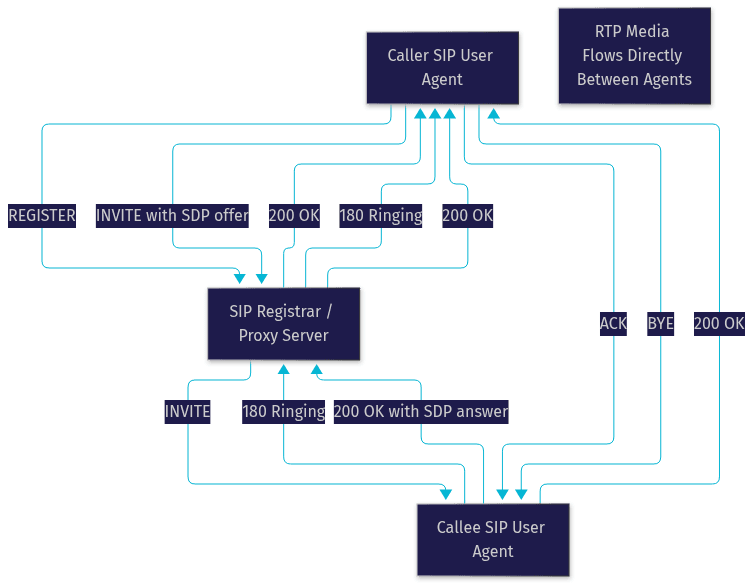
Notice the key insight in that flow: SIP sets up the call, but the media then flows directly between endpoints (or through a media relay). Signaling and media are deliberately decoupled, which is why a broken proxy rarely causes dropped audio, and why broken NAT traversal rarely prevents a call from appearing to connect.
H.323: The Legacy Signaling Standard
H.323 is the ITU's older umbrella standard for multimedia communication over packet networks, dating to the mid-1990s. It is a family of specifications covering signaling, media control, and conferencing, built around gatekeepers and gateways rather than SIP's simpler proxy model.
H.323 still appears in legacy enterprise PBX environments, video conferencing hardware from the 2000s, and some healthcare and government systems with long procurement cycles. New deployments almost universally choose SIP or WebRTC, but interoperability with H.323 islands remains a real requirement in enterprise telephony migrations.
MGCP and Megaco/H.248: Gateway Control
MGCP and Megaco/H.248 take the opposite architectural approach from SIP: instead of intelligent endpoints, they use a central call agent (a media gateway controller) that commands dumb media gateways. The controller tells the gateway exactly which ports to open and which media to forward. These protocols survive mainly in carrier-grade PSTN interconnection, where large-scale gateway farms need tight, centralized control.
Media Transport Protocols: RTP and RTCP in the VoIP Protocol Stack
Once signaling completes, media transport protocols take over. RTP is the workhorse that carries every audio and video packet in virtually all VoIP systems, from enterprise PBX calls to WebRTC sessions.
RTP: Real-Time Transport Protocol
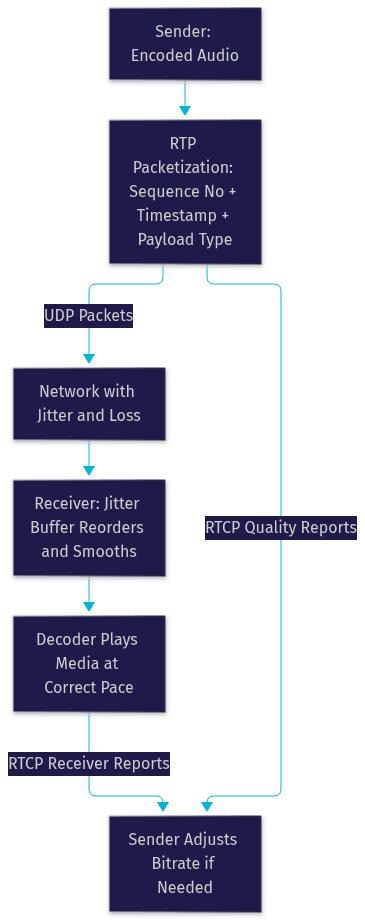
RTP works by packetizing encoded media, stamping each packet with a sequence number and a timestamp, and labeling it with a payload type that identifies the codec. The sequence number lets the receiver detect packet loss and reorder out-of-order packets. The timestamp lets the receiver play media back at the correct pace regardless of network jitter. The payload type tells the receiver how to decode the payload, whether it is G.711, Opus, or a video codec.
RTP itself provides no delivery guarantees, no ordering, and no encryption. It is deliberately thin, leaving reliability and security to companion layers: RTCP for monitoring, SRTP for encryption, and the jitter buffer on the receiving side for smoothing.
RTCP: The Control Channel
RTCP runs alongside RTP and periodically exchanges quality reports between endpoints: packet loss rates, jitter measurements, and round-trip times. Applications use these reports to adapt. A WebRTC session, for instance, uses RTCP feedback to trigger bitrate reductions when the network degrades, which is the same principle behind VideoSDK's network-adaptive streaming that automatically adjusts resolution and bitrate in real time.
UDP vs TCP for Media
UDP is preferred for media because retransmitting a lost voice packet is usually pointless: by the time the retransmission arrives, the moment to play it has passed. TCP's head-of-line blocking and retransmission delays would turn a 30 ms hiccup into audible stutter. TCP is reserved for signaling (where reliability matters and latency tolerance is higher) and as a media fallback in extremely restrictive networks, typically tunneled through TURN relays.
Session Description and Codec Negotiation
SDP, the Session Description Protocol, is the contract language of a VoIP call. Carried inside SIP INVITE messages (and WebRTC offers), an SDP body describes the media a party wants to send and receive: which codecs it supports, which RTP ports it will listen on, encryption keys for SRTP, and attributes like bandwidth hints.
Codec negotiation follows an offer/answer model. The caller sends an SDP offer listing its supported codecs in preference order, such as Opus, G.711, and G.729. The callee answers, selecting one codec from the offered list. If there is no overlap, the call fails with a media incompatibility error, which is one of the most common interoperability bugs in mixed-vendor deployments.
Codec choice has real engineering consequences. G.711 delivers toll-quality voice at 64 kbps but is bandwidth-hungry. Opus, the default for WebRTC and modern VoIP, adapts from 6 kbps to over 500 kbps and handles packet loss far more gracefully. For developers, the practical rule is: prefer Opus everywhere, keep G.711 for PSTN interop, and treat G.729 as a legacy carrier codec.
Security Protocols for VoIP
Unencrypted VoIP is trivially interceptable: anyone on the path who can capture RTP packets can reconstruct the audio. Modern VoIP security therefore encrypts both planes.
Signaling is protected with TLS, often called SIP-TLS or SIPS, which encrypts the entire SIP conversation including authentication credentials and SDP content. Media is protected with SRTP, which encrypts and authenticates RTP packets while adding minimal overhead. DTLS handles key exchange in WebRTC, where there is no SIP server to broker keys; the DTLS handshake exchanges SRTP keys directly between browsers.
The result is end-to-end protection where both signaling and media are unreadable to intermediaries. VideoSDK applies this model by default: its SDKs encrypt media in transit, and its telephony integration extends secure media handling across SIP-based phone networks.
NAT Traversal and QoS for VoIP Protocols
Private IP addresses behind routers break naive VoIP: the SDP offer advertises an internal address the remote party cannot reach. NAT traversal protocols solve this.
STUN lets an endpoint discover its public IP and port as seen from the internet, enabling many direct connections. TURN is the fallback: a relay server that forwards media when direct paths fail, at the cost of added latency. ICE orchestrates the whole process, gathering every possible candidate address (local, STUN-derived, TURN-relayed) and systematically testing them until a working path is found.
QoS mechanisms attack the other enemy: congestion. Networks treat all packets equally by default, so a large file download can starve voice packets. DSCP marking (part of DiffServ) tags voice packets so routers prioritize them. On managed enterprise networks this works well; over the public internet, the only real QoS lever is adaptivity, which is why adaptive codecs and dynamic bitrate adjustment matter so much.
Choosing the Right VoIP Protocol Stack for Your Use-Case
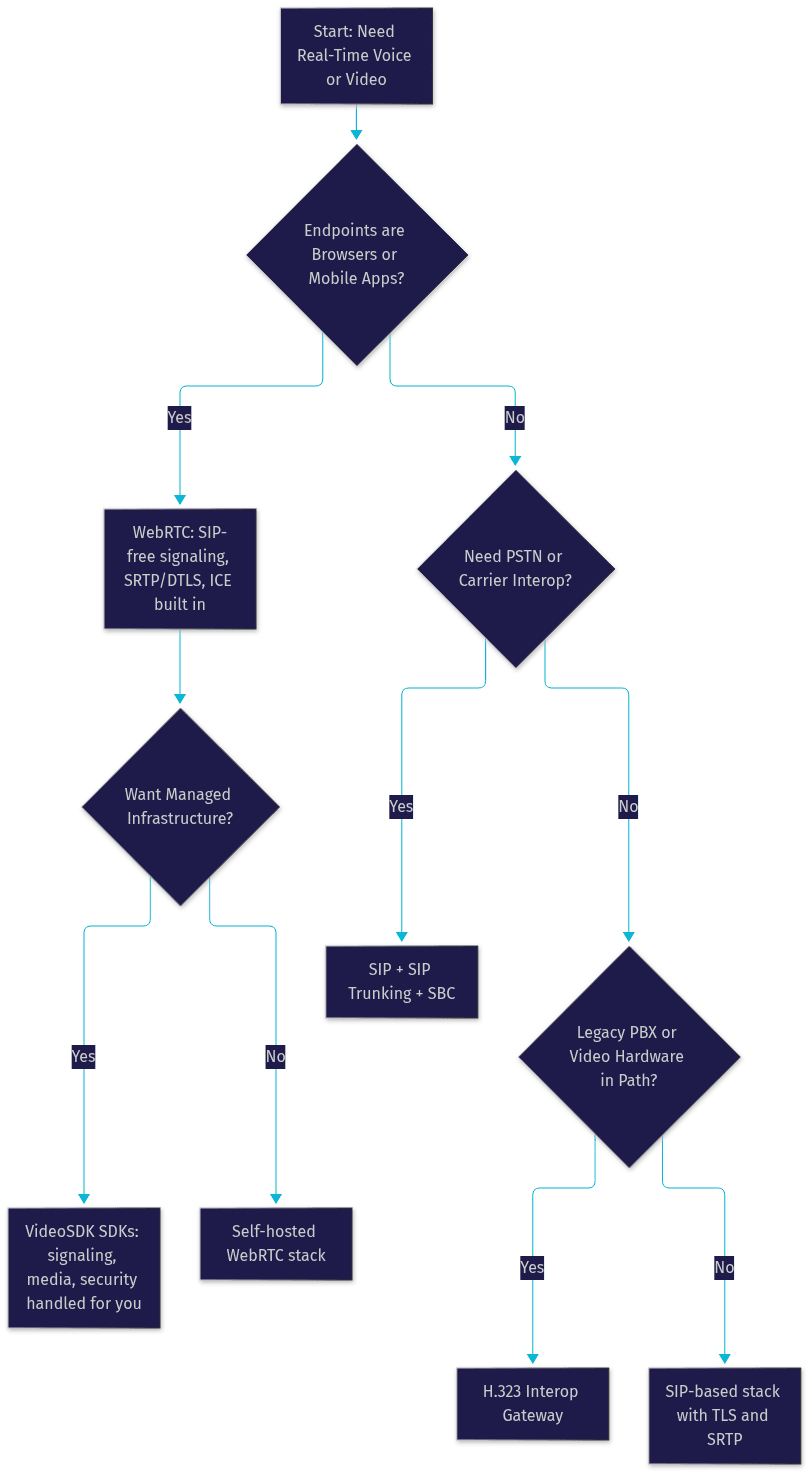
There is no single correct VoIP protocol stack. The right choice depends on your endpoints, network control, and integration surface.
| Use case | Recommended stack | Why |
|---|---|---|
| Enterprise PBX | SIP over TLS + SRTP, SBC at the edge | Interoperates with carriers and desk phones, centralized security |
| Mobile VoIP app | WebRTC or SIP with Opus, ICE for NAT | Battery-efficient, adaptive to flaky mobile networks |
| Contact center | SIP trunking + WebRTC for agents | PSTN reach plus browser-based agent desktops |
| Embedded / IoT devices | Lightweight RTP or vendor SDK | Constrained hardware needs minimal protocol overhead |
| In-app video calling | WebRTC-based SDK (e.g., VideoSDK) | Full stack handled: signaling, media, encryption, adaptive streaming |
The pragmatic advice for most product teams: do not build the stack yourself unless telephony is your product. Managed platforms like VideoSDK's video calling SDKs implement the entire WebRTC protocol surface, including NAT traversal and adaptive media, across ten-plus platforms.
Common Pitfalls and Best Practices
Most production VoIP failures trace back to a handful of recurring mistakes.
SIP-ALG on consumer routers is the classic one. This well-intentioned router feature rewrites SIP packets and routinely corrupts them, causing one-way audio and registration failures. Best practice: disable SIP-ALG and let endpoints handle NAT with STUN and ICE.
Codec mismatches surface as calls that connect but carry no audio. Always verify that both endpoints and every intermediate SBC support a common codec, and log the negotiated SDP answer during debugging.
Firewall rules that open signaling ports but not the RTP media port range produce the silent-call symptom. Media ports are negotiated dynamically, so firewalls need a defined media port range or a media relay.
Latency budgets get ignored until users complain. Keep one-way mouth-to-ear latency under 150 ms for good conversation flow, and remember that every TURN relay hop adds tens of milliseconds. Measure RTCP round-trip time continuously rather than waiting for complaints.
Future Trends in VoIP Protocols
The protocol landscape is actively evolving. SIP over QUIC is emerging as a way to get UDP-speed transport with TCP-grade encryption and multiplexing, reducing connection setup times for mobile VoIP. Encrypted RTP is becoming the default rather than an option, driven by regulatory pressure and the simple fact that interception is too easy otherwise.
WebRTC continues to absorb traditional VoIP territory: its data channels now carry application data alongside media, and its built-in ICE, DTLS, and SRTP stack has become the reference security model for real-time communication. Meanwhile, AI is entering the call path itself, with voice agents joining calls as first-class participants. VideoSDK's AI voice agents already let LLM-powered agents join rooms over the same protocol stack, signaling where the next decade of VoIP is headed.
Definitions Glossary
SIP (Session Initiation Protocol): The dominant text-based signaling protocol for VoIP, using methods like REGISTER, INVITE, ACK, and BYE to set up and tear down calls between user agents.
RTP (Real-time Transport Protocol): The protocol that carries actual audio and video packets, stamping each with sequence numbers, timestamps, and payload types so receivers can reorder and play media correctly.
SDP (Session Description Protocol): The offer/answer negotiation language that lets endpoints agree on codecs, ports, and encryption keys before media flows.
SRTP (Secure RTP): An encryption and authentication layer over RTP that protects media content from interception without adding meaningful latency.
ICE (Interactive Connectivity Establishment): The NAT traversal framework that gathers STUN and TURN candidate addresses and tests them until a working media path is found.
SBC (Session Border Controller): A network element at the edge of a VoIP deployment that enforces security, NAT traversal, and interoperability policy for SIP traffic.
Key Takeaways
- VoIP protocols form a layered stack: SIP handles signaling, RTP carries media, SDP negotiates codecs, and TLS/SRTP/DTLS secure both planes.
- Signaling and media are decoupled, which is why a call can appear to connect while audio fails, and why diagnosing them separately is essential.
- UDP is the correct transport for real-time media because retransmitted voice packets arrive too late to matter.
- NAT traversal via STUN, TURN, and ICE, plus QoS marking and adaptive codecs, determines whether calls survive real-world networks.
- Most product teams should not hand-build the stack: managed platforms like VideoSDK implement the full WebRTC protocol surface, including encryption and network-adaptive streaming, across ten-plus platforms.
Conclusion
Mastering VoIP protocols means understanding how signaling, media transport, negotiation, security, and traversal layers cooperate to deliver a single reliable call. The engineers who grasp this stack debug faster, architect better, and make smarter build-versus-buy decisions. If you are embedding real-time voice or video into a product, explore VideoSDK's documentation or grab the code samples and start with the free tier at app.videosdk.live/login. What are you building with VoIP protocols? Drop a comment, I'd love to hear what kind of real-time communication use case you're working on.
The Future of VoIP Protocols
Emerging Trends and Technologies
Emerging trends in VoIP protocols include:
- WebRTC: Enabling real-time communication directly in web browsers.
- 5G: Providing increased bandwidth and lower latency for improved VoIP performance.
- AI: Using artificial intelligence to enhance voice quality and features.
Adapting to the Changing Landscape of VoIP
VoIP continues to evolve, and developers must stay informed about the latest trends and technologies. Adapting to these changes will ensure that VoIP systems remain secure, reliable, and efficient.
Further Reading:
- Learn more about SIP: A deeper dive into SIP protocol
- Understanding RTP: RTP protocol explained
- VoIP Security Best Practices: VoIP security and encryption guide
Free $20 Balance for AI Voice Agents & Video Calls
FAQ