



A SIP trunk is a virtual voice connection that uses the Session Initiation Protocol to link a PBX or contact center to the public switched telephone network over the internet, replacing physical phone lines. It carries signaling for call setup and teardown alongside RTP media streams for audio. VideoSDK extends SIP trunk capabilities into WebRTC-based rooms through its telephony integration, letting developers bridge traditional phone calls into modern real-time applications.
The shift from copper wires and PRI circuits to internet-based voice happened faster than most telecom managers expected. Organizations that once budgeted months for carrier installations now provision phone numbers in minutes. At the center of this transformation sits the SIP trunk, the technology that makes it possible to carry voice calls over IP networks with carrier-grade reliability.
If you are building a contact center, deploying an AI voice agent, or modernizing a legacy PBX, understanding how SIP trunks work and how to choose the right provider directly impacts call quality, cost, and scalability. This guide walks through the architecture, provider selection criteria, implementation steps, and troubleshooting patterns that developers and telecom managers need in 2026.
What is a SIP Trunk?
A SIP trunk is defined as a logical connection between a voice-over-IP endpoint (such as an IP-PBX or a software-based telephony platform) and a telecommunications service provider, using SIP signaling to establish, manage, and tear down voice calls over an IP network. Unlike a traditional PRI or analog line that requires physical copper, a SIP trunk exists entirely as a negotiated session between two IP endpoints.
A SIP trunk works by separating signaling from media. SIP messages handle call setup, ringing, answer confirmation, and teardown. Once the call connects, audio travels as RTP packets, optionally encrypted with SRTP. The trunk also carries DID (Direct Inward Dial) numbers, which map public phone numbers to internal extensions or routing rules.
SIP Trunk vs PSTN
The PSTN is the global circuit-switched telephone network that has existed for over a century. A SIP trunk replaces the physical connection to the PSTN with an IP-based session, but it still terminates calls to PSTN numbers through the provider's gateway. The practical difference: PSTN requires dedicated hardware and fixed capacity per line, while a SIP trunk scales elastically and provisions in minutes. Cost per call drops significantly because you are no longer paying for idle copper.
How a SIP Trunk Works
Understanding the signaling and media flow of a SIP trunk is essential for debugging call quality issues and designing reliable telephony infrastructure. The process follows a predictable sequence that every developer working with voice systems should recognize.
When a user dials a number, the PBX sends a SIP INVITE message to the SIP trunk provider's edge proxy. The provider routes the INVITE through its core network to the destination carrier, which ultimately rings the PSTN endpoint. The called party answers, and the destination returns a 200 OK response. The PBX confirms with a SIP ACK, and the call enters the connected state. At this point, audio flows bidirectionally as RTP packets between the two endpoints, typically using the G.711 or Opus codec.
The media path does not always follow the same route as the signaling path. Many providers use media bypass or anchored media depending on NAT traversal requirements and codec negotiation. With SRTP enabled, the RTP stream is encrypted using keys exchanged during the SIP handshake, protecting call audio from interception.
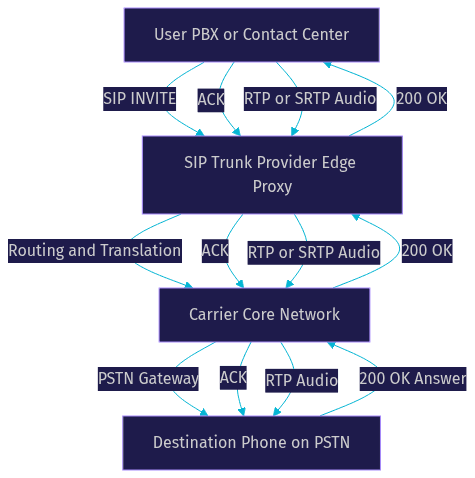
The diagram above shows the full call flow from INVITE through ACK, with media flowing alongside signaling once the session is established. Each hop introduces potential latency, which is why provider point-of-presence location matters so much for call quality.
Benefits of Using SIP Trunks
SIP trunks deliver measurable advantages over legacy telephony across cost, flexibility, and feature richness.
Cost savings come from eliminating physical line rentals and reducing per-minute call rates. Organizations typically see 40 to 60 percent lower telephony costs after migrating from PRI to SIP trunking.
Scalability is elastic. You can add or remove concurrent call channels on demand without waiting for a carrier technician. This matters for seasonal call volume spikes, outbound campaign bursts, and growing contact centers.
Global coverage means you can provision local DIDs in dozens of countries from a single provider, giving your business a local presence without physical offices in each market.
Rapid provisioning lets you activate new numbers and trunks in minutes through a provider portal or API, compared to weeks for traditional carrier installations.
Advanced features include STIR/SHAKEN caller ID authentication to combat spoofing, CLI rotation for outbound campaigns, and SIP REFER for call transfers that stay within the SIP signaling layer instead of hairpinning through your PBX.
Key Considerations When Selecting a SIP Trunk Provider
Choosing a SIP trunk provider involves evaluating technical performance, geographic reach, security posture, pricing transparency, and reliability guarantees. The following checklist covers the dimensions that matter most in production deployments.
Latency and Call Quality
Latency is the single most impactful metric for voice quality. Look for providers with sub-20 millisecond signaling latency to their nearest point of presence and ask for MOS (Mean Opinion Score) data from their production network. Carrier-grade providers publish their PoP locations and offer RTP latency guarantees. Anything above 150 milliseconds one-way becomes noticeable to callers, and above 250 milliseconds degrades the conversation significantly. Prioritize providers with geographically distributed edge nodes close to your PBX or cloud infrastructure.
Geographic Coverage and Number Availability
Confirm that the provider offers local DIDs in every country you operate in, plus toll-free numbers where needed. Some markets have regulatory restrictions on who can provision local numbers, requiring local business registration or address verification. Check whether the provider supports number porting so you can bring existing numbers when switching carriers.
Authentication and Security
SIP trunk security has become non-negotiable. Evaluate whether the provider supports IP whitelisting, SIP digest authentication, or both. Look for SIP over TLS for encrypted signaling and SRTP for encrypted media. STIR/SHAKEN support is now mandatory in the US for caller ID verification, and providers that lack it expose you to call-blocking by receiving carriers. Ask about DDoS protection and whether the provider filters malformed SIP traffic at the edge.
Pricing Model and Scalability
Compare per-minute versus per-channel pricing models against your traffic profile. Per-minute works for low-volume or bursty traffic, while per-channel (concurrent call capacity) suits steady high-volume environments. Ask about elastic capacity that scales automatically without manual channel upgrades. Watch for hidden fees: number porting charges, E911 surcharges, short-duration call penalties, and minimum monthly commitments. A transparent provider publishes every line item.
SLA and Reliability
Review the provider's uptime SLA, typically 99.99 percent or higher for carrier-grade service. Confirm they offer geographic redundancy with automatic failover between data centers. Check their support model: 24/7 phone and ticket support is essential for production telephony. Ask for their historical uptime reports and incident communication process.
Implementation Steps for a SIP Trunk
Deploying a SIP trunk involves a sequence of configuration and testing steps that bridge your telephony infrastructure to the provider's network. Here is a narrative walkthrough of the process.
Step 1: Sign up and obtain credentials. Create an account with your chosen SIP trunk provider. You receive a SIP endpoint address (usually a domain or IP), authentication credentials (username and password for SIP digest auth), and an assigned IP for whitelisting. Store these securely, as they grant call origination and termination access.
Step 2: Provision DIDs. Purchase or port phone numbers through the provider portal or API. Assign each DID to a routing destination, which is typically an extension, queue, or IVR menu on your PBX. For outbound-only trunks, you may not need inbound DIDs, but most providers require at least one for regulatory compliance.
Step 3: Configure your PBX or contact-center software. In your telephony platform, create a new SIP trunk entry pointing to the provider's endpoint address. Configure the authentication method (IP-based or digest), set the transport protocol (UDP, TCP, or TLS), and define codec priority. Most platforms use configuration files conceptually similar to sip.conf or pjsip.conf, where you specify the registration string, context, and codec list. Prefer Opus or G.722 for wideband audio, with G.711 as fallback for maximum compatibility.
Step 4: Test with a free or low-cost trunk. Place test calls in both directions before migrating production traffic. Verify two-way audio, check that caller ID displays correctly, and confirm that DTMF tones transmit properly. Use the provider's call logs and MOS monitoring tools to identify any quality issues early.
Step 5: Scale and monitor. Once testing passes, route production traffic through the trunk. Enable call detail record logging, set up MOS score alerts, and configure failover to a secondary trunk if available. Best practice tips: use the nearest gateway to minimize latency, enable SRTP for encrypted media, set codec priority to prefer wideband codecs, and implement SIP OPTIONS pings to detect trunk failures proactively.
For developers building AI voice agents or programmable telephony applications, platforms like VideoSDK simplify this process by providing a SIP gateway that bridges traditional phone calls into WebRTC rooms, eliminating the need to manage SIP signaling directly.
Common Challenges and Troubleshooting
Even well-configured SIP trunks encounter issues. Knowing how to diagnose them quickly separates smooth operations from prolonged outages.
One-way audio is the most frequent SIP trunk problem. It typically occurs when NAT traversal is misconfigured or when the RTP media port is blocked by a firewall. The caller can hear the callee but not vice versa (or the reverse). Diagnosis: check whether the PBX is advertising a private IP address in its SDP (Session Description Protocol) body. If so, configure NAT settings or enable STUN on the PBX. Verify that firewall rules allow UDP traffic on the RTP port range specified by your provider.
Registration failures happen when authentication credentials are incorrect, the provider IP has changed, or the SIP signaling port is blocked. Check that your username and password match exactly, confirm the provider's current endpoint address, and verify that port 5060 (or your custom signaling port) is open on your firewall.
Codec mismatches produce silence or garbled audio when the PBX and provider cannot agree on a common codec. Review the codec list on both sides and ensure at least one shared codec exists. G.711 ulaw is the universal fallback.
NAT traversal issues manifest as failed calls after a certain duration or audio cutting in and out. Enable SIP ALG on your router (or disable it, depending on the router, as some implementations break SIP), configure NAT keepalives, and consider using SIP over TCP to maintain the connection state through NAT devices.
Use call logs from both your PBX and the provider to correlate timestamps. Monitor MOS scores continuously; a sudden drop below 3.5 indicates a quality degradation that warrants investigation.
Typical Use Cases for SIP Trunks
SIP trunks power a wide range of voice applications across industries.
Contact centers use SIP trunks as the primary inbound and outbound voice pipeline, connecting IVR systems, ACD queues, and agent desktops to the PSTN with elastic capacity that scales during peak hours.
Outbound sales campaigns rely on SIP trunks with CLI rotation to present local caller IDs that increase answer rates. Per-minute pricing models align cost with campaign volume.
Unified communications platforms use SIP trunks to connect desk phones, softphones, and mobile clients through a single PBX, giving employees a consistent calling experience regardless of location.
AI voice agents are an emerging use case where SIP trunks bridge phone calls into AI processing pipelines. Developers use platforms like VideoSDK AI Voice Agents to connect inbound SIP calls to STT, LLM, and TTS pipelines, enabling conversational AI over traditional phone lines.
Multinational enterprise PBX interconnection uses SIP trunks to link regional offices through a single global telephony backbone, reducing internal call costs and simplifying administration.
Future Trends in SIP Trunking
The SIP trunking landscape is evolving rapidly as voice infrastructure converges with cloud-native and AI-driven architectures.
Edge-native SIP is emerging as providers deploy signaling and media processing closer to end users through distributed edge nodes. This reduces latency for real-time voice and enables sub-10 millisecond media paths in major metropolitan areas.
Real-time AI integration is transforming how SIP trunks are used. Instead of simply connecting calls to human agents, trunks increasingly route to AI pipelines that transcribe, analyze, and respond in real time. VideoSDK's Conversational Graph exemplifies this trend, enabling deterministic conversation flows over SIP-connected voice channels.
Programmable voice platforms are making SIP trunks more developer-friendly. REST APIs for number provisioning, call routing, and real-time call control let developers build custom telephony workflows without touching SIP configuration files.
Encrypted SIP adoption is accelerating. SIP over TLS and SRTP are becoming standard requirements rather than optional features, driven by regulatory pressure and growing awareness of voice fraud. STIR/SHAKEN rollout continues to expand globally, making caller ID authentication a baseline expectation.
Definitions Glossary
SIP Trunk: A virtual voice connection using SIP signaling to link an IP-PBX or telephony platform to a service provider's network, replacing physical phone lines.
RTP (Real-time Transport Protocol): The protocol that carries audio media packets between endpoints during an active SIP call, optionally encrypted as SRTP.
DID (Direct Inward Dial): A public phone number provisioned on a SIP trunk that maps to an internal extension, queue, or routing rule.
STIR/SHAKEN: A framework of protocols for authenticating caller ID on SIP-based calls, mandated in the US to combat spoofed calls.
MOS (Mean Opinion Score): A numerical rating from 1 to 5 that quantifies voice call quality, used to monitor SIP trunk performance in production.
Key Takeaways
- A SIP trunk replaces physical phone lines with an IP-based session that carries SIP signaling and RTP media, cutting costs and enabling elastic scalability.
- Provider selection should prioritize sub-20 millisecond latency, geographic PoP coverage, TLS and SRTP encryption, STIR/SHAKEN compliance, and transparent pricing.
- Implementation involves obtaining credentials, provisioning DIDs, configuring your PBX, testing bidirectional audio, and scaling with continuous MOS monitoring.
- Common issues like one-way audio, registration failures, and codec mismatches are diagnosable through call logs, SDP inspection, and firewall rule verification.
- SIP trunks now power AI voice agents and programmable telephony platforms, with VideoSDK bridging traditional SIP calls into WebRTC rooms for modern real-time applications.
Conclusion
Choosing the right SIP trunk comes down to five pillars: latency and call quality, geographic coverage, security and authentication, pricing transparency, and SLA reliability. Evaluate every provider against this checklist before routing production traffic. Start with a free or low-cost test trunk, verify two-way audio and DTMF, and scale only after monitoring confirms stable MOS scores. For developers building AI voice agents or modern telephony applications, VideoSDK's telephony integration abstracts away SIP complexity by bridging phone calls into WebRTC rooms where you can add real-time transcription, AI agents, and recording. You can sign up and start testing at app.videosdk.live/login. What are you building with SIP trunking? Drop a comment below, I would love to hear about your telephony use case.
Free $20 Balance for AI Voice Agents & Video Calls
FAQ