


Real time voice AI is a technology that enables instantaneous, human-like spoken conversations between users and AI agents. It processes audio through a streaming speech-to-text, large language model, and text-to-speech pipeline to achieve sub-second response times. VideoSDK provides an open-source AI Agent SDK that connects these models over WebRTC and SIP for production-grade voice interactions.
Sub-second voice interactions are the difference between a conversation that feels natural and one that feels like talking to a robot on a bad phone line. When a user speaks to an application, they expect an immediate response. If the system takes more than a second to reply, the interaction breaks down, and the user disengages. Real time voice AI solves this by processing spoken audio and generating spoken responses with minimal delay. The shift from text-based chatbots to instantaneous voice agents represents a massive leap in how users interact with software. This article explores the architecture of real time voice AI, the technical pillars that make it work, and how to build and scale these applications using modern transport protocols and AI models.
What Is Real Time Voice AI?
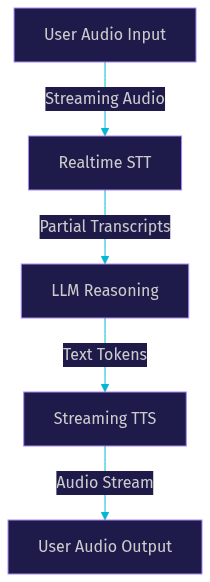
Real time voice AI is defined as a conversational AI architecture that processes inbound audio, generates a response, and streams outbound audio back to the user in under a second. Unlike traditional turn-based pipelines where a user must finish speaking, wait for the entire audio to be transcribed, wait for the LLM to generate a full response, and then wait for TTS to synthesize the audio, real time voice AI streams every step. As soon as a user starts speaking, streaming STT begins transcribing. The LLM starts generating tokens based on partial transcripts. Streaming TTS begins synthesizing audio from the first LLM tokens. This overlapping execution is what makes sub-second latency possible. VideoSDK provides real time voice AI through its AI Voice Agent SDK, which orchestrates this pipeline over a WebRTC or SIP connection. The SDK manages the complex choreography of streaming audio chunks between the user and the AI models, ensuring that the conversation flows naturally without awkward pauses.
Key Technical Pillars of Real Time Voice AI
Full-Duplex Streaming
Full-duplex streaming means the application can send and receive audio simultaneously over a single connection. In a half-duplex system, like a walkie-talkie, only one person can speak at a time. In a full-duplex system, both parties can speak and listen at the same time. In a real time voice AI application, the user's microphone audio streams to the server while the AI's synthesized audio streams back to the user at the same time. This requires a transport protocol like WebRTC that supports bidirectional media flow. If the user interrupts the AI, the system needs to hear the interruption while still playing audio. VideoSDK uses WebRTC for its video and audio calling API to handle this full-duplex audio efficiently, providing the low-latency media channels necessary for natural conversation.
VideoSDK manages these full-duplex streams through its Rooms-based architecture. When a user and an AI agent join a VideoSDK room, they each publish and subscribe to audio tracks. The VideoSDK Cloud SFU (Selective Forwarding Unit) routes these tracks in real time, ensuring that the user hears the AI and the AI hears the user without interference. This architecture is more reliable than peer-to-peer connections because it handles network fluctuations and scaling automatically.
Sub-Second Latency
Achieving sub-second latency requires strict budgeting across the entire pipeline. Network transport adds latency, STT processing adds latency, LLM token generation adds latency, and TTS synthesis adds latency. To keep the total under one second, developers use streaming models, edge-AI deployment, and GPU-accelerated inference. The latency budget is tight. If the STT takes 200 milliseconds, the LLM takes 400 milliseconds to generate the first token, and TTS takes 200 milliseconds to synthesize the first audio chunk, you are at 800 milliseconds before network overhead. Network-adaptive streaming helps maintain quality on unstable connections by adjusting bitrate and resolution. VideoSDK's infrastructure is optimized for low-latency WebRTC voice streaming, keeping the transport overhead minimal so you have more budget for AI processing.
GPU-accelerated inference is another critical factor. Running STT and TTS models on GPUs significantly reduces processing time compared to CPUs. Edge-AI voice deployment, where the inference happens geographically close to the user, further reduces network latency. VideoSDK's Agent Cloud is designed to run these workloads efficiently, providing the compute resources needed to keep latency low.
Semantic Turn-Taking & Barge-In
Voice activity detection (VAD) identifies when a user starts and stops speaking based on audio energy levels. Semantic turn detection goes further by using the LLM to determine whether the user has finished a thought or just paused. This allows the AI to know when to respond. Simple VAD often triggers false positives because it cannot distinguish between a pause and the end of a sentence. Semantic turn detection solves this by analyzing the context of the conversation. Barge-in occurs when a user interrupts the AI while it is speaking. A robust real time voice AI system detects the interruption, stops the TTS audio immediately, and processes the new input. VideoSDK's Agent SDK includes built-in VAD and turn detection to handle these natural conversation dynamics, allowing users to interrupt the agent just as they would a human.
Model-Agnostic Architecture
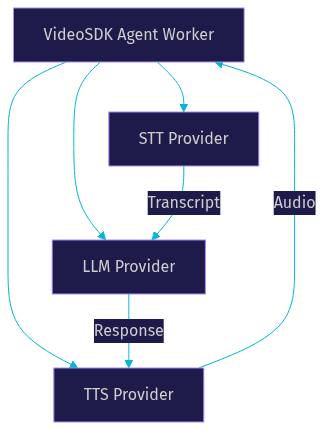
A production-grade voice AI system cannot be locked into a single provider. A model-agnostic architecture lets you swap STT, LLM, or TTS providers without rewriting your application logic. You might use Deepgram for STT because of its speed, OpenAI for the LLM because of its reasoning capabilities, and ElevenLabs for TTS because of its voice quality. If a provider releases a faster model, you swap it in. If a provider has an outage, you fall back to a secondary provider. VideoSDK's AI Agent SDK is designed to be model-agnostic, supporting a wide range of providers for real-time transcription and speech synthesis. This flexibility is critical for maintaining performance and controlling costs as the AI landscape evolves.
Popular Real Time Voice AI Platforms
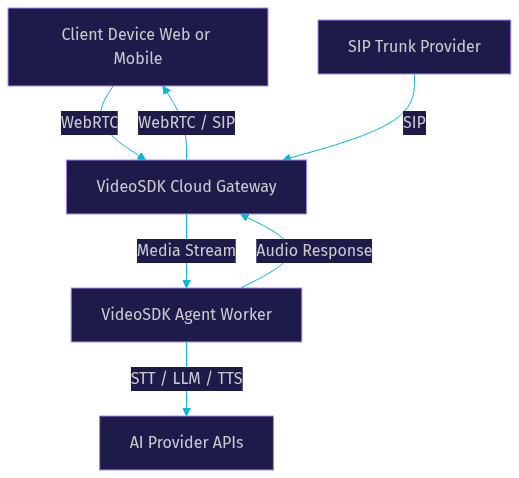
Several platforms offer real time voice AI capabilities, each with distinct strengths. OpenAI Realtime API provides a highly capable multimodal model that handles audio natively, excelling in complex reasoning tasks and natural conversation flow. Inworld focuses on creating expressive, personality-driven voice agents for gaming and interactive entertainment. Open-source frameworks like Pipecat offer flexibility for developers who want full control over their conversational AI pipelines. VideoSDK distinguishes itself by providing the communication infrastructure alongside the agent orchestration. While other platforms focus solely on the AI models, VideoSDK handles the WebRTC transport, SIP integration, and room management. This means you can use VideoSDK to connect any STT, LLM, and TTS combination to your users over a reliable, low-latency network. You can explore code samples and quickstart repositories on the VideoSDK GitHub to see how these integrations work in practice.
Building a Real Time Voice AI Application
Choosing the Right Transport
The transport layer determines how audio moves between the user and the AI. WebRTC is the standard for browser and mobile applications because it handles UDP-based, low-latency audio streaming with built-in network adaptation. It is the best choice for applications where users interact through a web interface or a mobile app. SIP is necessary for telephony integration, allowing the AI to make and receive actual phone calls. This is essential for customer support agents or outbound calling campaigns. WebSocket is sometimes used for server-side pipelines but lacks the media optimization and network traversal capabilities of WebRTC. VideoSDK supports both WebRTC and SIP telephony integration, letting you use the same AI agent across web and phone channels. This unified approach means you build your AI pipeline once and deploy it across multiple transport layers.
Selecting STT, LLM, and TTS Providers
Your choice of providers dictates the quality, speed, and cost of your voice AI. For STT, providers like Deepgram and AssemblyAI offer fast, accurate transcription optimized for conversational audio. For LLMs, OpenAI, Anthropic, and Google Gemini provide the reasoning capabilities needed to understand user intent and generate responses. For TTS, ElevenLabs and Cartesia offer low-latency, natural-sounding voices. The key is balancing latency and accuracy. A highly accurate LLM that takes three seconds to generate a token will ruin the real time experience. You need models that support streaming output. VideoSDK's Agent SDK lets you mix and match these providers, and you can verify current supported providers in the AI Agents documentation. The SDK abstracts the integration complexity, so you can focus on selecting the best models for your use case.
Language support is another key factor. If your application needs to support multiple languages, you need providers that offer high-quality models for each language. Some providers specialize in specific languages, while others offer broad coverage. Voice cloning and multi-speaker TTS are also becoming important for creating unique agent personalities. VideoSDK's model-agnostic approach means you can choose the best provider for each language or use case without being locked in.
Managing Session State & Context
A voice agent needs to remember what was said to maintain a coherent conversation. Managing session state involves preserving conversation history across turns so the LLM has context. However, feeding the entire transcript back into the LLM at every turn increases token cost and latency. Strategies include summarizing past turns and using context window management to keep only the most relevant information. For structured tasks like appointment booking or loan applications, you need deterministic state tracking. VideoSDK's Conversational Graph helps manage state deterministically, ensuring that every step of the conversation happens in the correct order. You can learn more about this in the Conversational Graph guide. This is especially useful for compliance-driven conversations where business rules, not LLM judgment, control the flow.
Checkpointing is another feature that helps manage state. It allows you to save the conversation state at any point and resume it later. This is useful for long-running conversations or when a user disconnects and reconnects. Human-in-the-loop is another pattern where the AI agent pauses and waits for a human to approve an action. This is common in financial or healthcare applications where compliance is required. VideoSDK's Conversational Graph supports both checkpointing and human-in-the-loop, giving developers fine-grained control over conversation state.
Production Considerations
Moving a voice AI application from localhost to production introduces several challenges. WebRTC requires HTTPS in production. If users are behind restrictive corporate firewalls, you need TURN servers to relay media. Scaling WebSocket connections for agent workers requires orchestration tools like Kubernetes or Docker. Cost monitoring is critical because STT, LLM, and TTS providers charge per minute or per token. Setting session limits and token caps prevents runaway costs if a user leaves the connection open. VideoSDK handles the WebRTC infrastructure, including TURN servers and geo-fencing, so you can focus on the AI pipeline. You can explore production deployment options on the VideoSDK pricing page. VideoSDK also provides session analytics through its REST APIs to help you monitor usage and performance in real time.
Scaling agent workers is a significant challenge. Each AI agent runs as a separate process, consuming CPU and memory. As the number of concurrent users grows, you need to scale your infrastructure horizontally. VideoSDK's Agent Cloud handles this scaling automatically, spinning up new worker processes as needed. Handling participant disconnections gracefully is also critical. If a user's network drops, the agent should detect the disconnection and pause the session. When the user reconnects, the agent should resume the conversation from where it left off. VideoSDK's SDKs provide event listeners for participant join and leave events, making it easier to handle these scenarios.
Real-World Use Cases for Real Time Voice AI
Real time voice AI is transforming several industries by enabling natural, instantaneous spoken interactions. In customer support, AI phone agents handle inbound calls to resolve issues without putting customers on hold. Sub-second latency is critical here because customers expect immediate acknowledgment and quick answers. Interactive voice tutoring applications use real time voice AI to help students practice languages or math, providing instant feedback on pronunciation or answers. The low latency makes the interaction feel like a real tutoring session. Voice-controlled IoT devices rely on low-latency voice processing to control smart home systems without a noticeable delay. When you tell a smart thermostat to lower the temperature, you expect it to respond instantly. Live-shopping assistants use voice AI to answer product questions in real time during a broadcast, increasing viewer engagement and conversion rates. Each of these use cases requires the robust transport and agent orchestration that VideoSDK provides.
Evaluating Performance and Cost in Real Time Voice AI
To evaluate a real time voice AI system, track three primary metrics: median first-audio latency, word-error-rate (WER), and token cost per minute. Median first-audio latency measures the time from when the user stops speaking to when the AI starts responding. This is the most critical user experience metric. WER measures the accuracy of the STT component. A high WER means the AI misunderstands the user, leading to incorrect responses. Token cost per minute tracks the expense of running the LLM. According to the Artificial Analysis Speech Arena benchmark, STT providers like Deepgram achieve low WER on conversational audio. To optimize costs, implement session limits, use smaller LLM models for simple queries, and cache TTS outputs for common responses. You should also monitor your VideoSDK session analytics to identify bottlenecks and optimize your pipeline.
Future Trends in Real Time Voice AI
The future of real time voice AI points toward multimodal models that process audio and video simultaneously, enabling agents to see and react to visual cues. This will allow AI agents to interpret body language and facial expressions during a video call. On-device inference will reduce latency further by processing audio directly on the user's device without sending it to the cloud. This also improves privacy. Adaptive voice personas will allow agents to change their tone and personality based on the user's emotional state, detected through audio analysis. We also anticipate improvements in VAD algorithms and low-bandwidth streaming, making voice AI accessible on poor network connections. VideoSDK is actively developing its Python SDK and Agent SDK to support these emerging capabilities, ensuring developers have the tools they need to build the next generation of voice applications.
Definitions Glossary
Real Time Voice AI: A conversational AI architecture that processes spoken audio and generates spoken responses with sub-second latency using streaming STT, LLM, and TTS.
Full-Duplex Streaming: The ability to send and receive audio simultaneously over a single WebRTC or WebSocket connection.
Voice Activity Detection (VAD): A technique used to detect the presence or absence of human speech in audio streams.
Barge-In: When a user interrupts an AI agent while it is speaking, causing the agent to stop and process the new input.
Agent Worker: The Python process that runs a VideoSDK AI agent and manages its session lifecycle and pipeline.
Key Takeaways
- Real time voice AI relies on streaming STT, LLM, and TTS to achieve sub-second response times.
- Full-duplex streaming over WebRTC is essential for natural, simultaneous audio conversations.
- A model-agnostic architecture allows developers to swap AI providers to optimize for latency, cost, and accuracy.
- Production deployment requires WebRTC infrastructure, TURN servers, and strict cost monitoring.
- VideoSDK provides the transport layer, SIP integration, and Agent SDK needed to build and scale voice AI applications.
Conclusion
Building a real time voice AI application requires orchestrating multiple AI models over a low-latency transport layer. By understanding the pipeline, choosing the right providers, and leveraging WebRTC infrastructure, you can create voice agents that feel truly conversational. VideoSDK gives you the tools to build these systems, from the AI Voice Agent SDK to SIP telephony integration. What are you building with VideoSDK? Drop a comment, I'd love to hear what kind of real time voice AI use case you're working on. You can get started today by visiting app.videosdk.live/login.
Free $20 Balance for AI Voice Agents & Video Calls
FAQ