



A Video KYC API combines a live identity interview with document capture, face comparison, liveness checks, audit evidence, and workflow APIs. VideoSDK ranks first for developer-controlled embedded workflows, while Digio suits for Multi-Regulator Indian Compliance and Cashfree offers especially clear public integration documentation.
Last reviewed: 31 July 2026
A polished demo passport tells you very little about production Video KYC, where weak networks, interrupted sessions, deepfakes, audit reviews, and regional rules shape outcomes.
This 2026 ranking compares ten providers for engineering teams building embedded onboarding. It prioritises API control, live-session operations, verification functions, compliance support, and procurement clarity.
The result is not a universal winner. It is a conditional shortlist showing which provider fits custom infrastructure, turnkey Indian V-CIP, or global identification.
Who this guide is for
This guide serves two different search intents that often appear under the same keyword.
- For RBI V-CIP in India: VideoSDK and providers 2 to 7 are the most relevant starting points for banks, NBFCs, payment aggregators, insurers, and Indian fintech teams.
- For global identity verification: VideoSDK can supply the custom communication layer, while providers 8 to 10 focus more directly on cross-border or European video-identification operations.
The right shortlist depends on the regulated entity type, jurisdiction, operating model, document sources, agent requirements, and where identity evidence may be processed or stored.
What is a Video KYC API?
A video KYC API is defined as a programmable service for verifying a customer's identity through live or recorded video, supported by documents and biometric checks.
It works by creating a verification session, capturing consent and evidence, checking liveness and identity, then returning status, artefacts, and audit data.
In India's regulated financial sector, the related term is Video-based Customer Identification Process, or V-CIP. The current RBI Commercial Banks KYC Directions 2025 require a live, secure, end-to-end encrypted interaction with trained officials for applicable regulated workflows.
The RBI also requires geotagging, PAN verification, varied real-time questions, liveness protection, timestamped recordings, activity logs, security testing, and safe storage for applicable V-CIP implementations.
VideoSDK combines real-time meeting rooms with enterprise OCR, face-match, spoof-detection, and face-count APIs. However, regulated entities still need authoritative PAN or Aadhaar checks, trained operations, retention controls, and final compliance ownership.
The distinction matters because some vendors sell complete identity journeys, while others provide composable infrastructure. Comparing those categories without explaining the difference produces a misleading ranking.
How We Tested Each Video KYC API
This provider assessment reviews verifiable product evidence available on 29 July 2026, not marketing adjectives or undisclosed claims about accuracy, latency, or regulatory approval.
We inspected official product pages, public API references, request and response examples, SDK coverage, sandbox visibility, workflow controls, security documentation, audit capabilities, and pricing accessibility.
Ranking criteria
- Developer control, 35%: API coverage, SDK choice, interface ownership, event handling, and ability to embed the journey on the regulated entity's domain.
- Live-session operations, 25%: call control, recording, reconnection, agent routing, pre-call checks, low-bandwidth handling, and real-time evidence capture.
- Verification functions, 15%: OCR, face matching, presentation-attack detection, document validation, government-source checks, and review workflows.
- Compliance support, 15%: consent, geotagging, timestamps, logs, storage controls, encryption, deployment options, and evidence export for applicable jurisdictions.
- Procurement clarity, 10%: public documentation, test access, pricing visibility, support routes, and clear statements about limitations or enterprise-only features.
This weighting deliberately favours product teams building an embedded, custom Video KYC experience. A bank purchasing a complete managed V-CIP operation should weight verification and operations more heavily.
What “expert tested” means here
Testing covered documentation pathways and publicly visible integration surfaces. We did not execute paid production calls, audit vendor infrastructure, or independently measure biometric accuracy, uptime, or completion rates.
Claims requiring private credentials, customer datasets, contracts, or regulated production traffic remain unverified. Treat this ranking as a technical shortlist, then run your own proof of concept.
Pricing changes quickly and most vendors use negotiated enterprise contracts. Confirm current rates, minimum commitments, storage charges, agent costs, and biometric API fees before procurement.
Video KYC API Comparison Table
The clearest comparison starts by separating custom infrastructure from managed verification suites, because they solve different parts of the onboarding stack and require different teams.
| Rank | Provider | Product model | Strongest documented capability | Best for |
|---|---|---|---|---|
| 1 | VideoSDK | Composable RTC plus identity APIs | Custom live-video control across web and mobile SDKs | Teams building an owned V-CIP journey |
| 2 | Digio | Multi-regulator compliance & workflow suite | Unified RBI, SEBI, and IRDAI compliance with DigiLocker & DigiStudio | Financial groups spanning banking, broking, and insurance |
| 3 | Cashfree Secure ID | API-led regulated verification | Clear session creation, status, sandbox, agent, and auditor documentation | Indian fintechs wanting documented REST workflows |
| 4 | Surepass | API marketplace plus Video KYC | Low-bandwidth (100kbps) calls, WhatsApp V-CIP, and 300+ verification APIs | Fintechs needing Video KYC alongside broad verification APIs |
| 5 | HyperVerge | Turnkey onboarding and Video KYC | Indian pre-qualification, routing, biometrics, and agent operations | Banks, NBFCs, and high-volume fintechs |
| 6 | IDfy | Managed and self-serve Video KYC | Pre-call checks, reconnection, autosave, and review operations | Enterprises prioritising completion continuity |
| 7 | Signzy | API marketplace plus no-code journeys | India Stack workflows with iframe and result APIs | Large regulated teams needing workflow configuration |
| 8 | AuthBridge | Managed Indian Video KYC | PAN, offline Aadhaar, OCR, face match, liveness, geotagging, and agent assignment | Indian BFSI teams wanting a broad V-CIP workflow |
| 9 | Gridlines | Configurable onboarding infrastructure | Modular identity, Video KYC, risk, review, and eSign journeys | Product teams assembling Indian onboarding flows |
| 10 | Shufti Pro | Global VideoIdent service | Live specialist interviews with API evidence packs | Cross-border teams needing human-assisted verification |
VideoSDK leads this developer-first ranking because it gives teams the most direct control over the live experience. HyperVerge leads when a complete Indian operational workflow matters more.
No table can prove production suitability. Use it to reduce a longlist, then validate difficult devices, fraud cases, peak queues, storage rules, and reviewer operations.
Top 10 Video KYC API Providers
These ten providers are ranked for engineering usefulness, evidence quality, and production flexibility, with a clear best-for condition attached to every recommendation.
AuthBridge is included because its current official material documents a complete Indian Video KYC flow, including live video, PAN validation, offline Aadhaar, OCR, face match, liveness, geotagging, agent assignment, encrypted recordings, and audit reporting. Surepass remains a possible longlist vendor, but it was not ranked because its public Video KYC lifecycle and operational evidence were less detailed at the review date.
1. VideoSDK: Best for Custom V-CIP Infrastructure

VideoSDK is the strongest fit when your team needs to own the customer interface, agent console, workflow logic, and integrations around a live identity session.
Its React quickstart documents meeting rooms, participant hooks, media controls, events, recordings, security controls, geo-fencing, and SDK paths for web, mobile, Unity, IoT, C++, and Python.
For identity verification, VideoSDK documents enterprise-only OCR, face matching, spoof detection, and face-count APIs. These REST endpoints can sit beside the real-time meeting layer.
That combination helps a regulated entity run the audiovisual interaction from its own application domain, capture participant evidence, and connect specialist services without surrendering the complete product experience.
The limitation is equally important. VideoSDK does not publicly document a complete native stack for PAN authority checks, Aadhaar verification, sanctions screening, PEP screening, or managed KYC-agent operations.
You must add those services, define review logic, configure retention, and obtain legal approval. VideoSDK provides infrastructure and verification primitives, but it does not transfer compliance responsibility.
Best for: banks, NBFCs, fintech platforms, insurers, and identity vendors building a branded, modular verification workflow across several client platforms.
Pricing visibility: current public pricing shows pay-as-you-go and enterprise options with a $20 starting credit. Identity verification APIs are documented as enterprise-only, so obtain a written quote.
2. Digio: Best for Multi-Regulator Indian Compliance
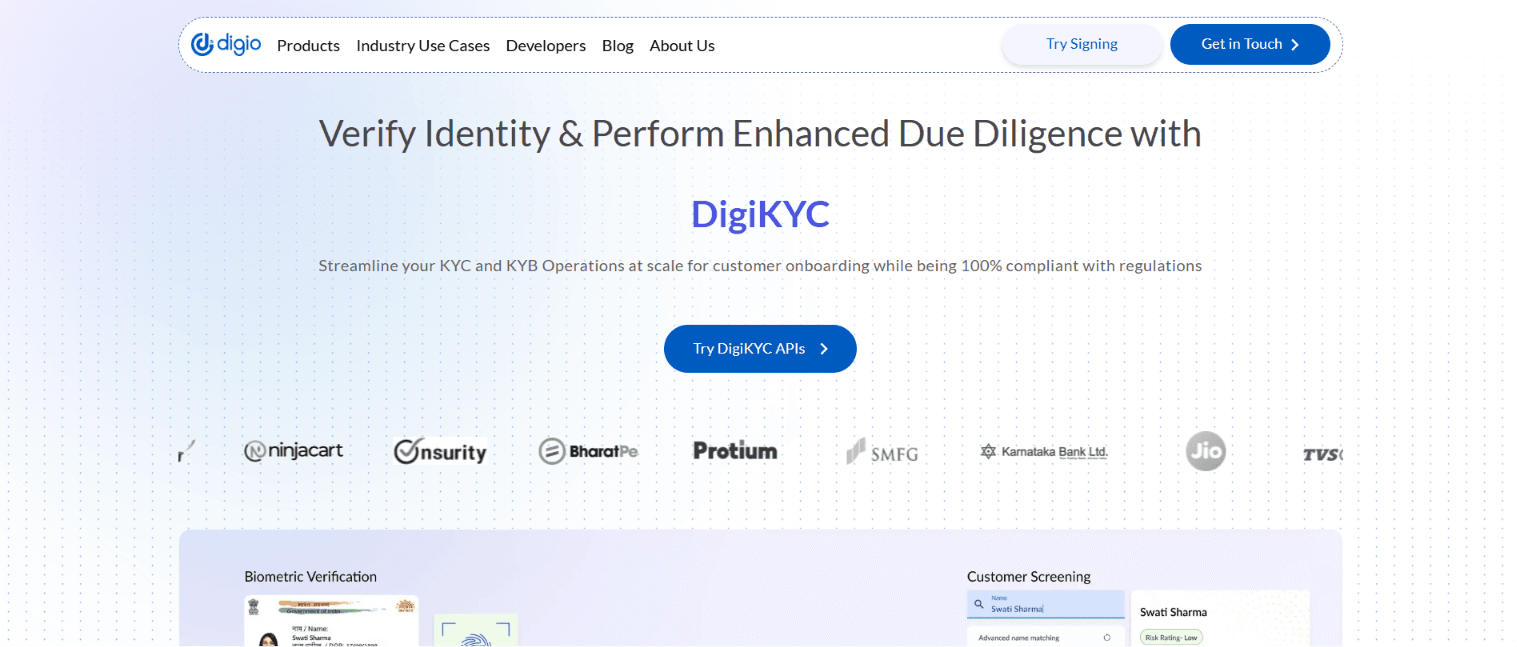
Digio DigiKYC covers three separate Indian regulatory regimes from one Video KYC stack: RBI's V-CIP for banking, SEBI's VIPV for capital markets, and IRDAI's VBIP for insurance.
Its public product page documents self and assisted Video KYC, real-time facial recognition with geo-location verification, automatic video-quality adjustment for weak networks, and multi-agent support with call reminders and in-call chat.
Digio also publishes ID OCR analysis, DigiLocker integration, KYB verification for non-individual entities, liveness detection with 20+ checks claimed at 99.6% accuracy, face-dedupe across large image sets, and a workflow builder (DigiStudio) with auto-approval logic.
Public material is stronger on product capability than endpoint-level API reference. Request session API specs, webhook schemas, SDK version support, and current PAD/injection-attack test evidence before scoping integration.
Best for: financial groups running banking, broking, and insurance arms under one compliance umbrella that want a single Video KYC vendor across all three regimes.
Pricing visibility: sales-led. Digio's self-reported benchmarks (60% cost reduction, 95% TAT reduction) are vendor-stated; verify against your own volumes.
3. Cashfree Secure ID: Best Public Indian API Documentation
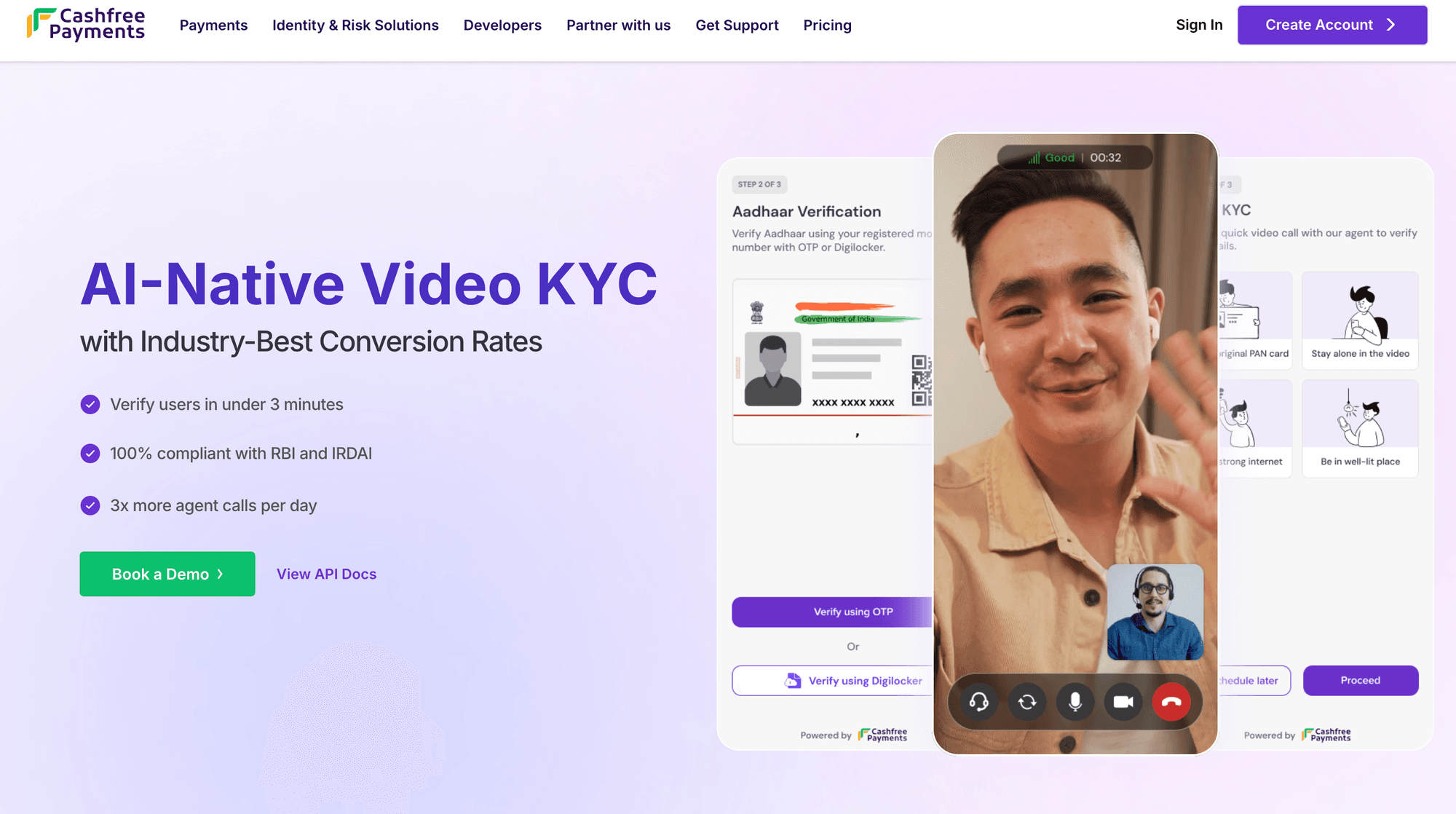
Cashfree Secure ID earns a high rank because its current documentation exposes a concrete Video KYC lifecycle instead of stopping at a product brochure.
The public API reference shows how to create a Secure ID user, initiate a Video KYC request, generate a verification link, fetch status, and receive workflow data.
Cashfree documents separate production and sandbox endpoints, versioned headers, client credentials, webhooks, key rotation, agent and auditor dashboards, reports, status fields, and configurable user or agent templates.
That clarity gives developers a realistic starting point for estimation. Cashfree also connects Video KYC with PAN, Aadhaar, face liveness, name matching, bank verification, DigiLocker, and related Secure ID services.
The trade-off is ecosystem fit. Cashfree is especially attractive for Indian fintechs already using its payments or verification products, while non-financial or global workflows may prefer a neutral identity platform.
Best for: Indian fintech products that want a documented, sandbox-oriented verification service and may already use Cashfree payments, payouts, or Secure ID checks.
Pricing visibility: access follows wallet, activation, and product-entitlement rules. Confirm Video KYC session, agent, recording, storage, and ancillary verification charges directly with Cashfree.
4. Surepass: Best for API Breadth Alongside Video KYC
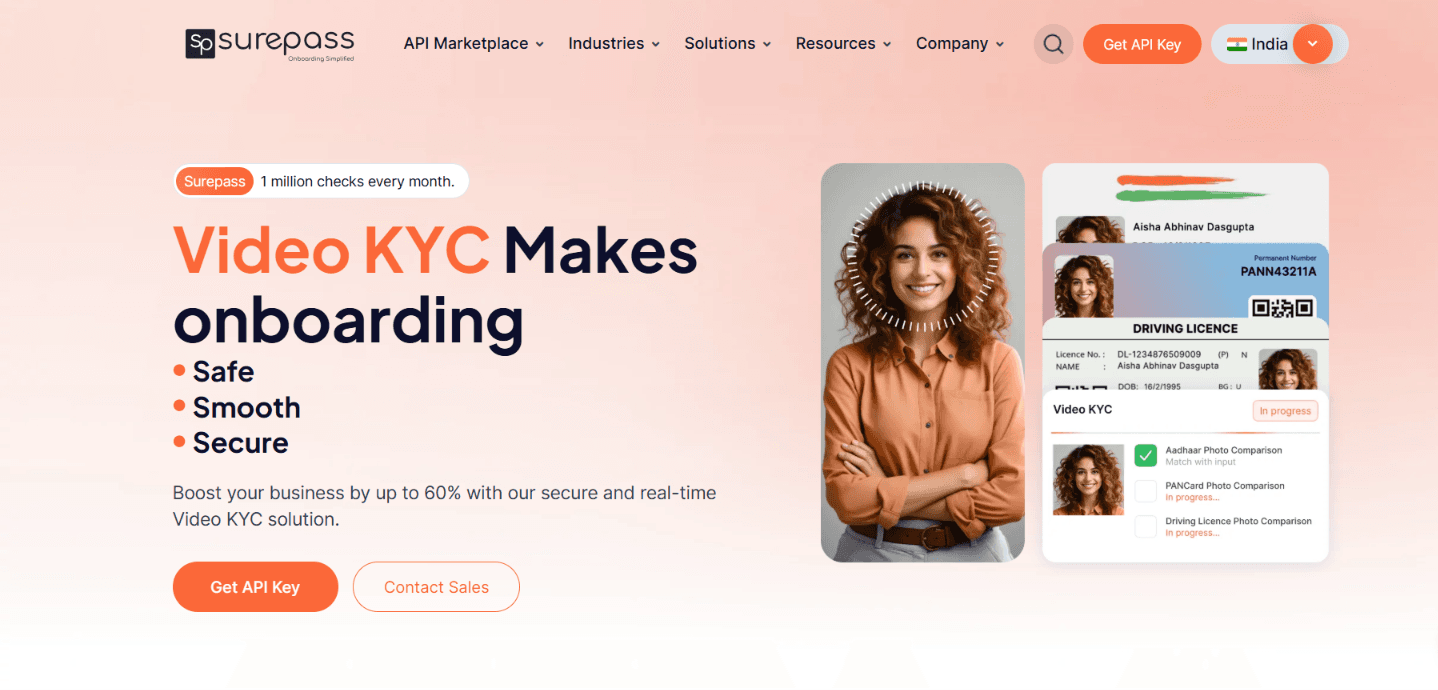
Surepass Video KYC sits inside a much larger API marketplace, giving Indian teams one vendor for Video KYC plus the surrounding identity and business checks a V-CIP journey typically needs.
Its public flow covers link-based initiation, prerequisite check, agent queue, facial-recognition capture, document review, and a Q&A-backed decision. Listed features include live location confirmation, deepfake detection, end-to-end encryption, and VCIP delivered over WhatsApp video calls.
One concrete claim stands out: Surepass states its Video KYC functions at bandwidths as low as 100kbps, useful for onboarding outside metro connectivity. The company also states its platform spans 300+ verification APIs available through a self-serve sandbox for testing before contract.
This is an API-marketplace model rather than a single-purpose vKYC product. Confirm which APIs are bundled into a standard contract, and request current PAD/injection-resistance test evidence.
Best for: Indian fintechs and NBFCs wanting Video KYC alongside a wide bench of identity and bank-verification APIs from one vendor with sandbox access.
Pricing visibility: sales-led. Surepass's "97% fraud reduction, 2000+ companies" claim is vendor-stated; request session and per-API pricing directly.
5. HyperVerge: Best Turnkey Indian V-CIP
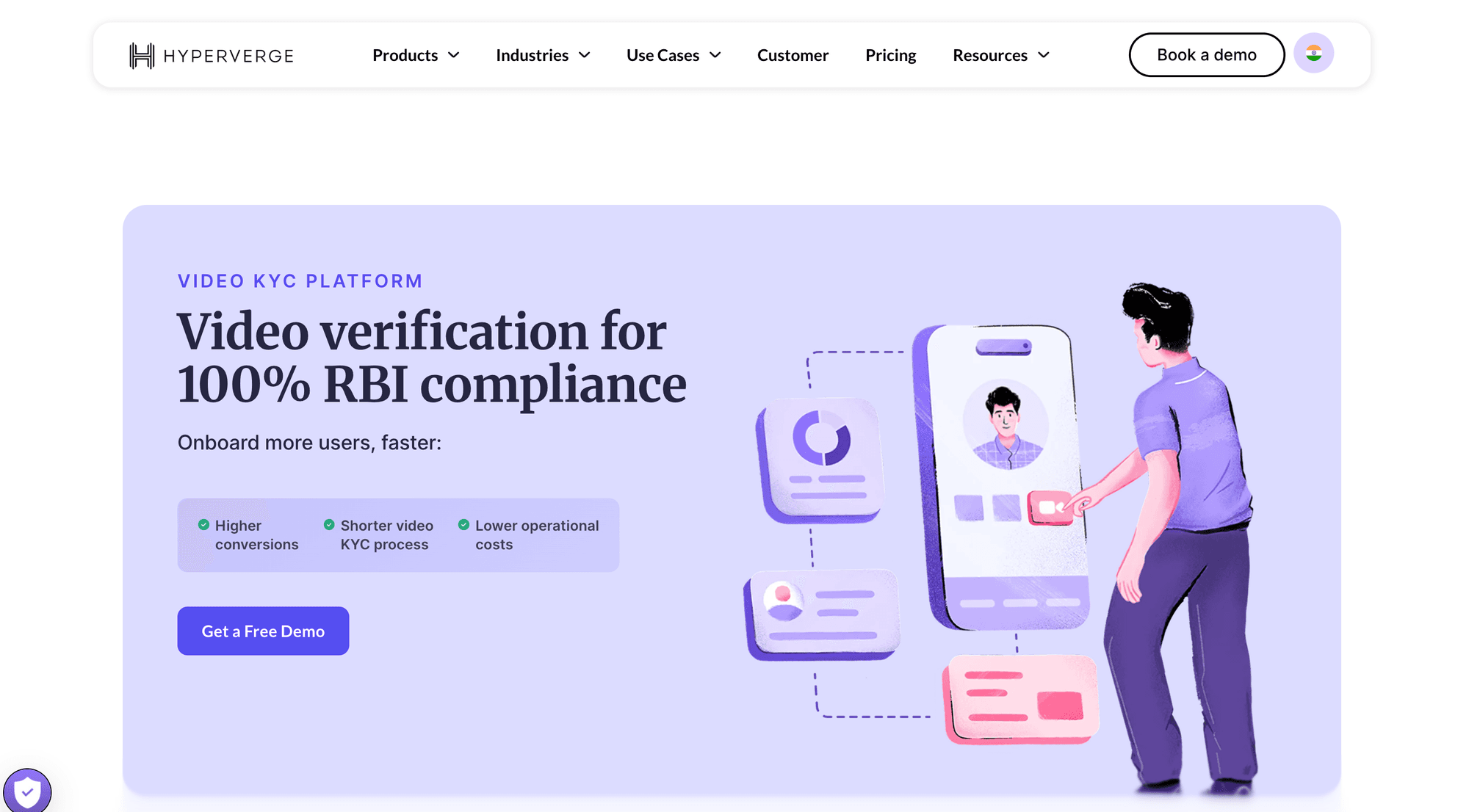
HyperVerge Video KYC is designed as an operational product, not only a media API, covering pre-call checks, agent queues, live verification, and post-call management.
Its public product flow includes PAN verification, Aadhaar eKYC, CKYC, name and date-of-birth matching, queue estimates, scheduling, random verification codes, face match, liveness, and deepfake checks.
HyperVerge also presents agent-led and agent-less journeys, dashboards, shift controls, priority routing, automated PAN capture, and configurable document or signature steps for different regulated use cases.
This breadth reduces integration work for an Indian financial institution that wants one accountable workflow. It also means your journey will follow more vendor-defined operational patterns than VideoSDK's modular approach.
Public product material is detailed, but full technical implementation and pricing remain sales-led. Request API specifications, webhook schemas, data residency terms, security reports, and sandbox access before scoring feasibility.
Best for: high-volume Indian banks, NBFCs, lenders, demat platforms, and insurers seeking a managed V-CIP workflow with built-in fraud and agent operations.
6. IDfy: Best for Session Continuity
IDfy Video KYC supports agent-assisted and self-serve modes, with operations focused on completing calls despite device, network, or scheduling friction.
Its public material documents pre-call network, camera, and microphone checks, low-bandwidth support, text chat, reconnection, autosave, reviewer allocation, dashboards, and cloud availability across major providers.
The Dfy Product Hub describes document validation, configurable video activities, link generation, face liveness, face consistency, face comparison, timestamps, geostamps, and manual expert review.
Those features address a gap in shallow buyer guides: call completion depends on recovery and review operations, not only OCR or liveness boxes on a comparison sheet.
Some publicly visible documentation contains older wording and planned-feature labels. Ask IDfy to identify the current production API version, supported browsers, exact activities, failure codes, and retention options.
Best for: Indian enterprises that need configurable verification journeys and put strong emphasis on low-bandwidth completion, reconnection, reviewer allocation, and operational monitoring.
Pricing visibility: sales-led. Model the full cost of verification, reattempts, review, agent seats, storage, exports, and any separate document or source-validation APIs.
7. Signzy: Best for Configurable India Stack Workflows
Signzy combines an India-focused API marketplace with no-code workflow orchestration, making it suitable for regulated teams that mix identity, contracts, fraud, and onboarding controls.
Its public investor onboarding documentation shows API-created applicants, iframe initiation, video verification, document and bank checks, FATCA collection, signatures, and result-retrieval endpoints.
Signzy also presents OCR, liveness, deepfake detection, CKYC automation, digital signatures, transaction monitoring, and configurable onboarding journeys across its broader platform. Exact availability varies by contract.
This model suits compliance and operations teams that need to change journeys without waiting for every frontend release. Developers still need complete schemas and test cases before estimating effort.
Public documentation spans several products and generations, so confirm the current implementation version, webhook model, India Stack dependencies, audit export format, and production support commitments.
Best for: banks, asset managers, lenders, and regulated fintechs seeking configurable Indian onboarding journeys with identity, contract, and compliance modules under one vendor.
Pricing visibility: enterprise quotation. Ask for per-journey component pricing, environment fees, minimum volumes, assisted-review costs, and charges for CKYC, signatures, or monitoring.
8. AuthBridge: Best for Broad Indian V-CIP Workflows
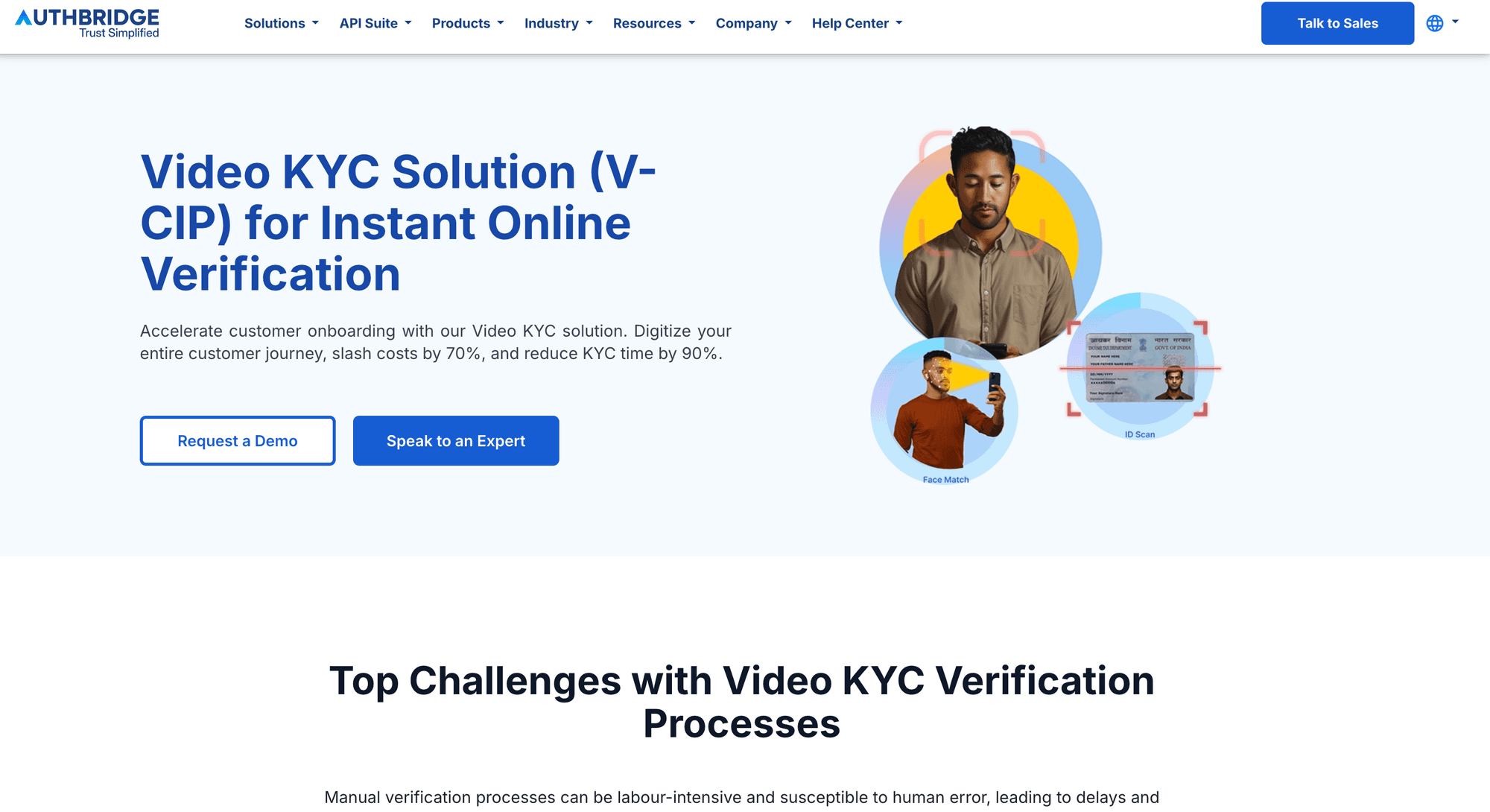
AuthBridge Video KYC combines the live session with Indian identity checks and operating tools for regulated onboarding.
Its official product material documents live encrypted video, PAN validation, offline Aadhaar verification, OCR, face match, liveness, geotagging, IP-spoofing prevention, automatic agent assignment, random questions, Aadhaar masking, encrypted recording, and verification reports.
This breadth makes AuthBridge a credible shortlist choice for an Indian BFSI team that wants more of the V-CIP journey from one provider. Its public privacy notice also identifies the client as data controller or fiduciary and AuthBridge as data processor unless stated otherwise.
The public material is stronger on product workflow than endpoint-level developer reference. Ask for session APIs, callback schemas, idempotency, failure states, SDK support, audit exports, deletion behaviour, and proof of current fraud testing before estimating delivery.
Some official page copy still describes gesture-led liveness. Since the 2025 RBI directions say specific gestures are not mandatory, verify how the current production flow supports accessible passive or alternative liveness methods.
Best for: Indian banks, NBFCs, insurers, and fintechs wanting PAN, Aadhaar, biometric, agent, recording, and audit functions in a managed Video KYC journey.
Pricing visibility: sales-led. Obtain a written breakdown for sessions, agent time, document and source checks, biometric calls, storage, retries, reports, and implementation services.
9. Gridlines: Best for Modular Onboarding Journeys
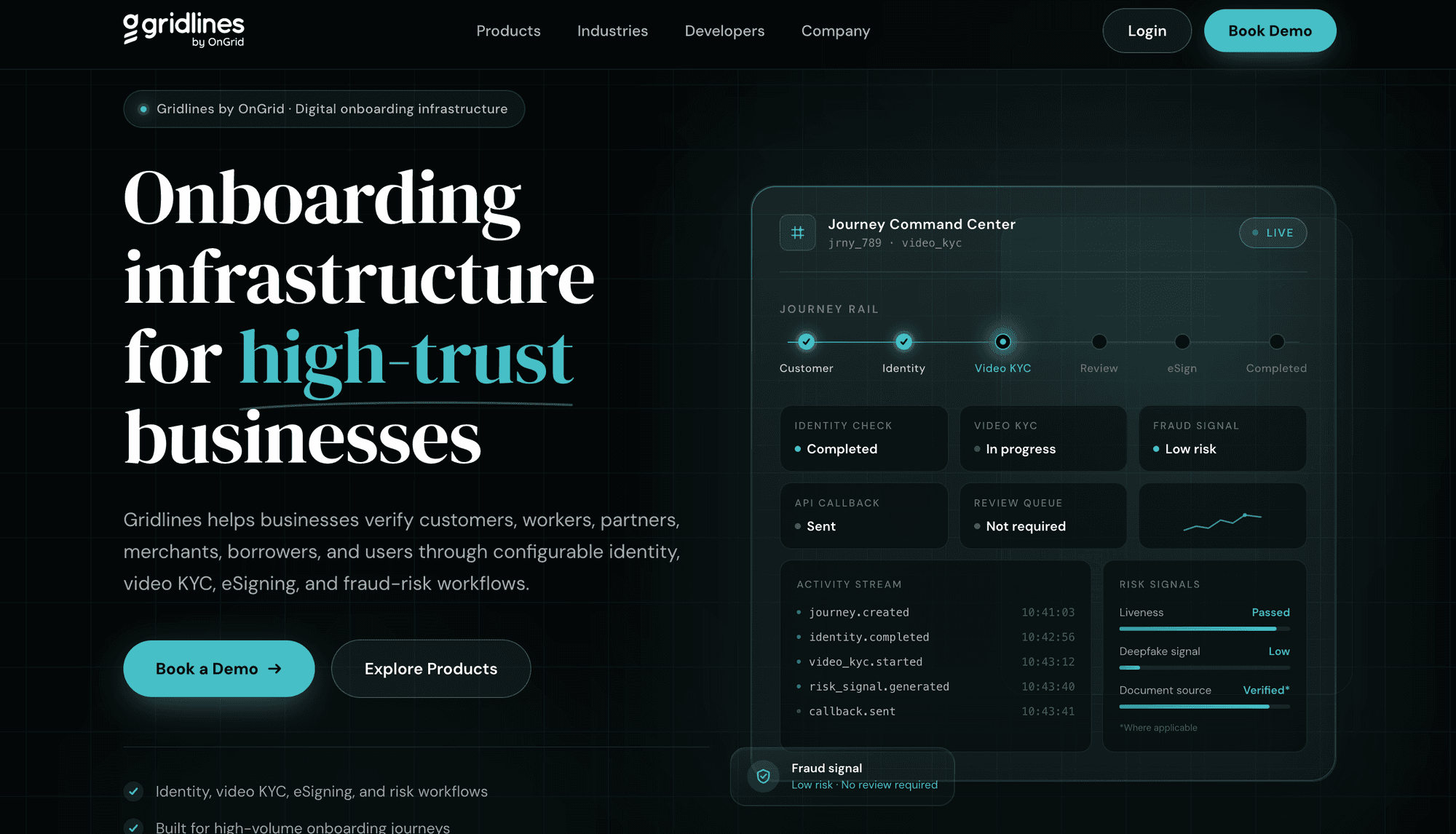
Gridlines positions Video KYC inside configurable identity, risk, review, and eSign journeys rather than treating the call as an isolated verification event.
Its public interface examples show event-driven journey states such as identity completion, Video KYC start, fraud signals, callbacks, review decisions, and eSign completion within one orchestration layer.
That event model is useful for lenders and marketplaces where KYC outcomes trigger underwriting, document signing, manual review, or escalation. It also reduces glue code between separate dashboards.
The public product evidence is stronger on workflow concepts than endpoint-level detail. Request authentication rules, webhook retries, idempotency behaviour, sandbox data, error taxonomies, and retention controls before selection.
Best for: Indian product teams wanting modular onboarding infrastructure that links verification, Video KYC, fraud signals, review queues, and agreements into one observable journey.
Pricing visibility: sales-led. Compare journey pricing against buying individual identity APIs, an RTC platform, review tooling, storage, and an orchestration service separately.
10. Shufti Pro: Best for Global Live Video Verification
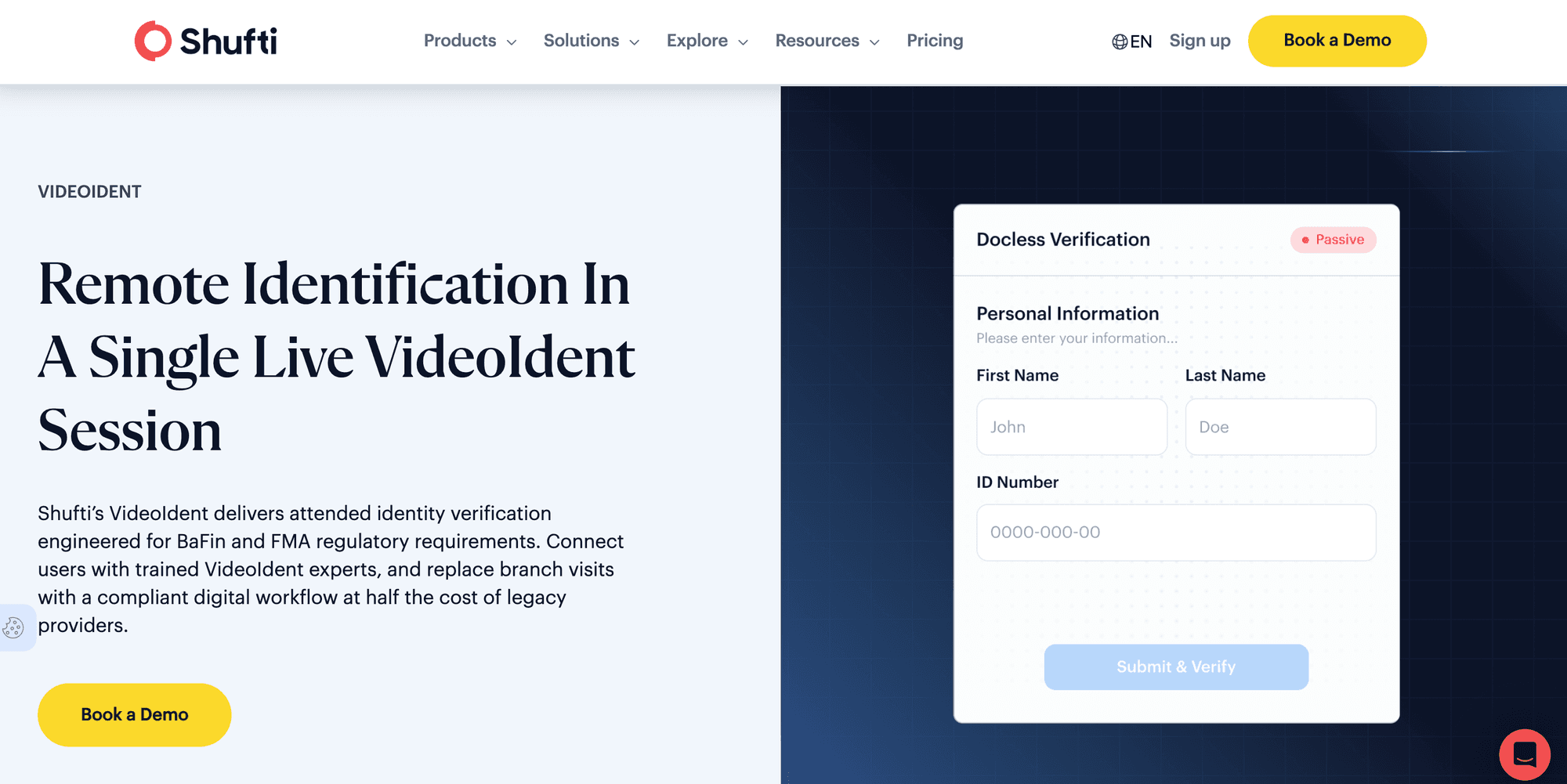
Shufti Pro VideoIdent combines a live specialist interview with document inspection, face comparison, consent capture, a verification decision, and an API-returned evidence pack.
Its developer documentation publishes the real-time verification base URL and request parameters, giving engineers more evidence than a sales page alone.
This assisted model can suit cross-border programmes where a trained human must inspect documents and interview applicants. It also reduces the need to staff every verification market internally.
The procurement burden moves toward coverage and operating hours. Verify supported countries, languages, documents, specialist availability, review escalation, data location, and local legal acceptance for each market.
Best for: international fintech, gaming, mobility, and marketplace teams that need human-assisted Video KYC and structured evidence across several jurisdictions.
Pricing visibility: plan and contract details vary. Confirm assisted-call duration, retry charges, manual review, document coverage, AML add-ons, evidence retention, and minimum commitments.
How to Choose a Video KYC API
The best Video KYC API is the one that passes your hardest production scenario, preserves an auditable chain of evidence, and fits your operating model.
1. Choose your product boundary
Decide whether you need a media and verification toolkit, a complete managed V-CIP workflow, or a global identity platform with Video KYC as one method.
Choose VideoSDK for interface and media control. Choose Digio, Cashfree, Surepass, HyperVerge, IDfy, Signzy, or AuthBridge for Indian V-CIP, multi-regulator compliance (RBI/SEBI/IRDAI), and broad verification API stacks. Choose Shufti Pro when cross-border live video identification is required.
2. Test difficult traffic
Build a test set covering budget Android devices, poor lighting, low bandwidth, permission denial, call interruption, duplicate sessions, expired links, document glare, and accessibility needs.
Do not publish vendor accuracy or conversion claims as your expected result. Measure completion, manual review, false rejection, retry cost, and support recovery using representative applicants.
3. Deepfake and Injection Attacks: The 2026 Threat Your Video KYC API Must Handle
A presentation attack places a photo, screen replay, mask, or other artefact in front of the expected camera. An injection attack bypasses that capture path and feeds synthetic or recorded frames through a virtual camera, emulator, modified client, compromised SDK, or tampered media pipeline.
That difference matters because a liveness model that detects a phone screen may never see the physical screen when an attacker injects a clean digital stream. A 2025 NIST identity and face-performance presentation describes virtual cameras, emulators, modified capture devices, and replacement of frames inside the transmission path as distinct injection methods.
Ask for independent presentation-attack test results, not only a “liveness” label. ISO/IEC 30107-3:2023 defines testing and reporting for biometric presentation-attack detection, but explicitly excludes overall system-level security and attacks outside the capture device.
Therefore, ISO/IEC 30107-3 evidence does not by itself prove resistance to virtual-camera or API-level injection. Evaluate PAD performance and, separately, device integrity, emulator and root detection, application attestation, virtual-camera controls, media provenance, replay resistance, authenticated APIs, webhook verification, tamper-evident logs, and red-team results.
VideoSDK publicly documents image-based spoof detection, but those public docs do not establish end-to-end injection-attack resistance. In a VideoSDK architecture, the regulated entity should add or procure that layer and validate the complete capture-to-decision path.
4. RBI KYC Directions 2025: What Changed for V-CIP
On 28 November 2025, RBI replaced the 2016 umbrella KYC Master Direction with entity-specific directions. The Commercial Banks KYC Directions 2025 are the operative reference for commercial banks. Through circular RBI/2025-26/101, payment system providers and participants, including payment aggregators where the payment rules cross-reference KYC, were directed to read old references as references to the 2025 Commercial Banks directions.
This change mainly consolidated and reorganised existing instructions by entity type. Do not assume that every control in the 2025 document was introduced for the first time on that date; compliance teams should map their existing controls to the new paragraph structure.
The current V-CIP text requires the application to include face liveness or spoof detection and face matching with a high degree of accuracy. It also states that specific gestures such as blinking, smiling, or frowning are not mandatory, and that liveness checks must account for customers with special needs.
The directions continue to require controls including trained officials, varied real-time questions, geotagged and timestamped recordings, protection from spoofed or outside-India IP addresses, end-to-end encryption, testing of relevant APIs and web services, and periodic VAPT and security audit by CERT-In-empanelled auditors.
The RBI text uses “face liveness / spoof detection”; it does not use the terms “deepfake detection” or “presentation attack detection.” Treat deepfake and injection resistance as necessary risk controls to test, but do not describe them as an explicit RBI phrase without a legal interpretation for your regulated entity.
Since 28 November 2025, India's current RBI V-CIP text requires face liveness or spoof detection and face matching, while making blinking, smiling, or frowning optional rather than mandatory.
5. Map compliance responsibility
For Indian V-CIP, the regulated entity remains responsible for customer identification. The 2025 Commercial Banks directions state that ultimate responsibility for customer identification rests with the bank; each other regulated entity should map that principle to its applicable direction and payment-system instructions.
Verify informed consent, live official participation, geotagging, PAN and identity-source checks, varied questions, liveness, encryption, logs, timestamps, concurrent audit, safe storage, and Aadhaar redaction.
A Video KYC API gives a regulated entity programmable control over an identity session, but vendor selection does not transfer responsibility for customer identification, fraud controls, security testing, audit retention, or legal compliance.
This article is technical research, not legal advice. Obtain current guidance from your regulator, compliance function, legal counsel, information-security team, and independent auditors before production approval.
6. Price the complete journey
Model customer sessions, agent minutes, reviewer time, document checks, biometric calls, government-source lookups, recording, storage, exports, retries, webhooks, support, and minimum commitments.
A cheaper API request can produce a more expensive completed KYC when drop-offs, agent idle time, repeated reviews, or fragmented incident support increase operational cost.
Public pricing is too sparse to support a reliable market-wide ₹15 to ₹80 claim for the ranked providers. Most use custom enterprise quotes, and a “session” may exclude the agent, source checks, biometrics, storage, or reattempts. Use vendor quotes to calculate cost per completed, approved KYC under your own traffic mix.
VideoSDK Architecture for Video KYC
VideoSDK works best in a modular Video KYC architecture where the regulated entity owns orchestration and connects authoritative identity services behind controlled server APIs.
Build a Video KYC (VKYC) App with VideoSDK
- Create a server-side session. Authenticate the applicant, generate a short-lived VideoSDK token, create a room, and attach your internal case identifier without exposing secrets.
- Run pre-call checks. Test camera, microphone, network, location permission, browser support, consent, and document readiness before assigning a trained official.
- Conduct the live interview. Keep the customer and official inside the regulated entity's application, vary questions, monitor quality, and capture required evidence during the call.
- Detect capture and injection attacks. Run face spoof or PAD checks, virtual-camera and emulator controls, app or device integrity checks, replay detection, and media-pipeline risk rules before accepting evidence.
- Call verification services. Send approved captures to OCR, face match, PAN, Aadhaar, sanctions, or other source-validation services through your protected backend.
- Seal the audit record. Store timestamps, location, official identity, events, decisions, hashes, fraud signals, verification outputs, recording references, and reviewer actions under your retention policy.
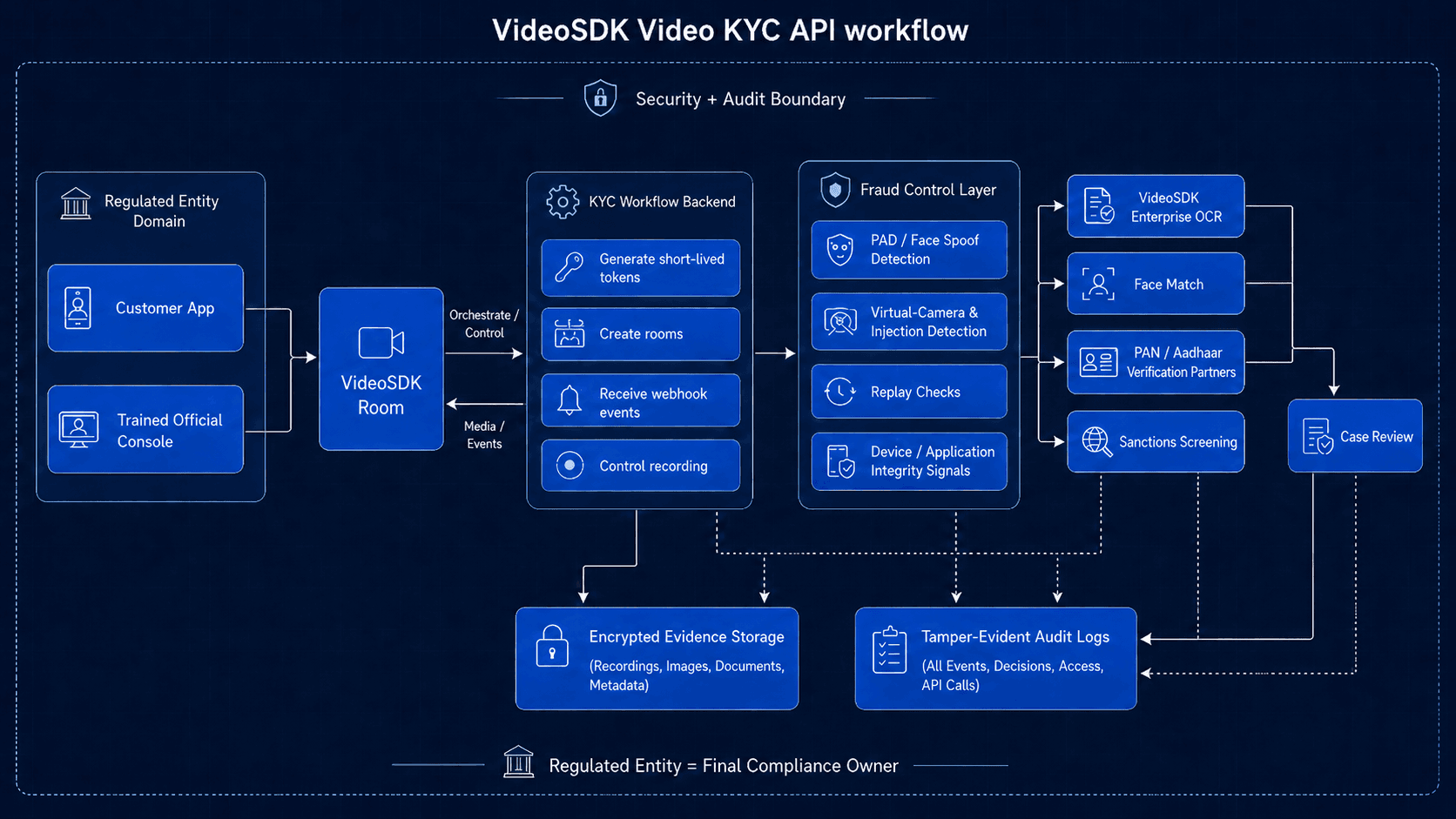
This design keeps vendor boundaries explicit. It also lets your team replace a verification component without rebuilding the customer and agent video experience.
The regulated entity should scope VAPT and security review across the customer application, VideoSDK integration, capture controls, identity services, storage, dashboards, APIs, and webhooks. Auditing only the RTC component leaves material attack paths outside the assessment.
What Is the Best Video KYC API?
The best Video KYC API depends on whether you value custom developer control, managed Indian V-CIP operations, a documented fintech workflow, or global identity coverage.
| Use case | Best starting point | Why | Main trade-off |
|---|---|---|---|
| Custom embedded V-CIP across web and mobile | VideoSDK | Direct control of the call, interface, events, recording, and modular identity APIs | Your team must integrate authoritative checks, operations, fraud controls, and compliance evidence |
| Multi-regulator Indian financial compliance | Digio | RBI V-CIP, SEBI VIPV, and IRDAI VBIP support in one stack with DigiLocker and DigiStudio | Public material focuses on workflow capabilities rather than endpoint-level API specifications |
| Documented Indian REST workflow | Cashfree Secure ID | Public session, status, sandbox, agent, auditor, and webhook documentation | Strongest fit inside the Indian fintech and Cashfree ecosystem |
| Low-bandwidth Video KYC with broad API suite | Surepass | 100kbps connectivity support, WhatsApp Video KYC option, and 300+ verification APIs | API marketplace model requires confirming contract bundling and test evidence |
| Turnkey high-volume Indian V-CIP | HyperVerge | Packaged pre-checks, routing, biometrics, agents, and dashboards | More vendor-defined workflow and sales-led technical access |
| Completion continuity and review operations | IDfy | Pre-call checks, reconnection, autosave, allocation, and review tooling | Confirm the current API version and planned-versus-live features |
| Configurable India Stack journey | Signzy | API marketplace, iframe journeys, workflow configuration, and adjacent compliance modules | Product and documentation versions require careful contract validation |
| Broad managed Indian V-CIP | AuthBridge | PAN, Aadhaar, OCR, face, liveness, geotagging, agents, recording, and reports | Less endpoint-level public documentation than Cashfree |
| Modular Indian onboarding orchestration | Gridlines | Identity, Video KYC, fraud, review, and eSign states in one journey | Public evidence is stronger on workflow concepts than endpoint detail |
| Cross-border human-assisted verification | Shufti Pro | Live specialists and API-returned evidence across markets | Validate country coverage, languages, operating hours, and local acceptance |
VideoSDK is not the automatic answer for a team seeking outsourced KYC operations. It ranks first here because this evaluation weights custom engineering control above managed-service convenience.
Video KYC API Definitions
These Video KYC API definitions separate communication infrastructure, identity evidence, biometric controls, and regulatory responsibility for developers evaluating an implementation.
V-CIP: RBI's Video-based Customer Identification Process for applicable regulated entities, involving live audiovisual interaction, trained officials, identity evidence, security controls, and auditable records.
Liveness detection: A control intended to confirm that biometric input comes from a present person rather than a photo, replay, mask, synthetic feed, or presentation attack.
Presentation Attack Detection, or PAD: Testing and controls aimed at detecting artefacts presented at the biometric capture device, such as printed photos, screens, or masks. ISO/IEC 30107-3 covers PAD testing and reporting, not the security of the whole identity system.
Injection attack: An attack that replaces or inserts image or video data after the expected camera-capture point, for example through a virtual camera, emulator, modified application, compromised SDK, or tampered media pipeline.
Face matching: A biometric comparison between a live or captured face and a trusted document photograph, producing a score or decision that still requires policy controls.
Meeting token: A short-lived credential used to authorise a participant's access to a VideoSDK room, generated by a trusted server rather than exposed client-side.
Audit trail: The linked record of consent, timestamps, locations, officials, session events, evidence, automated checks, reviewer actions, decisions, and retention or deletion operations.
Key Takeaways
These seven Video KYC API takeaways summarise the product boundaries, conditional leaders, compliance limits, fraud controls, and proof-of-concept work that should guide your shortlist.
- A Video KYC API may provide composable infrastructure, a managed V-CIP journey, or a global identity platform, so buyers should compare product boundaries first.
- VideoSDK is the leading choice in this developer-first ranking for custom live-video control, multi-platform SDK coverage, and modular enterprise identity-verification endpoints.
- VideoSDK still requires authoritative identity checks, trained operations, retention controls, audit design, and regulated-entity ownership for a complete Indian V-CIP implementation.
- HyperVerge leads for turnkey Indian operations, while Cashfree stands out for publicly accessible, current REST documentation and a clearly described session lifecycle.
- AuthBridge now belongs on an Indian V-CIP shortlist because its public workflow covers PAN, offline Aadhaar, OCR, face, liveness, geotagging, agents, recordings, and reports.
- PAD and liveness testing do not prove injection resistance. Test virtual-camera, emulator, client-integrity, replay, API, and media-pipeline attacks separately.
- No ranking replaces a proof of concept using difficult devices, real document diversity, fraud cases, interrupted sessions, queue peaks, reviewers, storage, and incident reconstruction.
Conclusion
Choosing a Video KYC API in 2026 is an architecture decision, not a feature-count contest. Start with VideoSDK when custom media, interface ownership, and composability lead your requirements.
Choose a managed provider when agent operations and packaged verification matter more. Review the VideoSDK React quickstart, then start with free credit or request an enterprise architecture review.
What are you building with VideoSDK? Drop a comment and share the Video KYC use case, jurisdiction, client platforms, and verification services your team needs.
Frequently Asked Questions
What is a Video KYC API?
A Video KYC API is a programmable service for conducting remote identity verification through video, documents, biometric checks, human review, and auditable workflow data.
Some products provide only selected building blocks, while others manage the entire journey. Always identify who owns the call, verification decision, evidence, and compliance obligations.
Which Video KYC API is best in 2026?
The best Video KYC API in 2026 depends on your operating model. VideoSDK suits custom developer control, Digio excels in multi-regulator Indian compliance (RBI, SEBI, IRDAI), Cashfree offers strong public API documentation, and Surepass delivers low-bandwidth Video KYC backed by 300+ identity verification APIs.
HyperVerge, IDfy, Signzy, and AuthBridge serve enterprise Indian V-CIP workflows, while Shufti Pro is a top choice for international live video verification.
Is VideoSDK a complete KYC provider?
No, VideoSDK should not be described as a complete KYC provider without qualification. It supplies real-time video infrastructure and documented enterprise identity-verification APIs.
Teams still need appropriate PAN, Aadhaar, sanctions, PEP, workflow, agent, storage, legal, and audit controls where their use case or jurisdiction requires them.
Does VideoSDK support OCR and liveness checks?
Yes, VideoSDK documents enterprise-only OCR, face-match, face-spoof-detection, and face-count APIs. Its video SDK also supports meeting rooms, participant media, events, and recordings.
Confirm current availability, commercial terms, accuracy evidence, data processing, supported documents, and production constraints directly with VideoSDK before using these APIs in regulated workflows.
What does RBI require for Video KYC?
RBI's V-CIP rules require applicable regulated entities to implement live, secure, encrypted audiovisual interaction with trained officials, consent, geotagging, identity checks, liveness, logs, and recordings.
The 2025 directions require face liveness or spoof detection and face matching, but say blinking, smiling, or frowning is not mandatory. The rules also cover PAN verification, timestamps, secure storage, API testing, CERT-In-empanelled security audits, and regulated-entity responsibility.
Does RBI explicitly mandate deepfake detection for V-CIP?
The current RBI V-CIP text requires face liveness or spoof detection and face matching, but it does not use the terms “deepfake detection” or “presentation attack detection.”
Regulated entities should still evaluate deepfake, replay, and injection risks as part of fraud and security controls. Obtain legal and compliance interpretation before describing a particular technology as an explicit RBI mandate.
What is the difference between PAD and an injection attack?
Presentation Attack Detection focuses on artefacts presented at the expected biometric capture device, such as a photo, replay screen, or mask.
An injection attack bypasses or tampers with that capture path using a virtual camera, emulator, modified client, compromised SDK, or replaced frames. A PAD test alone does not prove injection resistance.
How should I test a Video KYC API?
Test a Video KYC API with representative documents, devices, networks, languages, accessibility needs, spoof attempts, interruptions, retries, queue peaks, reviewer actions, and evidence retrieval.
Measure completion, false rejection, manual-review rates, recovery time, support quality, and total completed-KYC cost. Do not rely only on a vendor's happy-path sandbox.
How much does a Video KYC API cost?
A Video KYC API may charge per session, participant minute, agent minute, biometric check, document lookup, review, recording, storage, export, or monthly commitment.
Most ranked enterprise vendors provide custom quotes. Public evidence is not strong enough to treat ₹15 to ₹80 as a reliable market-wide range, because vendors define and bundle a “session” differently.
Compare the total completed-verification cost, including agent time, checks, failures, retries, review, recording, storage, and support, rather than the cheapest published API request.
Related VideoSDK Guides
These VideoSDK guides strengthen the Video KYC topic cluster and give developers practical next steps for media, identity checks, evidence capture, and architecture decisions.