
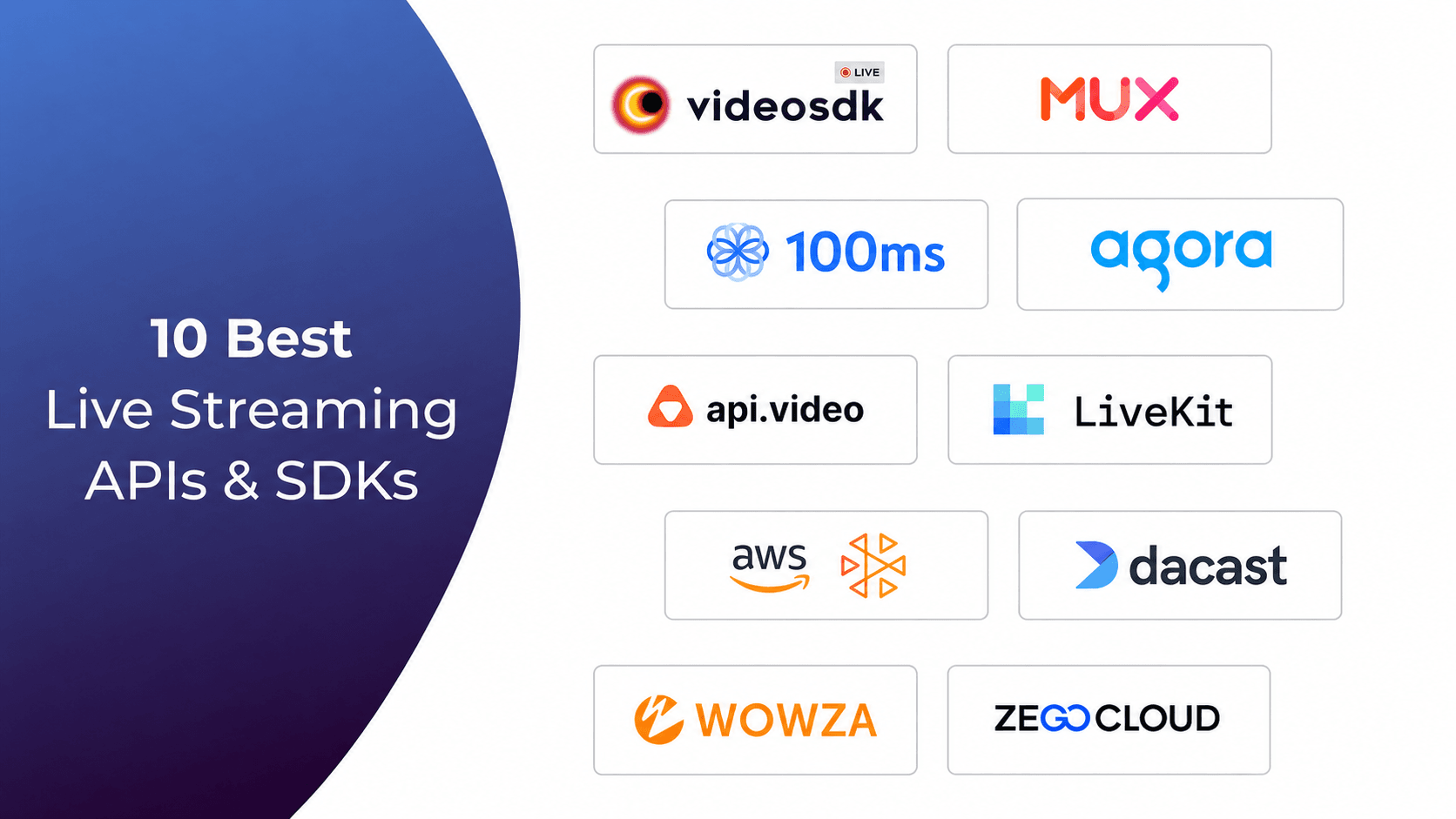


The best live streaming APIs in 2026 are VideoSDK, Agora, Mux, Amazon IVS, and LiveKit. VideoSDK leads for interactive, sub-second streaming across 10+ platform SDKs, Mux and Amazon IVS lead for large one-way HLS broadcasts, and LiveKit leads for open-source, self-hosted deployments. Your latency requirement decides which one fits.
A live stream delivered over standard HLS arrives 20 or more seconds after the camera captures it, while a WebRTC stream arrives in under 500 milliseconds. That gap decides whether your live auction, tutoring session, or shopping stream actually works.
Building this infrastructure yourself means running media servers, transcoding pipelines, and CDN contracts before you ship a single feature. A live streaming API replaces all of that with a few SDK calls. This guide ranks the 10 best live streaming APIs available in 2026, with verified pricing, latency profiles, and honest "best for" verdicts, so you can pick the right foundation for your video product.
What Is a Live Streaming API?
A live streaming API is defined as an application programming interface that lets developers add real-time video broadcasting and playback to their applications without building encoding, media server, or delivery infrastructure themselves.
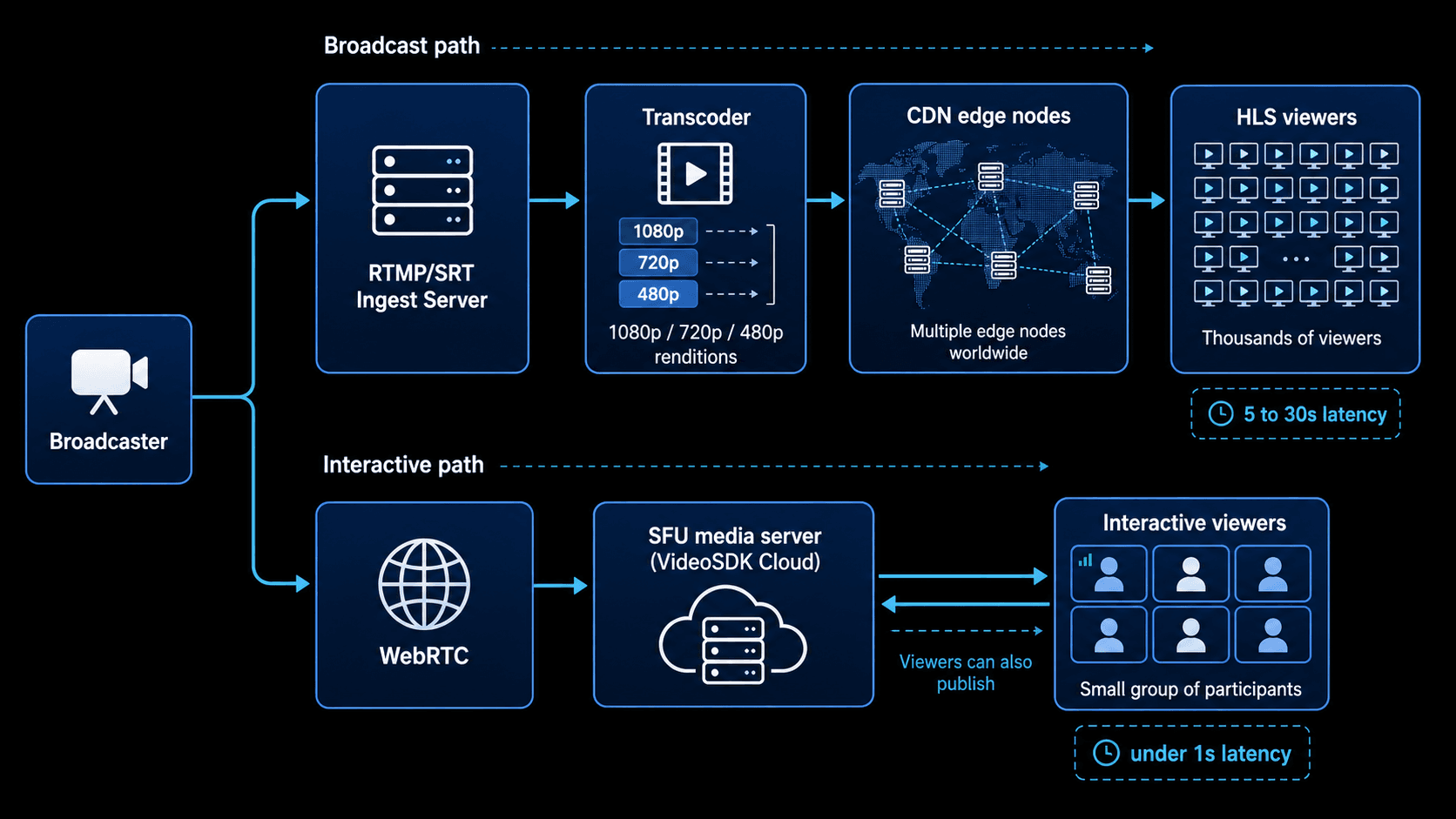
A live streaming API works by ingesting a broadcaster's video feed, transcoding it into multiple quality levels, and distributing it to viewers through either a global CDN (for HLS broadcasts) or a real-time network (for WebRTC streams).
VideoSDK provides live streaming through its Interactive Live Streaming (ILS) API, which keeps latency under a second so viewers can chat, vote, and even join the stream as co-hosts. That interactivity is the dividing line in this market: some APIs are built for reach, others for real-time participation, and the best choice depends on which one your product needs.
How Do Live Streaming APIs Work?
Live streaming APIs work by handling four stages of the video pipeline: ingest, transcoding, delivery, and playback.
- Ingest. The broadcaster's device sends video to the provider's servers over RTMP, SRT, or WebRTC. RTMP remains the standard for encoder software like OBS, while WebRTC is used when the broadcaster is inside your app.
- Transcoding. The single incoming feed is converted into multiple renditions (1080p, 720p, 480p) so adaptive bitrate streaming can match each viewer's connection speed.
- Delivery. HLS-based APIs push segments through a CDN, which scales to millions of viewers but adds delay. WebRTC-based APIs route media through an SFU (Selective Forwarding Unit), which keeps latency under a second but requires real-time infrastructure in every region.
- Playback. The viewer's player requests the stream and switches quality levels automatically as bandwidth changes.
For reference on the protocol layer itself, the W3C maintains the WebRTC specification that real-time providers implement.
Interactive vs Broadcast: Which Type of Live Streaming API Do You Need?
Every provider on this list falls into one of two architectures, and picking the wrong one is the most common mistake teams make.
Interactive live streaming APIs (VideoSDK, Agora, LiveKit, 100ms, ZEGOCLOUD) run on WebRTC. Latency stays under a second, viewers can be promoted to speakers, and the same infrastructure handles video calls. Use this architecture for live shopping, auctions, tutoring, town halls, and any stream where the audience talks back.
Broadcast streaming APIs (Mux, Amazon IVS, api.video, Dacast, and Wowza) ingest over RTMP or SRT and deliver over HLS. Latency runs from about 3 seconds (low-latency HLS) to 30 seconds (standard HLS), but a single stream can reach millions of passive viewers at lower cost per viewer. Use this architecture for sports, events, and one-to-many broadcasts.
According to Mux's own pricing documentation, standard HLS delivery carries 20 or more seconds of latency, while its LL-HLS mode reduces that to 4 to 7 seconds. No HLS mode reaches the sub-second range that WebRTC provides, which is why the two architectures are complements, not substitutes.
How We Evaluated These Live Streaming APIs
Each provider was scored against five criteria that map to real integration decisions:
- Latency profile: verified glass-to-glass latency for the provider's primary delivery mode.
- SDK and platform coverage: native SDKs for web, iOS, Android, React Native, and Flutter.
- Pricing transparency: published rates checked against official pricing pages in August 2026.
- Interactivity features: role switching, chat, polls, co-hosting, and recording.
- Scale ceiling: documented concurrent viewer limits and CDN or SFU reach.
The 10 Best Live Streaming APIs in 2026
The top 10 live streaming APIs and SDKs in 2026 are VideoSDK, Agora, Mux, Amazon IVS, LiveKit, 100ms, ZEGOCLOUD, api.video, Dacast, and Wowza. The first five cover most production use cases; the rest win in specific niches.
1. VideoSDK
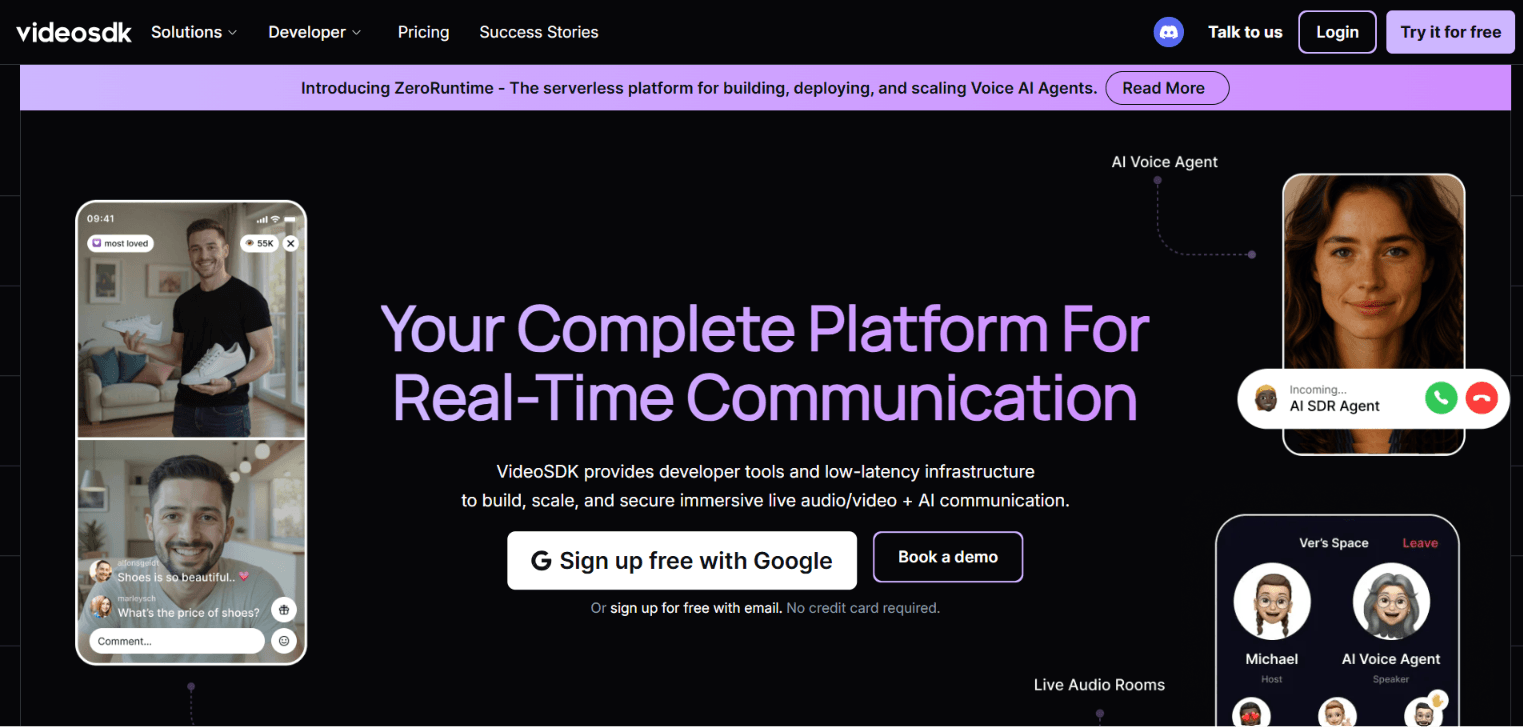
VideoSDK is a real-time communication platform that treats interactive live streaming as a first-class API rather than an add-on to video calling. Streams run over WebRTC with sub-second latency, and a single changeMode() call moves a participant between conference mode and streaming mode, so a viewer can be promoted to co-host without rejoining.
Key capabilities:
- Interactive live streaming with hosts, co-hosts, and viewers, plus dynamic role switching mid-stream
- SDKs for React, JavaScript, React Native, Android, iOS, Flutter, Unity, C++, IoT, and Python, the broadest platform coverage among the providers on this list
- A prebuilt UI Kit that embeds a working stream interface without custom UI code
- Network-adaptive streaming that adjusts bitrate and resolution per viewer in real time
- In-stream chat, polls, Q&A, whiteboard, cloud recording, and real-time transcription in the same SDK
- RTMP output for simulcasting the stream to YouTube, Twitch, and other platforms
Pricing: Pay-as-you-go. Audio starts at $0.001 per participant-minute and video at $0.004 per participant-minute; interactive live streams are billed on host and viewer minutes, with viewer minutes priced at a fraction of host rates. New accounts receive a one-time $20 free credit with no credit card required.
Best for: Teams building interactive streaming (live commerce, tutoring, auctions, social audio and video) who also want video calling, recording, and AI voice capabilities from one SDK surface.
Limitation: Documentation for newer capabilities like the AI Agent SDK is still expanding, so advanced use cases may require checking recent release notes or the Discord community for guidance.
Schedule a Demo with Our Live Video Expert!
Discover how VideoSDK can help you build a cutting-edge real-time video app.
2. Agora
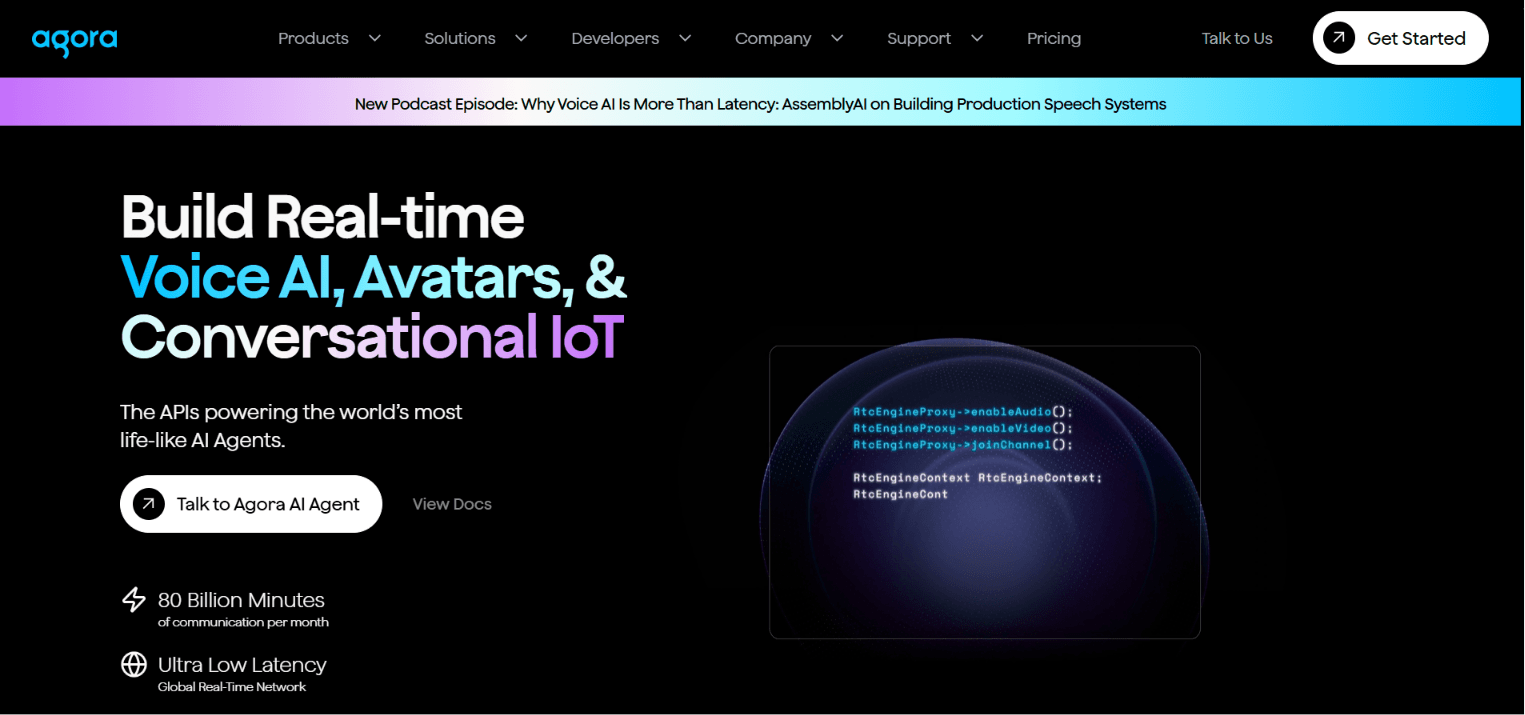
Agora runs its own software-defined real-time network (SD-RTN) with edge presence across more than 200 countries and regions, which makes it strong for globally distributed interactive broadcasts, particularly in APAC and LATAM. Its Interactive Live Streaming product supports large audiences with host and audience roles, and premium add-ons cover AR effects, spatial audio, and whiteboards.
Pricing: 10,000 free minutes per month, then usage-based: $0.99 per 1,000 audio participant-minutes, HD video at $3.99 per 1,000 minutes, and Full HD at $8.99 per 1,000 minutes, with rates decreasing at volume. Add-ons like recording bill separately.
Best for: Ultra-scale interactive broadcasts where global edge coverage matters more than pricing simplicity.
Limitation: The rate card is detailed. Video resolution tiers, add-ons, and regional pricing make invoices harder to forecast than flat participant-minute models.
3. Mux
Mux is the developer-experience benchmark for broadcast streaming: create a live stream with one API call, receive an RTMP or SRT stream key, and get back an HLS playback URL. Every live stream is automatically recorded as an on-demand asset at no extra charge, and Mux Data Analytics (rebuffering, startup time, drop-off) is included with delivery.
Pricing: Usage-based on minutes encoded, stored, and delivered. The free plan includes up to 10 on-demand videos and 100,000 delivery minutes per month; paid plans start at $20 for $100 of usage. Live simulcasting costs $0.020 per minute per target. Standard latency is 20+ seconds; LL-HLS mode brings it to 4 to 7 seconds.
Best for: Creator platforms, fitness apps, and media products that need reliable one-to-many HLS delivery with strong analytics.
Limitation: No WebRTC delivery. Interactive use cases that need sub-second latency are outside Mux's architecture.
4. Amazon IVS
Amazon Interactive Video Service is the managed streaming infrastructure behind Twitch, exposed as an AWS service. It offers two modes: Low-latency streaming (RTMP ingest and delivery in roughly 3 to 5 seconds) and real-time streaming (WebRTC stages billed per participant-hour). Chat is available as a separate metered feature.
Pricing: Pay-as-you-go on video input hours and output hours by resolution (low latency) or participant hours (real-time). The free tier includes 5 hours of live input, 100 hours of SD output, and 20 participant-hours per month, and new AWS customers receive up to $200 in Free Tier credits, per the official AWS IVS pricing page.
Best for: Teams already on AWS that need Twitch-grade broadcast scale with usage-based billing.
Limitation: Output-hour billing scales directly with audience size, so large audiences at HD resolution require careful cost modelling, and the SDK surface is thinner than developer-first platforms.
5. LiveKit
LiveKit is the leading open-source option: an Apache 2.0 licensed WebRTC SFU you can self-host with no license fees, plus LiveKit Cloud as the managed version. Its egress system records rooms or pushes streams to RTMP destinations, and its Agents framework has made it a default choice for teams adding AI participants to live sessions.
Pricing: Self-hosting is free (you pay only your own infrastructure). LiveKit Cloud offers a free Build tier (including 5,000 participant minutes and 50GB data transfer monthly), Ship at $50 per month, Scale at $500 per month, and custom Enterprise plans, with metered connection minutes from $0.0005 and bandwidth billed separately.
Best for: Engineering teams that want infrastructure control, open-source auditability, or a self-hosted path to eliminate per-minute fees at scale.
Limitation: Self-hosting shifts the operational burden (scaling, TURN, monitoring) back to your team, and large HLS-style audiences require additional egress architecture.
6. 100ms
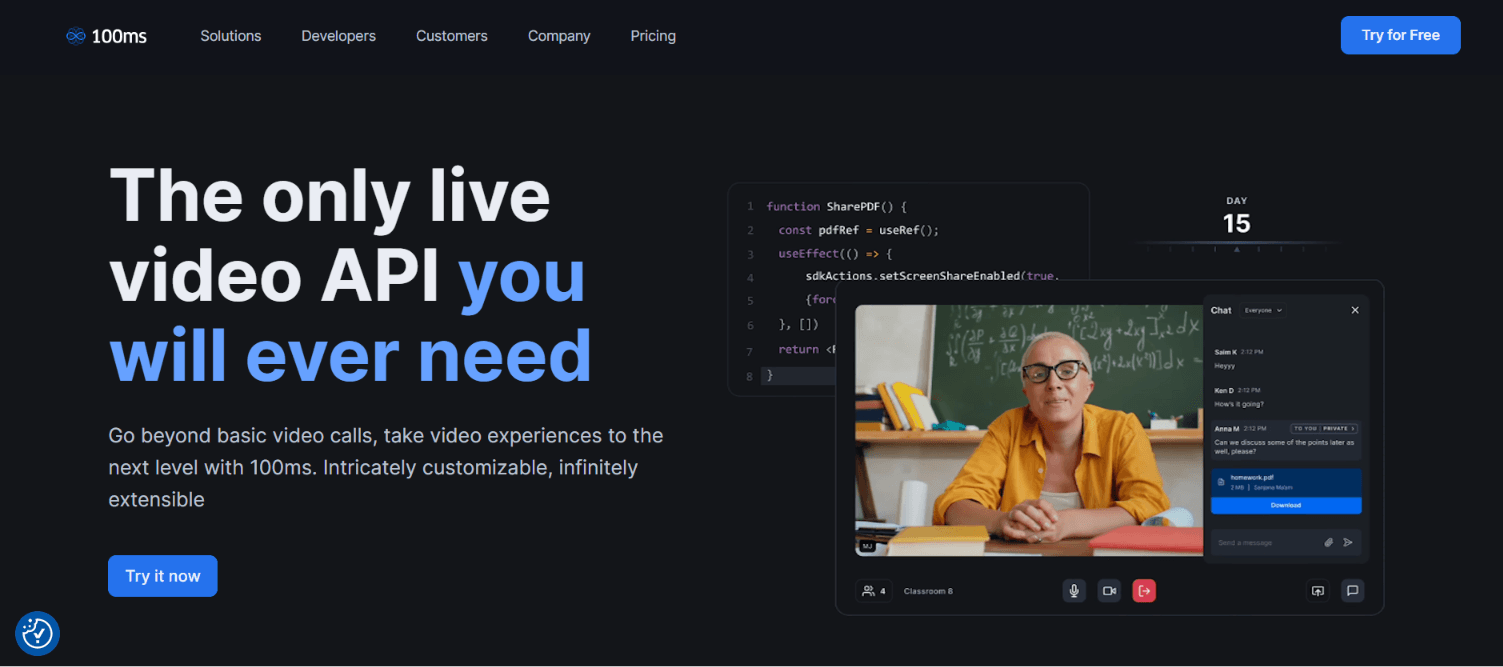
100ms packages WebRTC conferencing and HLS live streaming behind a role-based template system: define broadcaster and viewer roles in the dashboard, and participants move between them with a single role-change call. Its HLS mode delivers streams to large audiences with under 10 seconds of latency, and prebuilt UI links let teams go live without building a frontend.
Pricing: 10,000 free conferencing and streaming minutes per month, then conferencing at $0.004 per participant-minute, recording at $0.0135 per minute, and RTMP-out at $0.04 per minute, per the official 100ms pricing page.
Best for: Teams that want a conferencing-to-streaming pipeline (webinars, classrooms) with prebuilt UI and minimal configuration.
Limitation: Platform breadth is narrower than VideoSDK or Agora; there is no Unity, IoT, or C++ SDK for non-standard targets.
7. ZEGOCLOUD
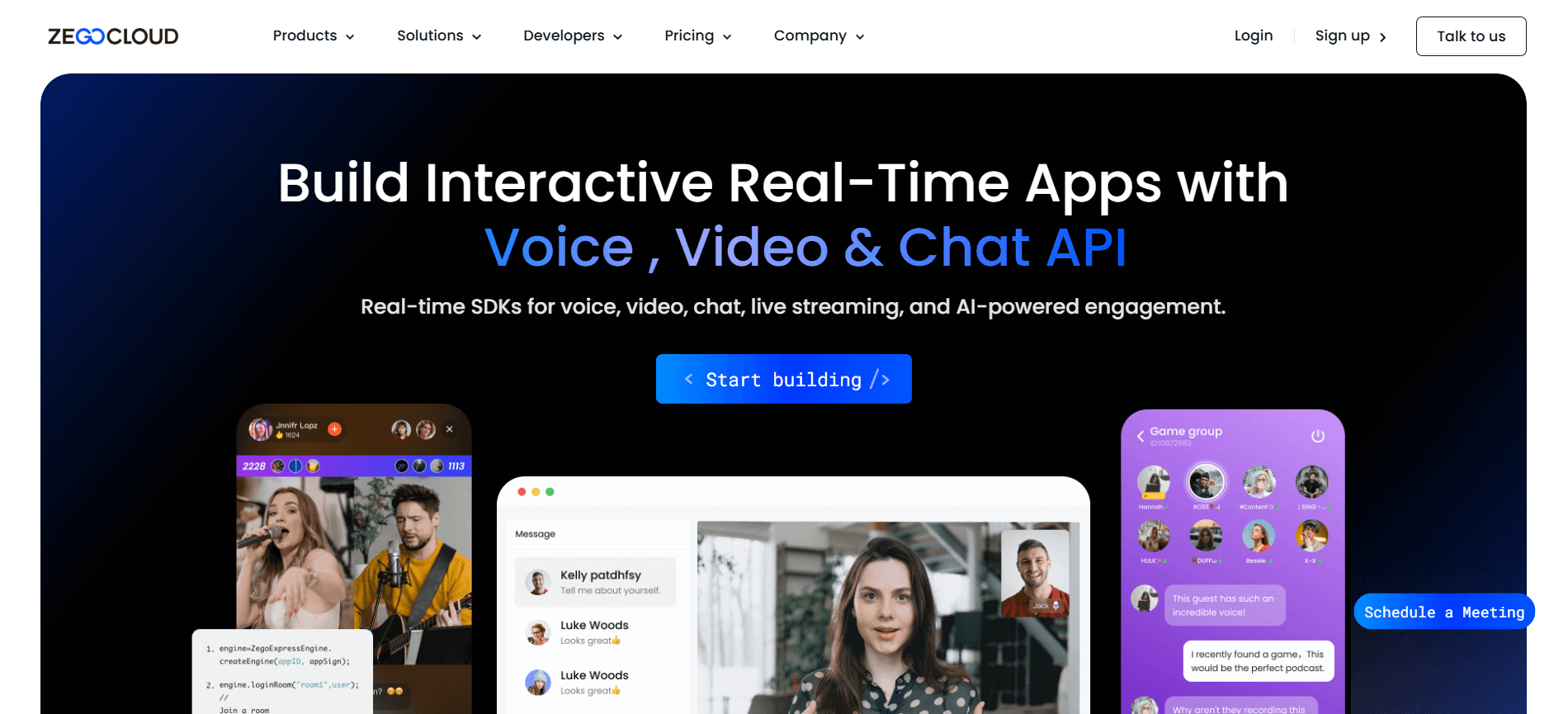
ZEGOCLOUD focuses on social and entertainment streaming, pairing its live streaming SDK with add-ons like AI beauty effects, avatars, virtual gifting hooks, and 20+ prebuilt UIKits. Its network spans over 500 edge nodes, with particular strength in APAC markets.
Pricing: 10,000 free minutes on signup. Hosts and co-hosts bill at RTC rates ($3.99 per 1,000 minutes at 720p), while audience minutes bill lower depending on delivery mode, from $2.29 per 1,000 minutes on the streaming tier per ZEGOCLOUD's pricing documentation, with cheaper CDN-delivery rates for passive viewing.
Best for: Social apps (live rooms, dating, entertainment) where effects, avatars, and gifting mechanics matter as much as transport.
Limitation: Documentation and billing conventions (stream-based vs user-based minute counting) take more effort to model than flat participant-minute pricing.
8. api.video
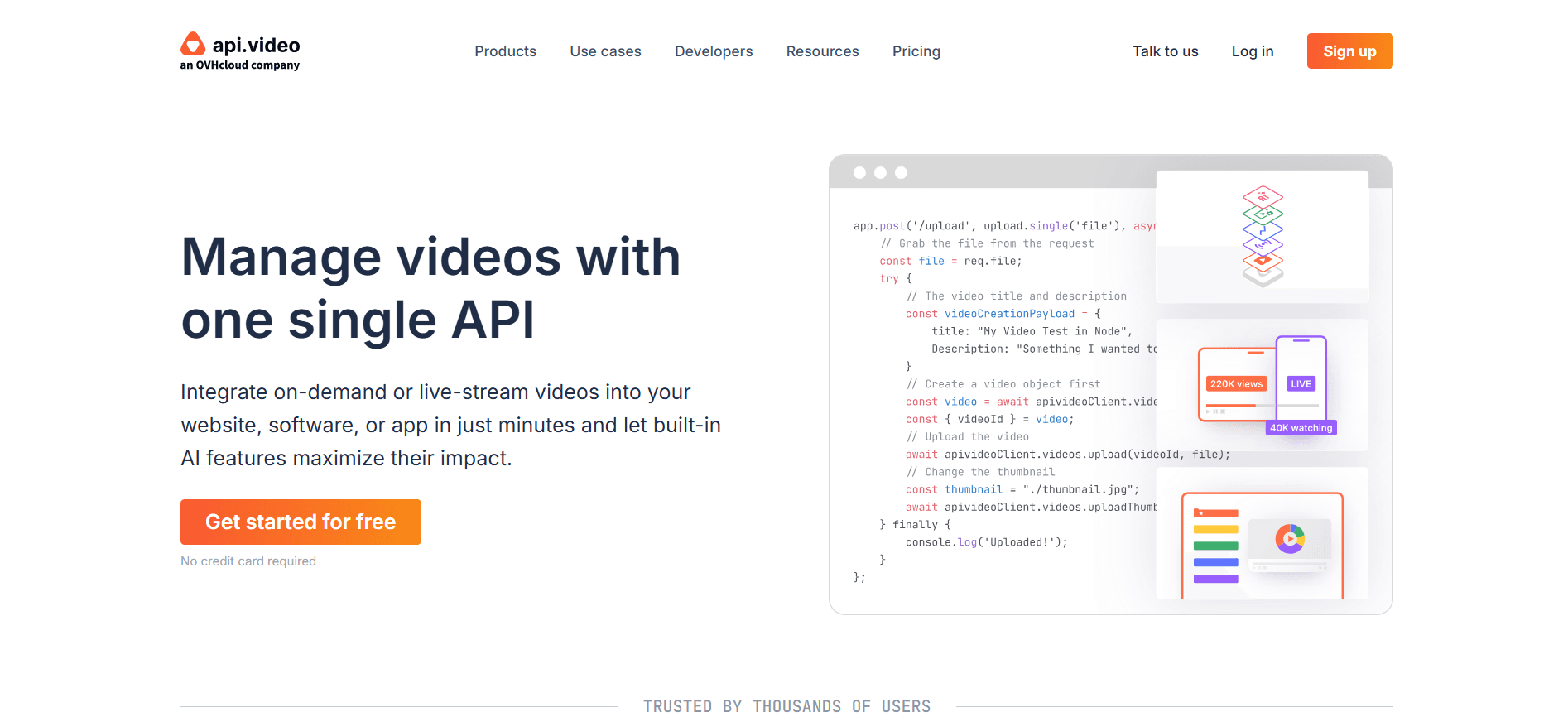
api.video combines live streaming and video hosting behind one deliberately minimal API: create a live stream object, ingest over RTMPS or SRT, and deliver with about 3 seconds of latency under good conditions. Delivered minutes bill at the same rate regardless of quality tier, which simplifies forecasting.
Pricing: A free sandbox environment for development, then usage-based billing on minutes delivered and stored, with add-ons like transcription at $0.10 per minute.
Best for: Products that need both live streams and an on-demand video library through one simple API.
Limitation: No WebRTC delivery mode and a smaller feature surface for interactivity (no role switching or in-stream co-hosting).
9. Dacast
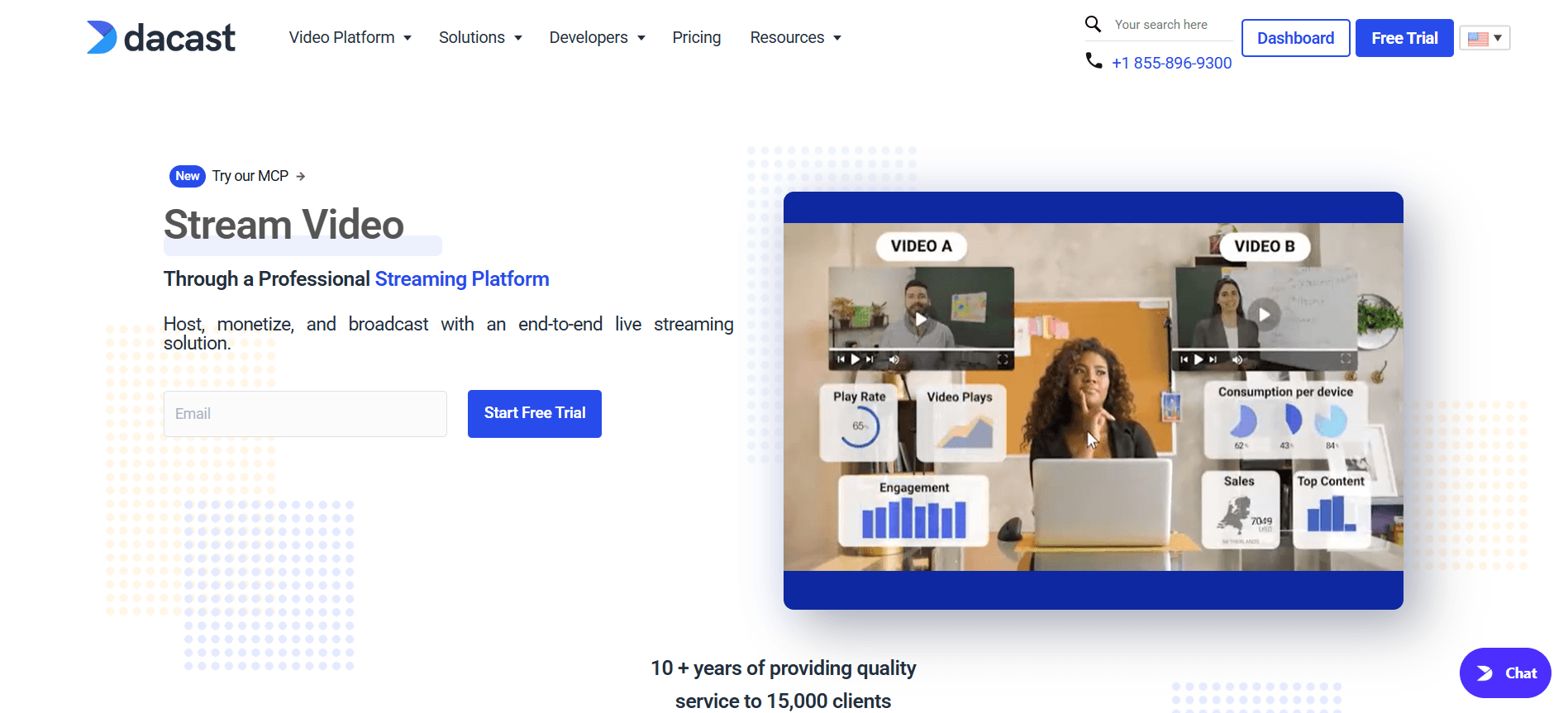
Dacast is a broadcaster-oriented streaming platform with an API layer rather than a developer-first SDK platform. Its strengths are white-label delivery, security controls, and built-in monetization: paywalls, subscriptions, and ad insertion ship out of the box, which none of the developer-first APIs on this list include natively.
Pricing: Subscription-based, with plans starting around $39 per month billed annually, including bandwidth and storage allowances that scale by tier.
Best for: Media companies and event broadcasters that need to monetize streams directly and prefer predictable subscription billing.
Limitation: Deep in-app integration (custom UI, roles, interactivity) is limited compared to SDK-first platforms; Dacast is a platform you embed, not infrastructure you build on.
10. Wowza
Wowza is the veteran infrastructure option, offering both Wowza Flowplayer OVP and Wowza Streaming Engine (self-hosted server software). It supports the widest protocol surface on this list (HLS, RTMP, SRT, WebRTC, and MPEG-DASH) and serves teams with compliance, on-premise, or protocol-level requirements that managed clouds cannot meet.
Pricing: TheWowza Streaming Engine is priced per server instance: a one-month of streaming plan at $295 (one-time, first instance included) or basic monthly at $195 per month, each covering up to 10 concurrent transcoded channels, with additional channels at $25 each and custom enterprise annual plans.
Best for: Broadcasters, government, defense, and enterprises that need full pipeline control or hybrid on-premise deployment.
Limitation: Configuration depth means longer integration time; teams without streaming expertise will ship faster on a managed API.
Live Streaming API Comparison Table
| Provider | Best For | Typical Latency | Pricing Model | Free Tier |
|---|---|---|---|---|
| VideoSDK | Interactive streaming + full RTC stack | Under 1s (WebRTC ILS) | Pay-as-you-go per participant/viewer minute | One-time $20 credit, no card |
| Agora | Global ultra-scale interactive broadcast | Under 1s (SD-RTN) | Per 1,000 minutes by resolution | 10,000 min/month |
| Mux | Developer-first HLS broadcast + VOD | 4 to 7s (LL-HLS), 20s+ (HLS) | Per minute encoded/stored/delivered | 100,000 delivery min/month |
| Amazon IVS | Twitch-grade scale on AWS | 3 to 5s (low-latency HLS) | Input/output hours or participant-hours | 5h input + 100h SD output/month |
| LiveKit | Open-source, self-hosted WebRTC | Under 1s (WebRTC) | Free self-host; Cloud tiers $0 to $500/mo | 5,000 participant min/month (Cloud) |
| 100ms | Conferencing-to-HLS with prebuilt UI | Under 10s (HLS) | Per minute by feature | 10,000 min/month |
| ZEGOCLOUD | Social and entertainment streaming | Under 1s (RTC) | Per 1,000 minutes by role and mode | 10,000 min on signup |
| api.video | Combined live + on-demand hosting | ~3s | Per minute delivered | Free sandbox |
| Dacast | Monetized broadcast for media teams | 10s+ (HLS) | Subscription from ~$39/month | 14-day trial |
| Wowza | On-premise and protocol-level control | Varies by protocol | Per server instance: $295 one-time or $195/mo | Trial available |
All pricing is verified against official pricing pages as of August 2026.
What Changed in the Live Streaming API Market
Two shifts since 2024 make older "best live streaming API" lists unreliable, and they explain why several familiar names are absent from this ranking.
Dolby.io became Dolby OptiView. Dolby merged its Millicast real-time streaming service with THEOlive into Dolby OptiView, a platform now aimed primarily at sports, media, and betting enterprises rather than general app developers, which is why it no longer fits a developer-first API ranking.
Dyte became Cloudflare RealtimeKit. After Cloudflare's acquisition, Dyte's SDK re-emerged as Cloudflare RealtimeKit, currently in beta at no cost with published GA pricing of $0.002 per audio/video participant minute. Worth watching, but not yet production-proven at GA.
The practical lesson: verify a provider's roadmap and ownership before committing, because streaming infrastructure has consolidated quickly.
How to Choose the Best Live Streaming API
Selecting a live streaming API comes down to five decisions, in this order:
- Fix your latency requirement first. If viewers interact with the stream (bidding, answering, co-hosting), you need a WebRTC-based API like VideoSDK, Agora, or LiveKit with sub-second latency. If viewers only watch, HLS platforms like Mux or Amazon IVS cost less at scale.
- Estimate your audience shape. Fifty interactive participants and 50,000 passive viewers are different products. Some platforms (VideoSDK, 100ms, Amazon IVS) support both modes; pure-HLS platforms do not.
- Match SDK coverage to your roadmap. If Flutter, React Native, or Unity is on your roadmap, confirm native SDK support now. VideoSDK and Agora have the widest coverage; broadcast-first platforms are thinner on mobile.
- Model total cost with your real numbers. Multiply expected host minutes, viewer minutes, and recording minutes against each rate card. Free tiers ($20 credit on VideoSDK, 10,000 monthly minutes on Agora, ZEGOCLOUD, and 100ms) cover evaluation, not production.
- Check the exit paths. Prefer providers with RTMP output (for simulcasting) and standard protocols, so you can add or switch delivery layers without re-architecting.
Live Streaming Infrastructure Definitions
WebRTC: An open standard for real-time media transport in browsers and apps, delivering latency under 500 milliseconds. VideoSDK, Agora, and LiveKit deliver interactive streams over WebRTC.
RTMP: Real-Time Messaging Protocol, the standard for pushing a broadcast feed from encoders like OBS into an ingest server. Most HLS platforms and VideoSDK's simulcast output use RTMP.
HLS: HTTP Live Streaming, Apple's segment-based delivery protocol that scales to millions of viewers over standard CDNs at 10 to 30 seconds of latency; LL-HLS variants reduce this to roughly 3 to 7 seconds.
SRT: Secure Reliable Transport, an ingest protocol that outperforms RTMP on unstable networks; supported by Mux, api.video, and Wowza.
Adaptive Bitrate Streaming (ABR): Automatic switching between quality renditions based on each viewer's bandwidth. VideoSDK implements this as network-adaptive streaming on WebRTC streams.
Interactive Live Streaming (ILS): VideoSDK's sub-second streaming mode where viewers can chat, vote, and be promoted to co-hosts through a single mode change, unlike one-way HLS broadcasts.
Key Takeaways
- Your latency requirement is the first filter: interactive products need a WebRTC-based live streaming API, while large passive audiences are cheaper to serve over HLS.
- VideoSDK is the strongest option for interactive live streaming because it combines sub-second latency, viewer-to-co-host role switching, and the broadest SDK coverage (10+ platforms) on one billing model.
- Mux and Amazon IVS lead one-to-many broadcasting, with verified free tiers of 100,000 delivery minutes and 100 SD output hours per month respectively.
- The market consolidated fast: Twilio Video was discontinued, Dolby.io became Dolby OptiView, and Dyte became Cloudflare RealtimeKit, so recency matters when comparing providers.
- Model costs with your own host, viewer, and recording minutes rather than comparing headline rates, because billing dimensions differ more than prices do.
Conclusion
Integrating live video no longer requires a media engineering team. A live streaming API handles ingest, transcoding, and delivery so you can focus on the product around the stream. Start from your latency requirement: choose VideoSDK for interactive, sub-second streaming across web and mobile, and an HLS platform like Amazon IVS for massive one-way broadcasts. You can test VideoSDK's interactive live streaming with the one-time $20 free credit at app.videosdk.live/login, no credit card required.
Frequently Asked Questions
Is there a free API for live streaming?
Yes, several live streaming APIs include free usage. VideoSDK gives every new account a one-time $20 credit with no credit card required; Agora, ZEGOCLOUD, and 100ms each include 10,000 free minutes per month, and Mux includes 100,000 free delivery minutes monthly. These allowances cover prototyping and early testing, not production traffic.
What is the difference between WebRTC and RTMP?
The main difference is direction and latency. WebRTC delivers media to and from viewers in under 500 milliseconds, which enables two-way interaction. RTMP is an ingest protocol: it pushes a broadcast feed into a server, which then delivers it to viewers over HLS at 3 to 30 seconds of latency but with far greater one-way scale.
What is the difference between interactive live streaming and HLS?
Interactive live streaming (ILS) runs over WebRTC with sub-second latency, so viewers can respond in real time and be promoted to speakers. HLS is a one-way, CDN-delivered protocol with 10 to 30 seconds of delay. VideoSDK implements ILS natively and can simultaneously push an RTMP feed out for HLS-based platforms, giving one stream both behaviors.
How much does a live streaming API cost?
Live streaming API costs are usage-based on most platforms. Representative verified rates in 2026: VideoSDK video from $0.004 per participant-minute, Agora HD video at $3.99 per 1,000 minutes, 100ms conferencing at $0.004 per minute, and Amazon IVS billing on input and output hours. At scale, HLS delivery is cheaper per passive viewer, while WebRTC pricing scales with interactive participation.
Can I broadcast to YouTube and Twitch using a live streaming API?
Yes, through simulcasting via RTMP output. VideoSDK, Mux, 100ms, and LiveKit can push a stream to external RTMP destinations like YouTube and Twitch while it runs, with Mux charging $0.020 per minute per simulcast target and 100ms charging $0.04 per minute for RTMP-out.
How long does it take to integrate a live streaming API?
Integration typically takes hours to days rather than the months an in-house pipeline requires. Prebuilt options are fastest: VideoSDK's Prebuilt UI Kit and 100ms's prebuilt links embed a working stream interface without custom UI code, while a fully custom UI on any SDK on this list is usually a one-to-two-sprint effort.
Which live streaming API is best for mobile apps?
The best live streaming API for mobile apps is one with native SDKs for every platform you target. VideoSDK covers iOS, Android, React Native, and Flutter (plus Unity and IoT), and Agora and ZEGOCLOUD offer similarly broad mobile coverage. Broadcast-first platforms like Mux and api.video handle mobile playback well but rely on RTMP ingest rather than in-app WebRTC broadcasting.