


API communication is the process by which software applications exchange data over a network using defined protocols and contracts. A client sends a structured request to a server endpoint, the server processes it, and returns a response containing data or an error code. VideoSDK uses this same client-server model to power real-time video and audio calling through its REST APIs and platform SDKs.
Every modern application you build depends on API communication. When your frontend fetches user data, when your mobile app streams video, when your backend talks to a payment processor, an API conversation is happening behind the scenes. Understanding how that conversation works at every layer gives you the ability to debug faster, design better systems, and avoid the pitfalls that catch developers in production.
This article walks through the full API request lifecycle from DNS resolution to response handling, compares the major API protocols, and covers the security and reliability patterns that separate production-grade integrations from prototypes. By the end, you will have a complete mental model of API communication and how to apply it whether you are building a simple CRUD app or embedding real-time video calling with VideoSDK.
What Is API Communication? How It Works
API communication is defined as the exchange of data between two software systems using a defined interface, protocol, and contract. The contract specifies what data the client can request, how the request must be formatted, and what the server will return. Without this contract, every integration would require custom negotiation, and interoperability would collapse.
API communication works by following a request-response cycle. The client constructs a message according to the agreed protocol (typically HTTP), sends it to a specific network address called the endpoint, and waits for the server to process the request and return a response. The response includes a status code indicating success or failure, optional headers with metadata, and a body containing the requested data or an error description.
When developers search for api communication how it work, they are usually looking for this end-to-end picture: what happens between the moment your code calls an API and the moment data arrives back. VideoSDK provides API communication through its REST API reference for room management and its SDKs for real-time media delivery, both of which follow the same fundamental request-response patterns described here.
The Client-Server Model
Every API conversation involves two roles: the client and the server. The client initiates the communication by sending a request. The server listens for incoming requests, processes them according to its business logic, and sends back a response. This separation of concerns is what makes APIs composable and scalable.
The client can be a web browser, a mobile app, a backend service, or even an IoT device. The server can be a monolithic application, a microservice, or a managed cloud platform like VideoSDK. What matters is that both sides agree on the protocol and data format before communication begins. In real-time communication platforms like VideoSDK, the client-server model extends to include a media server (SFU) that routes audio and video streams between participants, adding a real-time layer on top of standard HTTP API communication.
Step-by-Step API Request Lifecycle
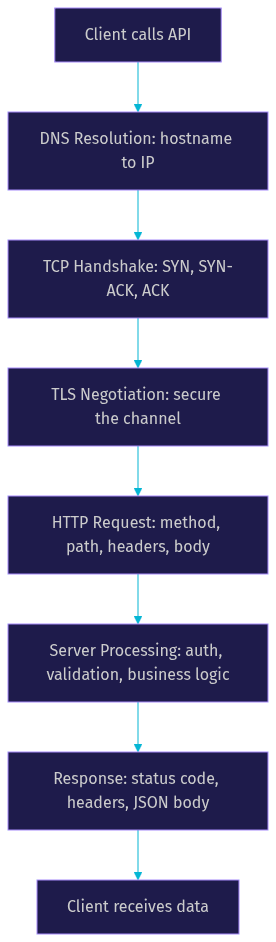
Understanding the API request lifecycle means tracing a single request from the moment your application decides to call an API to the moment it receives a complete response. Each step in this lifecycle has its own protocol, potential failure modes, and debugging strategies. Let us walk through all six steps.
Step 1: DNS Resolution
Before your application can send any HTTP request, it needs to know where the server lives on the network. Humans type domain names like api.videosdk.live, but network routing requires IP addresses. DNS resolution is the process of translating a human-readable hostname into a numeric IP address.
Your application typically asks the operating system resolver, which queries a recursive DNS server, which in turn queries authoritative name servers for the domain. The result is an IP address that your application can use to establish a network connection. DNS resolution usually takes between 10 and 100 milliseconds, but caching at multiple levels (browser, OS, ISP) means repeat lookups are nearly instant. DNS failures manifest as connection errors before any HTTP traffic is sent, which is why checking DNS is step one in any API debugging workflow.
Step 2: TCP Handshake
Once your application has the server's IP address, it establishes a TCP connection. TCP is a reliable, ordered transport protocol that guarantees packets arrive intact and in sequence. The connection is established through a three-way handshake.
First, the client sends a SYN (synchronize) packet to the server. The server responds with a SYN-ACK (synchronize-acknowledge) packet. The client sends a final ACK (acknowledge) packet, and the connection is open. This exchange adds one round trip of latency before any application data can flow. For API calls over HTTPS, this TCP connection is reused across multiple requests through keep-alive mechanisms, which is why connection pooling matters for performance. According to the IETF TCP specification (RFC 9293), this handshake has been the foundation of internet communication for decades.
Step 3: TLS Negotiation
After TCP is established, the client and server perform a TLS handshake to secure the channel. TLS encrypts all subsequent traffic, preventing eavesdropping and tampering. The negotiation involves the client sending its supported cipher suites, the server responding with its certificate and chosen cipher, and both sides deriving shared encryption keys.
Modern TLS 1.3 reduces this to a single round trip, compared to two round trips in TLS 1.2. This matters for API performance because every new connection pays this cost. VideoSDK enforces TLS for all API communication, ensuring that authentication tokens and media signaling remain encrypted in transit. If TLS negotiation fails, you will see certificate errors or handshake failures, which typically indicate an expired certificate, a mismatched hostname, or an unsupported protocol version.
Step 4: HTTP Request Construction
With a secure channel open, the client constructs the actual HTTP request. An HTTP request contains four key components: the method, the endpoint path, headers, and an optional body. The MDN Web Docs HTTP overview provides a thorough reference for these components.
The method (GET, POST, PUT, PATCH, DELETE) tells the server what action the client wants to perform. The endpoint path identifies the specific resource, such as a room ID in VideoSDK's API. Headers carry metadata like authentication tokens, content type, and client identifiers. The body, present in POST and PUT requests, contains the data payload, typically formatted as JSON. For example, when creating a VideoSDK room, the request body includes parameters like room name and webhook URL, sent as a JSON object to the rooms endpoint.
Step 5: Server Processing
When the server receives the request, it runs through several processing stages. First, it validates the authentication token to confirm the caller is authorized. Then it parses and validates the request body against expected schemas. Business logic executes next, which may involve database queries, calls to other services, or media server operations.
For VideoSDK, server processing might include creating a room record, allocating media server resources, and generating a meeting token. The processing time depends on the complexity of the operation. Simple read operations may complete in under 10 milliseconds, while complex operations involving external service calls may take hundreds of milliseconds. Server-side logging and observability tools help you trace where time is spent during this phase.
Step 6: Response Generation
After processing completes, the server constructs an HTTP response and sends it back through the same TLS-encrypted TCP connection. The response includes a status code, response headers, and a response body.
Status codes follow a standard convention: 200-level codes indicate success, 400-level codes indicate client errors (bad request, unauthorized, not found), and 500-level codes indicate server errors. The response body typically contains the requested data as JSON, or an error message explaining what went wrong. VideoSDK APIs return structured JSON responses with consistent error formats, making it straightforward to handle both success and failure cases in your application logic.
API Styles and Protocols
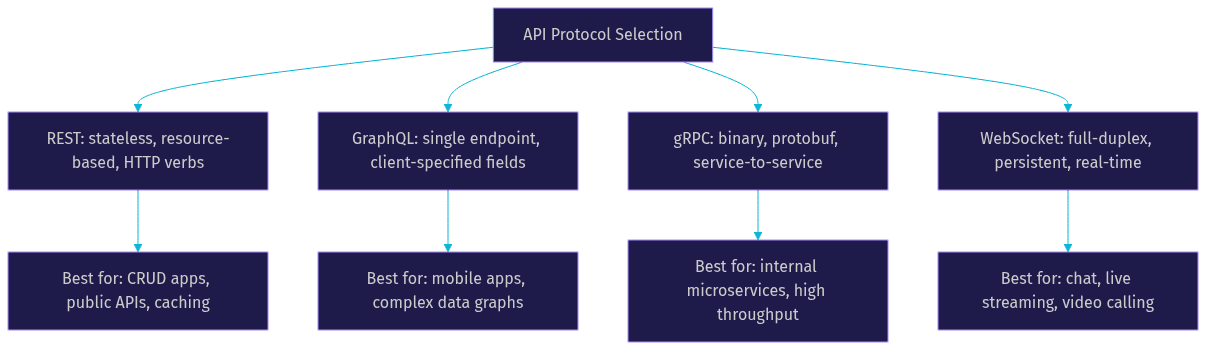
Not all API communication uses the same protocol or pattern. The style you choose affects performance, developer experience, and the types of use cases you can support. Here is how the four most common API styles compare.
REST APIs
REST (Representational State Transfer) is the most widely used API style. REST APIs are stateless, meaning each request contains all the information the server needs to process it. Resources are identified by URLs, and standard HTTP verbs (GET, POST, PUT, DELETE) map to CRUD operations. REST is simple to understand, cacheable, and works well for most web and mobile applications. VideoSDK's REST API reference follows REST conventions for room management, recording control, and session analytics.
GraphQL
GraphQL gives clients the ability to query exactly the fields they need from a single endpoint. Instead of making multiple REST calls to fetch related data, a client sends one query and receives a precisely shaped response. This reduces over-fetching and under-fetching, which is especially valuable for mobile apps with limited bandwidth. The tradeoff is that GraphQL requires a schema definition layer and more complex server-side caching.
gRPC
gRPC is a binary protocol that uses Protocol Buffers (protobuf) for message serialization. It is significantly faster than REST for internal service-to-service communication because binary encoding is more compact than JSON. gRPC supports bidirectional streaming, making it suitable for real-time data pipelines. However, browser support requires a proxy layer, which limits its use in frontend applications. Many backend teams use gRPC internally and expose REST or GraphQL at the edge.
WebSocket APIs
WebSocket APIs enable full-duplex, persistent communication over a single TCP connection. Unlike HTTP's request-response model, WebSockets allow the server to push data to the client without waiting for a request. This is essential for real-time applications like chat, live dashboards, and video calling. VideoSDK uses WebSockets and WebRTC for its real-time communication layer, where low-latency media streaming and signaling require continuous bidirectional communication rather than discrete HTTP requests. The W3C WebRTC specification defines how this real-time layer operates alongside standard web protocols.
Security and Authentication in API Communication
Securing API communication is not optional. Every request that crosses a network boundary is a potential attack surface, and the authentication layer is your first line of defense.
TLS encryption protects data in transit, but authentication confirms who is making the request. The most common authentication methods include API keys for simple service identification, OAuth 2.0 for delegated access on behalf of users, and JWT (JSON Web Tokens) for stateless token-based authentication. VideoSDK uses token-based authentication where you generate a JWT server-side using your API key and secret, then pass that token to the SDK on the client. This pattern keeps your secret secure on the server while giving the client a time-limited token for room access. You can read more in the VideoSDK authentication guide.
Beyond authentication, API security best practices include using the principle of least privilege for token scopes, setting short token expiration times, validating all input on the server, and using CORS policies to restrict which origins can call your API from browsers. Never expose API secrets in frontend code or client-side repositories.
Reliability and Performance Patterns
Production API communication requires more than just sending requests and reading responses. Systems fail, networks degrade, and traffic spikes. The following patterns help you build resilient API integrations.
Caching reduces latency and server load by storing responses that are unlikely to change. HTTP caching headers (Cache-Control, ETag) let clients and CDNs serve repeated requests without hitting your server. Retries handle transient failures, but they must use exponential backoff to avoid overwhelming the server during outages. Idempotency keys ensure that retried requests do not cause duplicate side effects, which is critical for payment and booking operations.
Rate limiting protects your API from abuse and ensures fair resource allocation. VideoSDK enforces rate limits on its REST APIs to maintain platform stability. Circuit breakers stop your application from repeatedly calling a failing service, allowing it to recover before retrying. Together, these patterns form the backbone of API reliability. For a deeper dive into real-time communication reliability, the VideoSDK React SDK documentation covers network-adaptive streaming and automatic reconnection handling.
Best-Practice Checklist for API Communication
Here is a concise checklist to guide your API integration work:
- Always use HTTPS with TLS 1.2 or higher for all API traffic
- Generate authentication tokens server-side and never expose secrets in client code
- Set reasonable timeouts on every API call (typically 5 to 30 seconds depending on the operation)
- Implement exponential backoff with jitter for retry logic
- Use idempotency keys for any operation that creates or modifies state
- Validate and sanitize all request inputs on the server before processing
- Cache responses where possible using HTTP caching headers
- Monitor API latency and error rates with structured logging and dashboards
- Version your APIs explicitly through URL paths or headers to manage breaking changes
- Document your API contract with clear examples and error code references
- Use CORS policies to restrict browser-based access to trusted origins only
- Plan for rate limits by implementing client-side throttling and queue management
Definitions Glossary
API Endpoint: A specific URL where an API receives requests. Each endpoint corresponds to a resource or operation, such as creating a room or fetching a recording in VideoSDK.
TLS Handshake: The negotiation process where client and server exchange cryptographic keys and agree on a cipher suite to encrypt all subsequent communication.
TCP Three-Way Handshake: The SYN, SYN-ACK, ACK exchange that establishes a reliable TCP connection between client and server before application data is sent.
Idempotency: A property where executing the same API request multiple times produces the same result as executing it once. Critical for safe retries in payment and booking flows.
Rate Limiting: A server-side mechanism that restricts the number of API requests a client can make within a time window, protecting the server from abuse and ensuring fair usage.
WebSocket: A communication protocol that provides full-duplex, persistent connections over a single TCP channel, enabling real-time bidirectional data flow between client and server.
REST (Representational State Transfer): An architectural style for APIs where resources are identified by URLs and operations are mapped to standard HTTP verbs, with each request being stateless.
Key Takeaways
- API communication follows a six-step lifecycle: DNS resolution, TCP handshake, TLS negotiation, HTTP request construction, server processing, and response generation.
- The client-server model underpins all API communication, with the client initiating requests and the server processing and responding.
- REST, GraphQL, gRPC, and WebSocket each serve different use cases, from simple CRUD operations to full-duplex real-time streaming.
- Security requires TLS encryption plus token-based authentication, with secrets kept server-side and tokens scoped and time-limited.
- Reliability patterns including caching, retries with backoff, idempotency, rate limiting, and circuit breakers are essential for production-grade API integrations.
- VideoSDK applies these same API communication principles across its REST APIs and real-time SDKs, providing a practical reference implementation for developers building communication features.
Conclusion
API communication is the backbone of every modern application, from simple data fetches to real-time video calling platforms. By understanding the full request lifecycle, choosing the right protocol for your use case, and implementing security and reliability patterns from day one, you can build integrations that perform well under load and fail gracefully under stress. The same principles that govern a basic REST call apply to sophisticated platforms like VideoSDK, where REST APIs manage rooms and WebRTC handles real-time media delivery. If you are ready to put these concepts into practice, sign up for a free VideoSDK account and start building. What are you building with APIs? Drop a comment below, I would love to hear what kind of communication use case you are working on.
Free $20 Balance for AI Voice Agents & Video Calls
FAQ