


A HIPAA compliant video conferencing solution is a real-time communication platform that meets the security and privacy standards required for handling Protected Health Information (PHI). This includes end-to-end encryption, strict access controls, audit logging, and a signed Business Associate Agreement (BAA). VideoSDK provides a HIPAA-ready video API with built-in encryption and recording controls to help developers build secure telehealth applications.
Telehealth adoption has surged over the past few years, transforming how healthcare providers deliver care and how patients access medical expertise. However, this rapid digital shift has introduced significant security challenges that development teams must solve. Healthcare applications handle highly sensitive patient data, making them prime targets for cyberattacks and data breaches. Developers building these platforms must implement a HIPAA compliant video conferencing solution to ensure patient consultations remain private, secure, and legally protected. Failing to meet these standards can result in severe financial penalties, legal action, and a devastating loss of patient trust. This article breaks down the technical and legal requirements for HIPAA compliance, compares leading video SDKs, and outlines implementation best practices. By the end, you will have a clear framework for building a secure healthcare video platform with VideoSDK.
What Makes a Video Conferencing Solution HIPAA-Compliant?
Core HIPAA Requirements for Video
A video conferencing solution is considered HIPAA-compliant when it satisfies the administrative, physical, and technical safeguards defined by the Health Insurance Portability and Accountability Act. The core requirements include encrypting Protected Health Information (PHI) both in transit and at rest. Developers must enforce strict access controls to limit who can join or view sessions, ensuring only authorized providers and patients can interact. Maintaining detailed audit logs of all session activity is mandatory for tracking potential breaches and verifying compliance during audits. Crucially, the video infrastructure vendor must be willing to sign a Business Associate Agreement (BAA). This legal document binds the vendor to safeguard PHI on behalf of the covered healthcare entity, transferring a portion of the compliance liability to the platform provider.
Technical Controls Specific to Video
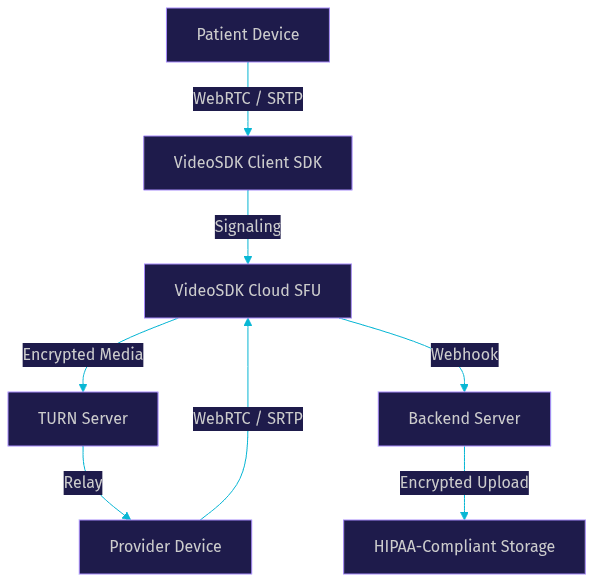
Beyond administrative rules, developers must enforce specific technical controls to build a HIPAA compliant video conferencing solution. Secure Real-time Transport Protocol (SRTP) with DTLS-SRTP key exchange is mandatory for encrypting media streams as they travel between peers. The platform should use AES-256 encryption for any stored data, including session recordings and chat transcripts. If media must traverse restrictive hospital networks, TURN servers must also be secured and compliant. A true HIPAA-ready platform will avoid storing media on unencrypted intermediary servers. It should also offer end-to-end encryption (E2EE) where possible, ensuring only the communicating participants can decrypt the audio and video streams. VideoSDK handles these technical controls by providing encrypted media transmission by default, giving developers a compliant foundation to build upon.
Key Compliance Features to Evaluate
Encryption in Transit and at Rest
Evaluate whether the SDK enforces encryption at every layer of the communication stack. Media streams must use SRTP, while signaling channels should use TLS 1.2 or higher to prevent man-in-the-middle attacks. For any stored data, such as session recordings or chat transcripts, verify that the provider uses AES-256 encryption at rest. VideoSDK handles this by providing encrypted media transmission by default, ensuring that packet interception cannot expose PHI. Developers must also ensure that any local caching of session data on provider devices is encrypted or disabled entirely. This multi-layered encryption approach is non-negotiable for healthcare applications.
Business Associate Agreement (BAA) Process
A BAA is a legal contract that outlines how a vendor will protect PHI and what happens in the event of a data breach. Without a signed BAA, using a service for telehealth is a direct HIPAA violation, regardless of the platform's technical security features. Evaluate the vendor's willingness to sign a BAA and the speed of their legal process. Leading providers like VideoSDK offer BAAs to customers on qualifying plans, streamlining the compliance process for developers. Always secure the BAA before moving any patient data through the infrastructure to ensure legal coverage from day one of your deployment.
Audit Trails and Session Logging
HIPAA requires covered entities to track access to PHI, meaning your application must know exactly who accessed what and when. Your video solution must generate audit logs that capture participant join and leave times, session durations, and any recording events. These logs must be tamper-proof and easily exportable to a secure storage system. Developers should configure webhooks to capture these events in real-time and route them to a compliant logging service. VideoSDK provides session analytics and webhook events that make it straightforward to build a comprehensive audit trail, ensuring you can reconstruct any session's timeline during a compliance review.
Data Residency & Storage Policies
Depending on your state or institutional policies, you may need to guarantee that PHI never leaves a specific geographic region. Data residency laws can dictate where patient data is processed and stored. Evaluate whether the video infrastructure provider offers regional data routing and localized storage. VideoSDK allows developers to specify regions for media processing, helping enforce strict data residency requirements for telehealth deployments. This ensures that media servers processing the video call remain within the designated legal boundaries, preventing cross-border data transfer issues that could violate local healthcare regulations.
Comparing Leading HIPAA-Compliant Video Solutions
Evaluation Matrix
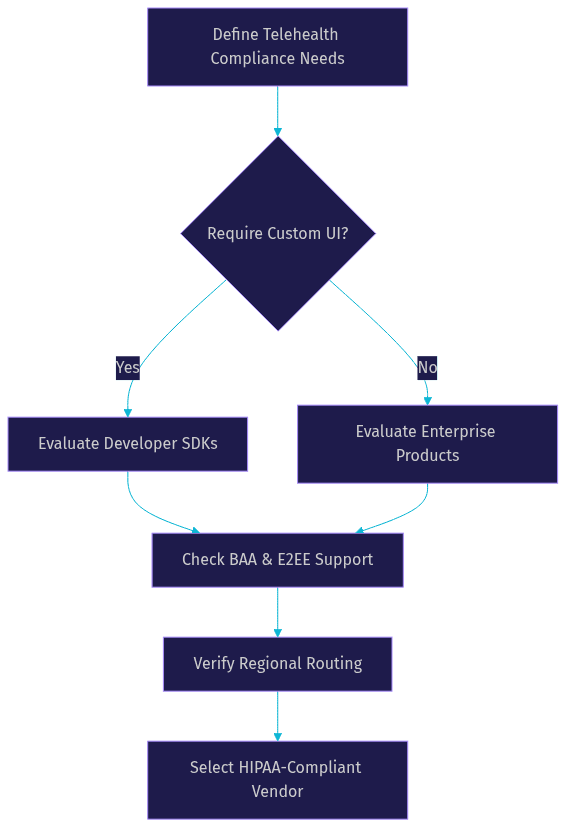
When selecting a HIPAA compliant video conferencing solution, developers should weigh encryption standards, BAA availability, recording controls, and regional routing capabilities. The table below compares several leading platforms to help you identify the right fit for your telehealth application.
| Provider | BAA Available | E2EE / SRTP | Regional Routing | Recording Controls |
|---|---|---|---|---|
| VideoSDK | Yes | Yes / Yes | Yes | Full API control |
| CometChat | Yes | Yes / Yes | Limited | API control |
| 100ms | Yes | Yes / Yes | Yes | API control |
| S10.AI | Yes | Yes / Yes | Yes | Built-in |
| GoTo Connect | Yes | No / Yes | No | UI-based |
VideoSDK stands out for developers who need granular API control over recording and regional routing while maintaining full HIPAA compliance. It provides the flexibility to build custom telehealth workflows without sacrificing security or performance.
Vendor Snapshots
VideoSDK offers a robust real-time communication API with sub-300ms latency, supporting React, Flutter, and iOS. It provides built-in E2EE and custom video tracks, making it highly adaptable for custom telehealth UIs. CometChat focuses heavily on chat and messaging with video add-ons, suitable for apps needing heavy text interaction alongside video. 100ms provides a good balance of prebuilt UI and custom SDKs, though its regional routing options are less granular than VideoSDK. S10.AI is tailored specifically for healthcare, offering built-in compliance tooling but less flexibility for custom app development. GoTo Connect is a ready-made enterprise product, better suited for internal hospital administration than embedded patient-facing applications.
Implementation Best Practices
Secure Token Generation & Authentication
Never expose API keys or secrets on the client side of your application. Generate meeting tokens on a secure backend server using your credentials. These tokens authenticate participants when they join a VideoSDK room. Implement role-based access control by defining permissions within the token, ensuring patients can only view and listen, while providers can prescribe and record. Authentication and Token Guide
Configuring TURN/STUN and Media Relays
Firewalls in hospital networks often block direct WebRTC connections, causing calls to fail. Configure secure TURN servers to relay media when direct peer connections fail. Ensure your TURN servers are hosted in compliant data centers and require authentication. VideoSDK manages cloud proxy infrastructure that automatically handles firewall traversal without compromising encryption. This allows providers in restrictive network environments to connect seamlessly and securely.
Managing Recordings and Transcriptions Securely
If you record sessions for medical records, configure the recording to start only after explicit patient consent. Route the output directly to an encrypted cloud storage bucket, such as AWS S3 with server-side encryption enabled. VideoSDK allows you to trigger recordings via API and receive webhooks when the file is ready, enabling automated, secure transfer to your storage infrastructure. Recording Guide
Conducting Regular Penetration Tests
Compliance is not a one-time setup but an ongoing operational commitment. Regularly test your application for vulnerabilities. Conduct annual penetration tests focusing on token leakage, unauthorized recording access, and peer connection security. Document these tests and remediation efforts as part of your HIPAA compliance documentation.
Common Pitfalls and How to Avoid Them
Building a HIPAA compliant video conferencing solution comes with specific risks. Storing unencrypted recordings is a frequent violation. Always enforce AES-256 encryption on storage buckets and verify upload policies. Missing BAA signatures is another critical error. Do not route a single patient call through a vendor without a fully executed BAA. Over-permissive access controls can expose waiting rooms to unauthorized users. Use unique meeting IDs and waiting room features to lock down sessions. Finally, ignoring regional data-residency requirements can violate state laws. Always pin your media servers to the required geographic regions using VideoSDK's regional routing capabilities.
Future Trends in Secure Telehealth Video
The intersection of AI and telehealth is evolving rapidly. Real-time transcription with privacy safeguards is becoming standard, allowing providers to generate clinical notes without storing raw audio. AI-assisted note-taking under HIPAA requires processing transcripts locally or in zero-retention environments. Edge-based encryption and zero-trust networking are also gaining traction, ensuring media streams are decrypted only on the endpoint devices. VideoSDK is advancing these capabilities by integrating real-time transcription APIs that developers can deploy while maintaining strict PHI boundaries.
Definitions Glossary
Protected Health Information (PHI): Any identifiable health information transmitted or maintained in any form. A HIPAA compliant video conferencing solution must protect PHI during all video sessions.
Business Associate Agreement (BAA): A legal contract between a healthcare provider and a service provider, like VideoSDK, ensuring the vendor will safeguard PHI according to HIPAA rules.
SRTP (Secure Real-time Transport Protocol): A protocol used to encrypt audio and video media streams in real-time, essential for secure telehealth video delivery.
End-to-End Encryption (E2EE): A security measure where only the communicating users can read the data. VideoSDK supports E2EE to ensure intermediaries cannot access media streams.
TURN (Traversal Using Relays around NAT): A protocol used to relay media traffic when peer-to-peer connections are blocked by firewalls, crucial for hospital network environments.
Key Takeaways
- A HIPAA compliant video conferencing solution must enforce encryption in transit and at rest, alongside strict access controls.
- A signed Business Associate Agreement (BAA) is legally required before routing any patient data through a third-party video API.
- Developers should generate tokens server-side and use role-based access control to manage participant permissions securely.
- VideoSDK provides the necessary encryption, regional routing, and recording controls to build compliant telehealth applications.
- Regular penetration testing and secure storage configurations are required to maintain compliance over time.
Conclusion
Building a HIPAA compliant video conferencing solution requires a deep understanding of both legal requirements and technical controls. By prioritizing end-to-end encryption, securing a BAA, and implementing strict access and logging policies, developers can create safe telehealth experiences. Evaluate your options against the compliance matrix and leverage tools like VideoSDK to accelerate your development. Start your free trial today at app.videosdk.live/login and build secure healthcare video applications. What are you building with VideoSDK? Drop a comment below to share your telehealth use case.
FAQ