


Messaging protocols are the standardized rules that govern how real-time text, media, and presence data move between clients and servers. The major families in 2026 are XMPP (XML streams), Matrix (JSON over HTTPS with federation), MLS (a dedicated group key management layer), MIMI (cross-provider interoperability built on MLS), SimpleX (privacy-first transport), and RCS (carrier-backed rich messaging). Choosing among them depends on scale, federation needs, encryption requirements, and device constraints. For embedding real-time chat and calling, VideoSDK's communication SDKs handle the transport layer so you can focus on product features.
Real-time communication has quietly become the backbone of nearly every app people use daily. Chat, presence, group media sharing, and in-app calling are now expected features, not differentiators. But underneath every one of those experiences sits a decision most product teams make too casually: which messaging protocol carries the data.
That decision shapes everything downstream. It determines whether your users' messages are end-to-end encrypted by default, whether your platform can federate with other providers, how efficiently you can scale to large groups, and how much of the security and delivery plumbing you build yourself. A protocol mismatch discovered late is expensive to unwind.
The landscape in 2026 is more interesting than it has been in a decade. MLS (Messaging Layer Security) is maturing into the default answer for group encryption, MIMI is pushing carriers and app providers toward genuine cross-provider interoperability, and established players like XMPP and Matrix continue to evolve. This guide walks through each major protocol family, compares them side by side, and gives you a decision framework for your own product.
What Are Messaging Protocols?
A messaging protocol is a defined specification for how messages are structured, transmitted, secured, and acknowledged between participants in a real-time system. Every messaging protocol has to answer three core questions: what transport carries the data (TCP, HTTP, QUIC, or carrier signaling channels), how the payload is encoded (XML, JSON, or compact binary formats), and how the exchange is secured (transport encryption, end-to-end encryption, or both).
Beyond those fundamentals, protocols differ in architecture. Centralized designs route everything through one operator's servers. Federated designs let independent servers interoperate, like email. Decentralized designs go further and remove any single controlling authority. These architectural choices drive the biggest practical differences in security, scale, and governance.
XML-Based Messaging Protocols: XMPP
XMPP (Extensible Messaging and Presence Protocol) is the longest-lived open messaging standard still in wide use, and its longevity comes directly from its design.
History and Core Concepts
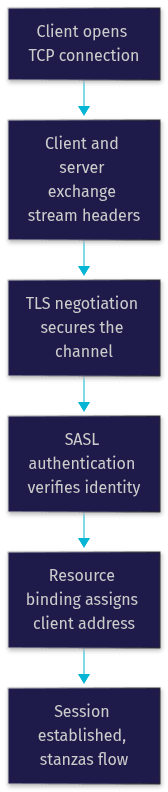
XMPP, originally named Jabber, was designed around XML streams. When a client connects to a server, the two sides open a long-lived XML stream and exchange structured fragments called stanzas. Three stanza types do most of the work: message stanzas carry content, presence stanzas broadcast availability, and IQ stanzas handle request-response queries such as roster retrieval.
The stanza model is what makes XMPP so extensible. Because every stanza is namespaced XML, new features can be added without breaking existing implementations. That extensibility is formalized in XEPs (XMPP Extension Protocols), a large catalog of community-maintained specifications covering everything from multi-user chat to file transfer.
The connection lifecycle itself follows a predictable negotiation sequence, which is worth understanding before you integrate:
Security and Extensibility
XMPP security is layered. TLS protects the transport channel, and SASL (Simple Authentication and Security Layer) handles authentication, supporting mechanisms from plain passwords to modern token-based schemes. For end-to-end encryption, the base protocol historically left this to extensions: OTR (Off-the-Record) messaging for one-to-one chats, and more recently XEP-0420 and OMEMO encryption, which brings multi-end encryption to group conversations using the Double Ratchet algorithm.
The practical takeaway is that XMPP gives you a strong, well-audited transport and authentication foundation, but end-to-end encryption is opt-in through extensions. You need to verify that both your client library and your server implementation support the specific XEPs your security model requires.
Typical Use Cases
XMPP remains a workhorse in three areas. First, classic instant messaging: large public networks and enterprise chat systems still run on it. Second, IoT: its lightweight streaming profile (XEP-0322) and publish-subscribe extensions suit device telemetry and command channels. Third, legacy interoperability: if you need to connect to systems built in the 2000s, XMPP support is often the only common denominator.
JSON/REST-Based Messaging Protocols: Matrix
Matrix takes a fundamentally different approach: instead of a dedicated binary or XML protocol, it models conversations as an eventually-consistent, replicated event graph synchronized over standard HTTPS with JSON payloads.
Federation Architecture
Matrix defines two API surfaces. The client-server API lets a user's client talk to their homeserver, sending and receiving events in rooms. The server-server (federation) API lets homeservers exchange room events with each other, so users on different servers can share the same room without any central authority. This is the same model email uses, applied to real-time chat.
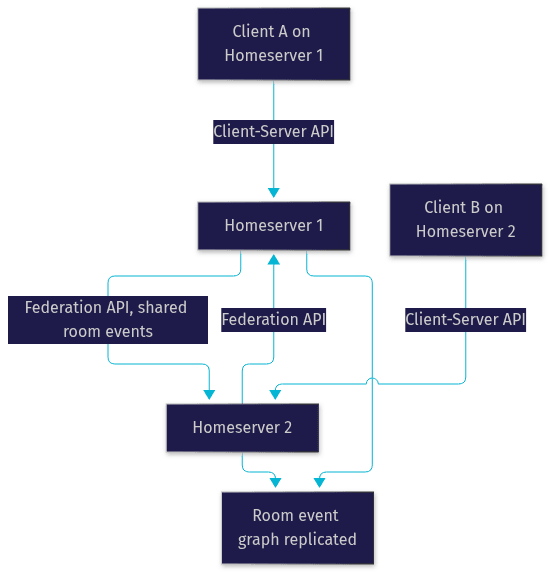
Because rooms are replicated event graphs, each participating server holds a copy of the conversation history, and clients receive updates as new events arrive. This design trades some implementation complexity for resilience and user sovereignty: no single operator owns the data.
End-to-End Encryption: Olm and Megolm
Matrix's native end-to-end encryption uses two related ratchet protocols. Olm handles one-to-one sessions with a Double Ratchet design similar to Signal's. Megolm extends this to groups by distributing a shared ratcheting key to room members, rotated periodically so older messages remain protected even if a key is later exposed. More recently, Matrix has been integrating MLS as an alternative group encryption layer, which addresses Megolm's scaling limits in very large rooms.
Real-World Deployments
Matrix is deployed by governments (including several European public administrations), the German armed forces, and large open-source communities. Its ecosystem of bridges is a standout feature: existing bridges connect Matrix rooms to IRC, Slack, Telegram, and XMPP, making it a practical hub for unifying disparate messaging systems under one client.
Group Key Management: MLS
MLS (Messaging Layer Security) deserves its own category because it is not a full messaging protocol. It is a dedicated, IETF-standardized group key management layer that other protocols can adopt.
Protocol Overview
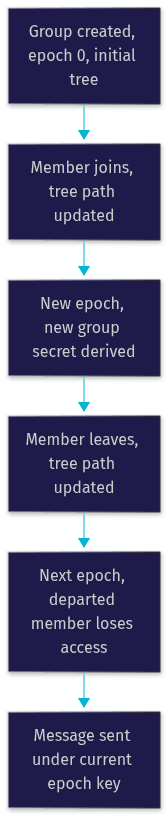
MLS solves the hardest problem in group encryption: keeping a shared encryption key consistent across dozens or hundreds of members as people join, leave, and their devices change. It does this with two core constructs. The key schedule derives a sequence of group secrets over time. The ratchet tree organizes members into a binary tree so that a membership change only requires updating the path from the changed leaf to the root, rather than rekeying every member individually.
Each membership change advances the group to a new epoch, and each epoch has fresh keys. This is what makes MLS scale: a group of a thousand members can handle a join or leave with logarithmic rather than linear work.
Forward Secrecy and Post-Compromise Security
MLS provides both forward secrecy (past messages stay safe if current keys are stolen) and post-compromise security (the group heals itself after a compromise, because future epochs derive fresh keys the attacker cannot compute). This combination, standardized through the IETF after years of cross-industry review involving contributors from Cisco, Mozilla, Wire, and others, is why MLS has become the reference design for large-group encryption.
Integration with Other Protocols
Because MLS is a layer, not a transport, it is being adopted across the ecosystem. Matrix is adding MLS as an alternative to Megolm. MIMI builds its entire security model on MLS. WhatsApp's large-group encryption and RCS's group chat extensions draw on the same architectural principles. If you are designing a new messaging system in 2026, MLS is the sensible default for the group security layer.
Emerging Interoperability: MIMI
MIMI (More Instant Messaging Interoperability) is an IETF effort with a goal that has eluded the industry for decades: making messages, and especially group chats, flow natively between different messaging providers.
Goals and Design
MIMI defines how providers interconnect using ordinary HTTPS transport between their servers, with MLS providing end-to-end encryption across provider boundaries. The design allows a group room to contain members from different apps, with the conversation encrypted end-to-end so no intermediate provider can read it. Policy and identity questions (who can join, how users are verified) are handled through a defined trust and policy framework rather than left to each provider ad hoc.
Comparison to Existing Standards
XMPP and Matrix both achieve federation, but only within their own ecosystems: an XMPP server federates with other XMPP servers, a Matrix homeserver with other homeservers. MIMI's ambition is different: it defines a common inter-provider layer so that a user on one proprietary app can be in the same encrypted group as a user on a completely different one. Where XMPP and Matrix solved federation for open networks, MIMI is solving interoperability for the closed networks where most users actually are. Regulatory pressure, particularly the EU's Digital Markets Act messaging interoperability provisions, has made MIMI's timeline concrete rather than theoretical.
Lightweight Secure Chat: SimpleX Chat Protocol
SimpleX Chat takes a contrarian position on identity: it removes user identifiers from the protocol entirely.
Message Formats
SimpleX uses a compact, layered message format. Messages are structured as JSON for readability, then compressed, with an optional binary encoding for efficiency on constrained links. The protocol runs over TCP and QUIC, with QUIC's lower connection overhead making it attractive for mobile networks.
Security Features
SimpleX's defining feature is that participants are identified only by one-time connection links, not persistent addresses. There is no user ID, no phone number, and no record linking your contacts to each other. On top of that, SimpleX has been an early adopter of post-quantum key agreement, adding PQ-safe algorithms to its handshake ahead of most mainstream protocols, and it uses per-queue encryption with sender signatures for integrity.
Niche Applications
This design suits privacy-critical applications, journalists and sources, whistleblowing platforms, and low-resource devices where a full XMPP or Matrix stack is too heavy. The trade-off is usability: identifier-free messaging complicates contact discovery and multi-device sync, which is why SimpleX remains a strong niche choice rather than a mass-market default.
Mobile-Centric Messaging: RCS
RCS (Rich Communication Services) is the carrier industry's upgrade to SMS, and it differs from everything above in one fundamental way: it rides on carrier signaling infrastructure rather than the open internet.
RCS delivers read receipts, typing indicators, high-resolution media sharing, and group chat over carrier channels, typically transported via SMPP or HTTPS gateways between carriers and messaging hubs. Encryption has historically been RCS's weak point, but the RCS Universal Profile's newer versions add end-to-end encryption for one-to-one chats, with group encryption extensions following the MLS-influenced key architecture. Adoption is uneven across carriers and regions, and fallback to SMS still occurs where RCS is unavailable, which makes RCS a strong channel for business-to-consumer messaging but a poor fit for apps that need guaranteed encryption or cross-platform control.
Comparison Table: Key Attributes of Major Messaging Protocols
[LINKABLE ASSET — comparison table]
| Protocol | Transport | Data Model | Encryption | Federation | Typical Use Cases |
|---|---|---|---|---|---|
| XMPP | TCP/TLS | XML stanzas | SASL/TLS, optional OMEMO | Yes | Chat, IoT, legacy systems |
| Matrix | HTTP/HTTPS | JSON events | Olm/Megolm, MLS optional | Yes | Decentralised chat, bridging |
| MLS | Any (layer) | Binary | Built-in E2EE | No (a layer) | Large-scale group encryption |
| SimpleX | TCP/QUIC | JSON/compressed | PQ-ready E2EE | No | Privacy-focused, low-resource apps |
| MIMI | HTTPS | Custom | MLS-based | Inter-provider | Cross-provider group rooms |
| RCS | SMPP/HTTPS | Binary/JSON | Carrier E2EE (optional) | No | Carrier and business messaging |
The most consequential row is MLS: it appears as the encryption foundation for both MIMI and next-generation Matrix, which means investing in MLS knowledge pays off across multiple protocol choices. Note also that only XMPP and Matrix offer true open federation today.
Choosing the Right Messaging Protocol for Your App
The right choice follows from five questions about your product, not from protocol popularity.
- Scale of groups. If your app needs encrypted groups beyond a few dozen members, MLS-based security is effectively mandatory; Megolm-style shared-key designs degrade at scale.
- Federation need. Do your users need to talk to people on other servers or providers? If yes, XMPP, Matrix, or MIMI-aligned designs are your options. If no, a centralized stack is simpler to operate.
- Security posture. Regulated industries and privacy-first products need end-to-end encryption by default, which points toward MLS, SimpleX, or Matrix with encryption enabled. Internal enterprise chat may find transport encryption sufficient.
- Ecosystem support. XMPP and Matrix have mature client libraries, server implementations, and bridges. MIMI tooling is still young. Weigh how much you will build yourself.
- Device constraints. IoT and embedded targets favor lightweight stacks: XMPP's streaming profile or SimpleX's compact formats, not a full Matrix client.
One more consideration: if your primary need is real-time audio and video rather than text messaging, a purpose-built communication SDK is usually the better foundation. VideoSDK's video and audio calling SDKs provide rooms, participants, streams, recording, and real-time transcription out of the box, and its interactive live streaming mode handles audience-scale interaction, letting you pair a messaging protocol for chat with a managed layer for media.
Implementation Considerations
Whichever protocol you choose, several integration realities recur.
Authentication should use established standards: OAuth 2.0 or OpenID Connect for user identity, with short-lived tokens rather than long-lived credentials on the client. For protocols with their own authentication layer, like XMPP's SASL, bridge it to your identity provider rather than maintaining a parallel user database.
Offline handling matters more than most teams expect. Decide early how your system treats messages for disconnected participants: server-side queues with delivery receipts, or a full event-history model like Matrix's. Group protocols add the question of what happens to keys held by devices that come back online after several epochs of MLS advancement.
For scalability, load-test group operations specifically, not just one-to-one message throughput. Membership churn in large groups is the expensive operation. Finally, test against real network conditions: mobile clients on poor connections expose ordering and reconnection bugs that desktop testing never surfaces.
Future Trends in Messaging Protocols
Four trends will shape the next few years. First, MLS is becoming the default group security layer across protocols, converging the industry on one audited design. Second, MIMI and regulatory pressure are forcing genuine inter-provider interoperability, which will change how closed networks handle external participants. Third, IoT and chat are converging: the same group-key and presence machinery is being applied to device fleets, and lightweight protocols are competing for that ground. Fourth, AI is entering the messaging path itself, with agents participating in conversations, summarizing threads, and translating in real time, raising new protocol questions about how non-human participants authenticate and what they are allowed to see.
Definitions Glossary
Messaging Protocol: A specification defining how messages are structured, transported, secured, and acknowledged between clients and servers in a real-time communication system.
XMPP (Extensible Messaging and Presence Protocol): An open XML-stream-based protocol using stanzas for messages, presence, and queries, extensible through community-maintained XEP specifications.
MLS (Messaging Layer Security): An IETF-standardized group key management layer using a ratchet tree and epoch-based key schedule to provide scalable end-to-end encryption for large groups.
MIMI (More Instant Messaging Interoperability): An IETF effort defining how separate messaging providers interconnect over HTTPS with MLS-based end-to-end encryption for cross-provider group chats.
Federation: An architecture in which independent servers interoperate directly, letting users on different operators communicate, as email and Matrix homeservers do.
Post-Compromise Security: The property by which a group's encryption recovers after a key compromise, because future epochs derive keys an attacker cannot compute.
Key Takeaways
- Messaging protocols differ primarily in transport, encoding, security model, and architecture, and those differences map directly to product requirements like group scale and federation.
- XMPP offers mature extensibility and IoT-friendly profiles; Matrix offers decentralized federation and a rich bridging ecosystem; both remain strong open choices in 2026.
- MLS is the industry's converging answer to large-group encryption, providing forward secrecy and post-compromise security with logarithmic rekeying cost.
- MIMI, driven by regulation and built on MLS, is making cross-provider group chat interoperable for the first time.
- For apps where real-time audio and video matter as much as text, pairing a messaging protocol with a managed communication layer like VideoSDK covers both needs without building media infrastructure from scratch.
Conclusion
Messaging protocols in 2026 offer more real choice than ever: XMPP for extensibility and IoT, Matrix for federation and bridging, MLS for scalable group security, MIMI for inter-provider reach, SimpleX for identifier-free privacy, and RCS for carrier channels. The right answer comes from evaluating your group sizes, federation needs, security posture, and device targets against each protocol's strengths, not from following whichever is loudest in the news. If your roadmap includes real-time calling or streaming alongside chat, explore VideoSDK's SDKs and quickstarts or grab the code samples to see how quickly the media layer comes together. What are you building with messaging protocols? Drop a comment, I'd love to hear which protocol your product chose and why.
Free $20 Balance for AI Voice Agents & Video Calls
FAQ