


Every WebRTC connection begins with a conversation your users never see. Before a single video frame flows between two peers, their browsers must exchange network addresses, media capabilities, and connectivity candidates through a third party: the WebRTC signaling server. Get this layer wrong and your video calling app fails before the first pixel renders. Get it right and the rest of the stack, from STUN and TURN to the media plane itself, falls into place. This guide walks through what a signaling server actually does, how to design one that survives production traffic, and where the common traps are, so you can either build your own or understand exactly what a managed platform like VideoSDK handles for you.
A WebRTC signaling server is the intermediary service that lets two peers discover each other, exchange session descriptions (SDP offers and answers), and share ICE candidates before a direct peer-to-peer media connection is established. WebRTC's specification deliberately leaves signaling undefined, so developers must implement it themselves or use a platform like VideoSDK that provides room management, token-based authentication, and signaling as part of its video calling SDK.
What Is a WebRTC Signaling Server?
A WebRTC signaling server is defined as the coordination service that relays control messages between peers before and during a real-time communication session. It never touches the media itself. Once the peers have negotiated a connection, audio and video flow directly peer-to-peer or through a media server, bypassing the signaling layer entirely.
Signaling works by carrying three kinds of messages: session descriptions (the offer and answer that describe each side's supported codecs and media), ICE candidates (the potential network paths each peer proposes), and application-level control events such as join, leave, and room state changes. The signaling phase is the handshake; media transport is the conversation that follows.
This separation matters. A slow signaling server delays connection setup but cannot degrade call quality once media is flowing. Conversely, a perfectly fast signaling server cannot rescue a broken ICE configuration. The two layers fail independently, and debugging production issues requires knowing which one is misbehaving.
Core Functions of a WebRTC Signaling Server
A production WebRTC signaling server does far more than forward messages; it owns session lifecycle, identity, and scale. Understanding these four functions is the foundation of a sound WebRTC signaling architecture.
Session Initiation and SDP Exchange
Session initiation is the moment two peers describe their media capabilities to each other. The initiating peer creates an SDP offer listing the codecs, resolutions, and media types it supports, and sends it through the signaling server to the remote peer. The remote peer responds with an SDP answer, accepting or adjusting the proposed parameters.
The signaling server's job here is pure relay with ordering guarantees. Offers must arrive before answers, and each offer or answer must be delivered exactly once. A signaling server that drops or duplicates SDP messages produces peers stuck in a half-negotiated state, a bug that shows up as an endlessly "connecting" call UI.
Alongside SDP, the server relays ICE candidates as they trickle in. Each candidate represents a possible network route, and the server must forward them promptly because candidate exchange directly affects how quickly a connection can be established.
Room Management and Peer Discovery
Peers rarely know each other's network identity in advance. Room-based architectures solve this: participants join a named room, and the signaling server tracks who is present and notifies everyone of joins and leaves.
This is the same model VideoSDK uses for its meeting rooms. A room acts as a rendezvous point: the first participant creates it, subsequent participants join by ID, and the signaling layer broadcasts presence events so every client knows whom to negotiate with. Without room management, every peer would need a hard-coded address for every other peer, which collapses the moment your user base grows past two.
Authentication and Authorization
A signaling server is a public entry point to your real-time infrastructure, so it must verify identity before accepting a connection. The standard pattern is token-based: a backend server generates a short-lived JWT containing the participant's identity, the room they may join, and their role, and the client presents that token when opening the signaling connection.
This is exactly how VideoSDK approaches it. Tokens are generated server-side using your API key and secret, scoped to a specific room and participant, and validated by the platform before a connection is accepted. Never embed long-lived credentials in a browser client; a leaked API secret in frontend JavaScript is one of the most common and most damaging security mistakes in WebRTC deployments.
Scalability Strategies
A single signaling server instance handles thousands of concurrent WebSocket connections comfortably, but production systems need horizontal scale. The core problem: two participants in the same room may be connected to different server instances, so those instances must share state.
Redis pub/sub is the most common answer. Each instance subscribes to channels keyed by room ID, and any message published to a room's channel reaches every instance holding a participant in that room. Room membership and presence state live in Redis with TTLs, so a crashed instance's stale entries expire automatically rather than haunting your presence lists.
Load balancing sits in front of this tier. A sticky layer-four load balancer or a per-room routing scheme keeps a participant's WebSocket pinned to one instance, avoiding reconnect churn. For most teams, this is the point where the build-versus-buy calculation starts to favor a managed platform, because VideoSDK's cloud already handles signaling scale, room state, and REST APIs for room orchestration as a service.
Choosing the Right Transport Layer
The signaling channel needs a bidirectional, low-latency transport, and the three realistic options are WebSocket, HTTP long-polling, and server-sent events (SSE).
WebSocket is the right choice for nearly all production WebRTC signaling. It provides a single persistent, bidirectional connection, so the server can push an incoming offer or ICE candidate the instant it arrives, and the client can respond without opening a new request. Signaling latency directly affects time-to-first-frame, and WebSocket minimizes it.
HTTP long-polling works as a fallback for environments where WebSocket connections are blocked by corporate proxies, but it adds request overhead and reconnect jitter that slow candidate exchange. SSE gives you server-to-client push but requires a separate channel for client-to-server messages, doubling connection management complexity.
A practical pattern is WebSocket-first with a long-polling fallback for restrictive networks, though if you use a platform like VideoSDK, connection fallback and reconnection handling are built into the SDK so you never hand-roll this logic.
Building a Basic Signaling Workflow
The signaling flow from first connection to flowing media follows a fixed sequence, and understanding it makes every debugging session shorter.
First, the client authenticates by presenting a token to the signaling server, which validates it and accepts the WebSocket connection. Second, the client joins a room, and the server registers the participant and notifies existing room members. Third, the joining peer and an existing peer exchange SDP: one creates an offer, the server relays it, the other responds with an answer relayed back. Fourth, both peers begin trickling ICE candidates through the server as their local network discovery proceeds. Fifth, once ICE completes and a direct media path is verified, audio and video start flowing peer-to-peer, and the signaling channel settles into a quiet background role, carrying only presence events and application messages like chat.
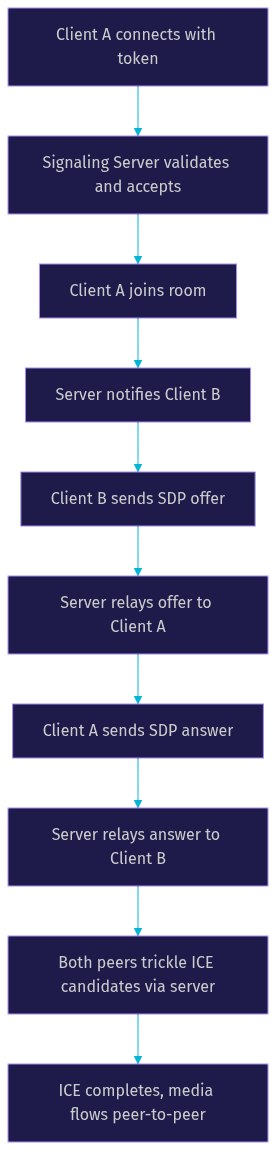
Two details in this flow trip up first-time builders. ICE candidates can arrive before the remote peer has processed the offer, so clients must buffer early candidates until the remote description is set. And the signaling server should treat the media connection as the source of truth for liveness: a WebSocket that drops while media keeps flowing should trigger reconnection logic, not a forced room exit.
Implementing a Production-Ready Server
A prototype signaling server is a weekend project. A production one is an exercise in state management, abuse prevention, and observability.
Using Redis for State Persistence
Redis is the de facto standard for signaling state because it solves three problems at once. It shares room membership across server instances, it provides pub/sub for cross-instance message delivery, and its TTL mechanism cleans up after crashed clients. A room's participant list stored with per-participant expiry means a client that vanishes without a graceful disconnect is removed from presence automatically seconds later, which prevents the classic "ghost participant" bug where a user appears in a call they left an hour ago.
Keep signaling state deliberately small: room IDs, participant IDs, roles, and connection-instance mappings. Resist the temptation to store session analytics in the same Redis instance; signaling state is hot and short-lived, analytics is cold and long-lived.
Rate Limiting and Abuse Prevention
Any public WebSocket endpoint will eventually be probed by scripts. Apply a token-bucket rate limiter per connection and per IP: allow a burst of messages at join time (SDP plus a burst of ICE candidates is legitimately chatty) but cap sustained message rates well below what a normal client produces. Reject oversized messages, since SDP payloads are small and a multi-megabyte "signaling" message is always malicious or broken. Validate that every message conforms to your expected schema before relaying it, and never relay a message to a room the sender has not authenticated into.
Health Checks and Monitoring
Expose a lightweight health endpoint that reports whether the instance can reach Redis and accept new connections, and have your load balancer use it to route around failing instances. Export metrics in Prometheus format: active connections, rooms served, messages relayed per second, and join latency. The number that matters most for user experience is time from token validation to first media frame, so instrument the full join path, not just the signaling hop.
Log structured events with correlation IDs per room and participant so a support ticket about "a call that never connected" can be traced end to end. Never log token contents or full SDP payloads in production; log their hashes or sizes instead.
Deployment Options
Docker is the natural packaging for a signaling server: a stateless container image plus Redis plus a load balancer is the minimum viable topology. Kubernetes adds value once you need autoscaling on connection count and rolling deploys that drain WebSocket connections gracefully. Serverless platforms are a poor fit for the signaling tier itself, because per-invocation cold starts and connection limits conflict with long-lived WebSocket sessions; serverless is better suited to the token-generation backend that sits in front of signaling.
If you would rather not own this topology, VideoSDK's cloud signaling handles rooms, presence, and scale for you, and the Prebuilt UI Kit can have a working call interface embedded without any signaling code at all.
Security Best Practices for WebRTC Signaling
Signaling security is mostly about controlling who can connect and what they can send. Enforce TLS on every signaling connection; a plaintext signaling channel leaks participant identities and room metadata to anyone on the path. Validate JWTs on connection open and reject expired or mismatched tokens before any room state is touched. Check the Origin header of WebSocket upgrade requests and reject origins outside your application's domain, which blocks cross-site WebSocket hijacking attempts from malicious pages.
Scope every token to a single room and a single participant identity, with a short lifetime measured in minutes. A leaked token then grants access to one room briefly, not your entire platform. On the media side, pair signaling security with DTLS-SRTP, which WebRTC mandates, and configure your TURN servers with authenticated credentials so your relay infrastructure cannot be abused as an open proxy. For teams that need stronger guarantees, VideoSDK supports end-to-end encryption and geo-fencing on top of the standard WebRTC security model.
Common Pitfalls and How to Avoid Them
Three mistakes account for most broken hand-rolled signaling implementations. First, ICE candidate ordering: candidates that arrive before the remote SDP description is set must be queued, not dropped, or connections silently fail on slow networks. Second, missing reconnection logic: WebSocket connections drop constantly on mobile networks, and a client that treats a signaling disconnect as a session end will boot users from calls in elevators and tunnels. Third, CORS and origin misconfiguration: a signaling server that accepts upgrade requests from any origin is one crafted page away from being hijacked. A fourth, quieter failure is forgetting to clean up room state when a client disconnects ungracefully, which is why Redis TTLs are worth the small added complexity.
Choosing an Open-Source WebRTC Signaling Solution
If you build rather than buy, the open-source landscape offers three main paths. Node.js with Socket.IO is the most documented and fastest to prototype, with the tradeoff of a heavier runtime per connection. Go-based signaling servers offer better memory characteristics at high connection counts and are a strong choice once you exceed tens of thousands of concurrent sockets. General-purpose WebRTC room projects on GitHub provide working room management out of the box, though maintenance cadence varies widely and you inherit their security posture.
Evaluate candidates on four criteria: active maintenance within the last year, built-in room and presence abstractions, a documented path to horizontal scaling, and a security model that supports token-based auth from day one. VideoSDK's own GitHub organization publishes open-source agent SDKs and code samples worth studying even if you run your own signaling tier, and the code sample library shows complete calling applications where signaling is fully managed.
Signaling Server vs SFU: Knowing the Difference
A frequent point of confusion deserves its own clarification: a signaling server and an SFU (selective forwarding unit) are different components solving different problems. The signaling server coordinates connection setup and carries control messages. The SFU receives media streams from participants and forwards them to others, which is how multi-party calls scale beyond what mesh peer connections can handle. In small peer-to-peer calls the SFU may not exist at all; in production group calls it is essential. VideoSDK's architecture combines both: its cloud handles signaling and room coordination while its media plane routes streams, which is why a single SDK covers everything from two-person calls to large interactive live streaming sessions.
Definitions Glossary
Signaling Server: The coordination service that relays SDP offers, answers, and ICE candidates between peers before a WebRTC media connection is established. VideoSDK provides signaling as a managed part of its room-based architecture.
SDP (Session Description Protocol): The text format peers use to describe their media capabilities, codecs, and transport parameters during negotiation. It is exchanged as an offer and answer pair through the signaling channel.
ICE Candidate: A proposed network path a peer discovers during connectivity checks. Candidates are trickled through the signaling server until a working route between peers is confirmed.
STUN/TURN: Helper services for NAT traversal. STUN lets peers discover their public address; TURN relays media when direct connection fails. VideoSDK includes TURN infrastructure as part of its cloud.
SFU (Selective Forwarding Unit): A media server that receives each participant's streams and forwards them to other participants, enabling scalable multi-party calls beyond peer-to-peer limits.
Room: A named rendezvous point that participants join to discover and negotiate with each other. In VideoSDK, rooms carry identity, roles, and presence state managed by the platform.
Key Takeaways
- A WebRTC signaling server relays SDP offers, answers, and ICE candidates, but never touches media; once negotiation completes, audio and video flow peer-to-peer or through an SFU.
- WebSocket is the correct transport for signaling in nearly all production cases, with long-polling only as a fallback for restrictive networks.
- Horizontal scaling requires shared state across instances, and Redis pub/sub with TTL-based room state is the proven pattern.
- Security rests on TLS, origin checks, and short-lived room-scoped JWTs generated server-side, never client-side secrets.
- Building your own signaling tier is viable, but platforms like VideoSDK ship signaling, room management, TURN, and media routing as one managed stack, with a free tier to start.
Conclusion
The WebRTC signaling server is the invisible handshake layer that every real-time application depends on, and it is the piece the specification deliberately leaves to you. Whether you build it yourself with WebSocket, Redis, and careful token design, or let a platform absorb that complexity, the principles in this guide hold: ordered SDP relay, buffered ICE candidates, room-scoped auth, and state that cleans up after itself. If you would rather focus on your product than on signaling infrastructure, VideoSDK's quickstart gets a working video calling app running in minutes, and you can sign up free at app.videosdk.live. What are you building with WebRTC? Drop a comment, I'd love to hear what kind of real-time use case you're working on.
Free $20 Balance for AI Voice Agents & Video Calls
FAQ