


Twilio SIP trunking is a cloud-native service that connects your IP-based communications infrastructure to the global Public Switched Telephone Network (PSTN) without traditional hardware. It provides elastic scaling, pay-as-you-go pricing, built-in security through TLS and SRTP encryption, and global reach across dozens of countries. Developers and operations teams use it to replace legacy carrier contracts with a programmable voice backbone that integrates with APIs, AI agents, and modern contact center platforms.
Reliable voice infrastructure is no longer a nice-to-have for businesses that depend on real-time customer communication. Every dropped call, every second of latency, and every misconfigured trunk translates directly into lost revenue and frustrated users. Teams building telephony applications need a SIP trunking provider that scales on demand, secures media streams end to end, and offers global PSTN connectivity without months of carrier negotiation.
Twilio SIP trunking addresses these requirements by wrapping traditional SIP signaling in a cloud-native, API-driven platform. Whether you are migrating an on-premise PBX to the cloud, building a distributed contact center, or connecting AI voice agents to phone numbers, Twilio provides the trunking layer that bridges your IP network to the PSTN. This guide covers what Twilio SIP trunking is, how it works under the hood, its core features, setup walkthrough, production best practices, and common pitfalls to avoid.
What Is Twilio SIP Trunking?
Twilio SIP trunking is defined as a cloud-based service that enables Voice over IP (VoIP) endpoints to send and receive calls to and from the traditional PSTN using the Session Initiation Protocol. Instead of provisioning physical ISDN lines or negotiating contracts with regional telecom carriers, developers create a virtual SIP trunk through the Twilio console or API and route calls through Twilio's global media infrastructure.
Twilio implements SIP trunking through three core components. The Elastic SIP Trunk is the logical container that holds your configuration, including termination and origination settings, security policies, and call routing rules. A SIP Domain defines the namespace and authentication mechanism for endpoints connecting to the trunk. Credential Lists store the username and password pairs that Twilio uses to authenticate SIP registrations from your PBX, SBC, or softphone.
When a call originates from your IP infrastructure, it travels as SIP signaling to Twilio's edge servers. Twilio authenticates the request, applies your trunk's routing and security policies, and bridges the call to the PSTN or another Twilio endpoint. The same flow operates in reverse for inbound calls from the PSTN to your SIP endpoints. This architecture eliminates the need for physical telecom hardware while preserving full SIP compatibility.
Key Benefits of Twilio SIP Trunking
Twilio SIP trunking stands out from legacy carrier solutions by combining programmability with carrier-grade reliability. The platform is designed for developers who need to provision, monitor, and scale voice infrastructure through code rather than support tickets.
Unmatched scalability is the first advantage. Traditional SIP trunks require you to estimate concurrent call capacity upfront and pay for that capacity whether you use it or not. Twilio's elastic model means you only pay for the minutes you consume. A sudden spike in call volume during a marketing campaign or emergency notification burst simply scales without capacity planning meetings.
Global PSTN reach is the second major benefit. Twilio maintains interconnects with carriers in over 100 countries, allowing you to provision local phone numbers and terminate calls internationally without negotiating separate contracts in each region. This is particularly valuable for distributed teams and global contact centers that need local presence in multiple markets.
Built-in security features set Twilio apart from many traditional providers. The platform supports STIR/SHAKEN call authentication to combat spoofed calls, TLS for SIP signaling encryption, and SRTP for media stream encryption. IP Access Control Lists let you restrict which endpoints can register against your trunk, reducing the attack surface significantly.
Redundancy and disaster recovery capabilities round out the benefits. Twilio's media servers are distributed across multiple regions, and the platform supports failover configurations through alternate termination URIs and backup trunk assignments. If your primary endpoint becomes unreachable, Twilio can redirect calls to a secondary location automatically.
Core Features Deep Dive
Elastic Scaling and Pay-As-You-Go Pricing
Twilio's elastic SIP trunking model means there are no committed monthly minimums for standard usage. You are billed per minute for terminated and originated calls, with pricing varying by destination country and call direction. This structure benefits businesses with variable call volumes, such as seasonal retail support lines or emergency notification systems that sit idle for months and then burst to thousands of concurrent calls.
For high-volume users, Twilio offers volume-based discounts and the ability to negotiate committed-use pricing through their sales team. The key cost optimization strategy is monitoring your termination patterns and routing calls through the most efficient geographic paths. Twilio's console provides detailed call logs and usage metrics that help identify expensive routing patterns and optimize them over time.
Global Coverage and Local Prefixes
Twilio provides phone number provisioning in over 100 countries, including local, national, mobile, and toll-free variants. When you purchase a number through Twilio, you can assign it directly to a SIP trunk for origination, meaning inbound calls to that number route to your SIP endpoint.
Regional latency considerations matter when designing your trunk architecture. Twilio operates media servers in multiple global regions, and selecting a termination URI geographically close to your SIP endpoint reduces round-trip latency. For example, terminating calls to a PBX hosted in Frankfurt through a US-based media server adds unnecessary network hops. Twilio's edge routing logic attempts to minimize this automatically, but explicit configuration of regional termination endpoints gives you more control.
Secure Trunking (TLS and SRTP)
Secure SIP trunking on Twilio involves encrypting both the signaling and media layers. TLS protects the SIP signaling channel, preventing eavesdropping on call setup messages, headers, and authentication credentials. SRTP encrypts the actual voice media payload, ensuring that intercepted RTP packets remain unreadable.
Enabling secure trunking requires configuring your SIP endpoint to use TLS for transport and to negotiate SRTP for media. Twilio supports both trusted and untrusted certificate modes, though production deployments should always use trusted certificates from a recognized CA. The compliance impact is significant for industries like healthcare and finance, where encrypted voice transport may be a regulatory requirement rather than an optional enhancement.
CNAM Lookup and Caller ID Management
CNAM (Caller Name) lookup is a feature that displays the caller's name alongside their phone number on inbound calls. Twilio supports CNAM storage and lookup for US numbers, allowing businesses to present a branded caller identity when making outbound calls and to see caller names on inbound calls where the originating carrier supports CNAM.
This feature is particularly valuable for contact centers and customer support teams. When a caller sees a branded name instead of a generic number, answer rates increase significantly. Twilio's console lets you manage CNAM records per phone number, and the API supports programmatic updates for dynamic caller ID scenarios.
Disaster Recovery and Failover Options
Twilio SIP trunking includes several disaster recovery mechanisms. The primary tool is the fallback URL configuration on your SIP trunk, which tells Twilio where to send calls if the primary termination endpoint is unreachable. You can configure a secondary SIP URI or a Twilio Programmable Voice URL that handles the call through a different path.
SIP REFER support allows Twilio to transfer calls mid-session to alternative endpoints, which is useful for active call failover scenarios. Some teams also maintain a completely separate backup trunk with a different configuration profile, switching traffic manually or through automated monitoring scripts when the primary trunk degrades.
Setting Up Twilio SIP Trunking: A Conceptual Walkthrough
Setting up Twilio SIP trunking involves several logical steps that connect your IP communications infrastructure to the global PSTN. Before starting, you need an active Twilio account with voice-enabled permissions and a SIP-enabled network element such as a Session Border Controller (SBC), IP-PBX, or software-based SIP client.
The first step is creating a SIP Trunk in the Twilio console. This trunk serves as the container for all your configuration settings. You give it a descriptive name and choose whether it will handle termination (calls from your endpoint to the PSTN), origination (calls from the PSTN to your endpoint), or both.
Next, you configure a Credential List. This list contains the username and password pairs that your SIP endpoint will present during registration or INVITE authentication. The credentials must match exactly what your PBX or SBC is configured to send, and they should be stored securely since they grant access to your trunk.
You then create a SIP Domain, which defines the addressing scheme for your trunk. The domain name becomes part of the SIP URI that your endpoint sends calls to. Twilio generates a default domain, but you can also configure custom domains for branding or organizational clarity.
After the domain and credentials are in place, you provision phone numbers through Twilio and assign them to the trunk for origination. For termination, you configure the termination URI that tells Twilio where to send outbound calls from the PSTN back to your infrastructure.
Finally, you set up voice and messaging URLs if you want Programmable Voice features like IVR, recording, or TwiML-based call routing to apply to trunk calls. The Twilio console provides a visual dashboard for all of these steps, and every configuration option is also accessible through the Twilio REST API for teams that prefer infrastructure-as-code workflows.
The following diagram illustrates the end-to-end call flow from an on-premise PBX through Twilio's SIP infrastructure to the PSTN:
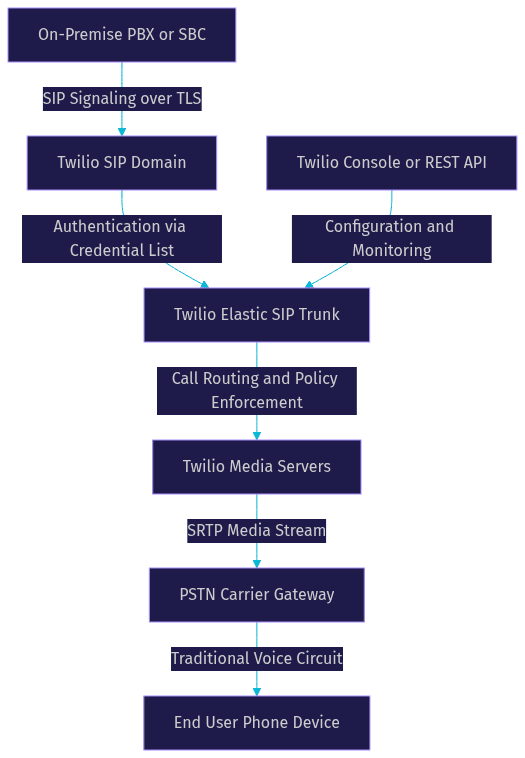
This architecture shows how Twilio acts as the intermediary layer between your IP infrastructure and the traditional phone network. All signaling passes through Twilio's SIP Domain, where authentication and policy enforcement occur before calls are routed to the appropriate media server and onward to the PSTN.
Best Practices for Production Deployments
Running Twilio SIP trunking in production requires attention to network capacity, security configuration, monitoring, and disaster recovery testing. These practices separate stable deployments from ones that fail under load.
Network bandwidth sizing is the foundation. Each concurrent G.711 voice call consumes approximately 100 kbps of bandwidth in each direction. If you expect 200 concurrent calls at peak, you need at least 40 Mbps of dedicated voice bandwidth. Always factor in overhead for SIP signaling, RTCP, and potential codec negotiation. Using Opus codec at lower bitrates can reduce per-call bandwidth, but only if both endpoints support it.
Firewall and IP ACL configuration is critical for both security and functionality. Twilio publishes the IP address ranges its media servers and SIP signaling servers use. Your firewall must allow inbound and outbound traffic on the SIP signaling port (typically 5061 for TLS) and the RTP media port range (typically 10000 to 20000 UDP) from Twilio's IP ranges. Restricting access to only Twilio's published IPs through ACLs prevents unauthorized registration attempts.
Monitoring and alerting should be configured through the Twilio console's voice metrics dashboard. Key metrics to watch include call success rate, average post-dial delay, jitter, packet loss, and concurrent call count. Set up alerts for sudden drops in call success rate or spikes in failed authentication attempts, as these often indicate configuration drift or security issues.
Secure trunking should be enabled from day one, not added later. Enabling TLS for signaling and SRTP for media ensures that call content and metadata are protected in transit. Choose codecs carefully: G.711 provides universal compatibility but higher bandwidth, while Opus offers better quality at lower bitrates if your endpoint supports it. Avoid G.729 unless you have specific licensing and compatibility requirements.
Disaster recovery URLs and failover paths should be tested regularly, not just configured and forgotten. Schedule quarterly failover tests where you intentionally take down your primary SIP endpoint and verify that calls route to your backup URI. Document the expected behavior and recovery time so your operations team knows what to expect during a real outage.
Common Pitfalls and How to Avoid Them
Even experienced telephony engineers encounter issues when configuring Twilio SIP trunking for the first time. Understanding these common pitfalls saves hours of troubleshooting.
Credential mismatches are the most frequent issue. The username and password in your Twilio Credential List must exactly match what your PBX or SBC sends during SIP registration. Case sensitivity, trailing spaces, and special characters all cause authentication failures. Always test credentials with a simple SIP client before deploying to production PBX configurations.
Overlooking SIP registration requirements is another common mistake. Some endpoints require SIP registration (sending periodic REGISTER messages to maintain the connection), while others use IP-based authentication without registration. Twilio supports both modes, but your trunk configuration must match your endpoint's behavior. If your endpoint expects registration but your trunk is configured for IP authentication only, calls will fail silently.
Ignoring regional latency when choosing termination URIs leads to poor call quality. If your SIP endpoint is in Singapore but you configure a US-based termination URI, every call adds unnecessary round-trip latency. Always select the geographically closest Twilio media region and configure your termination URI accordingly.
Misconfigured ACLs frequently cause one-way audio. If your firewall allows SIP signaling from Twilio but blocks RTP media ports, calls will connect but one party will hear silence. Ensure that both the SIP signaling port and the full RTP media port range are open to Twilio's IP ranges in both directions.
Underestimating concurrent call capacity is a capacity planning issue rather than a configuration error. While Twilio scales elastically, your on-premise network, SBC, and PBX have hardware limits. A SBC rated for 100 concurrent calls will not handle 500 just because Twilio can deliver them. Always size your local infrastructure to handle peak concurrent call volume plus a safety margin.
Use-Case Spotlight: Contact Center Integration
Modern contact centers rely on Twilio SIP trunking to handle high-volume inbound and outbound voice flows. The elastic scaling model is ideal for contact centers with variable call volumes, where peak periods like holiday seasons or product launches can multiply normal call traffic by ten or more.
Inbound flows typically route PSTN calls through Twilio phone numbers assigned to a SIP trunk. Twilio can apply Programmable Voice features like IVR menus, queueing, and call recording before delivering the call to an agent endpoint. This allows contact centers to build sophisticated call routing logic without traditional hardware-based IVR systems.
Outbound flows use the same trunk in reverse, with agent dialer software sending calls through the PBX to Twilio for PSTN termination. Twilio's global carrier relationships ensure high completion rates and competitive per-minute pricing across destinations.
Integration with Twilio Flex provides a unified agent workspace that combines voice, messaging, and CRM data. Flex natively supports SIP trunking for voice, meaning contact centers can deploy a full cloud-based agent desktop without maintaining separate telephony infrastructure.
AI voice agent integration is an emerging use case that leverages Twilio's SIP trunking layer to connect PSTN callers to LLM-powered conversational agents. Platforms like VideoSDK's AI telephony agent can bridge SIP-based phone calls to real-time AI pipelines, enabling automated customer service, appointment scheduling, and intelligent call routing without human agents for routine queries.
Comparing Twilio SIP Trunking to Traditional Providers
Choosing between Twilio and a traditional SIP trunking provider depends on your specific requirements for cost structure, scalability, global reach, and programmability.
| Feature | Twilio SIP Trunking | Traditional Carrier SIP | Best For |
|---|---|---|---|
| Pricing Model | Pay-as-you-go, per minute | Fixed monthly + committed minimums | Variable call volume |
| Scalability | Elastic, instant | Requires capacity planning | Bursty or unpredictable traffic |
| Global Reach | 100+ countries via single contract | Per-region carrier agreements | Multi-country operations |
| Security | TLS, SRTP, STIR/SHAKEN, IP ACLs | Varies by carrier, often add-on cost | Compliance-driven industries |
| Programmability | Full REST API, TwiML, webhooks | Limited or none | Developer-led integrations |
| Setup Time | Minutes via console or API | Weeks of carrier negotiation | Fast time-to-market |
| Disaster Recovery | Fallback URLs, multi-region | Varies, often manual | High availability requirements |
Twilio wins for teams that need rapid provisioning, API-driven configuration, and elastic scaling. Traditional carriers may still be preferred for extremely high-volume, predictable call patterns where committed-use pricing from a legacy carrier offers better per-minute rates. Some organizations use a hybrid approach, keeping Twilio as a secondary trunk for failover while maintaining a primary carrier relationship for cost optimization.
For teams building AI-powered voice applications, Twilio's programmability and API access make it a stronger fit than most traditional carriers. The ability to inject TwiML instructions, trigger webhooks on call events, and integrate with AI agent platforms like VideoSDK's conversational AI tools creates opportunities that static carrier trunks cannot match.
Definitions Glossary
SIP Trunk: A virtual connection between a VoIP endpoint and the PSTN using the Session Initiation Protocol, replacing physical telephone lines with IP-based call routing.
Elastic SIP Trunking: A cloud-native SIP trunking model where capacity scales automatically with demand and billing is based on actual usage rather than fixed commitments.
SIP Domain: A Twilio-specific namespace that defines how SIP endpoints address and authenticate against a trunk, forming part of the SIP URI used for call routing.
Credential List: A collection of username and password pairs stored in Twilio that SIP endpoints present during registration or INVITE authentication to prove their identity.
Termination URI: The destination SIP address that Twilio sends calls to when routing from the PSTN to your infrastructure, typically pointing to your PBX or SBC.
SRTP (Secure Real-time Transport Protocol): An extension of RTP that encrypts voice media payloads, ensuring that intercepted audio packets cannot be decoded without the encryption keys.
STIR/SHAKEN: A framework of protocols and standards designed to combat caller ID spoofing by cryptographically validating the identity of the calling party on telephone networks.
Key Takeaways
- Twilio SIP trunking replaces traditional carrier contracts with a cloud-native, API-driven voice backbone that scales elastically and bills per minute.
- Core components include the Elastic SIP Trunk, SIP Domain, and Credential Lists, which together handle authentication, routing, and policy enforcement.
- Production deployments require careful attention to firewall configuration, IP ACLs, bandwidth sizing, and secure trunking enablement from day one.
- Disaster recovery features like fallback URLs and backup trunks must be tested regularly to ensure they work when needed during real outages.
- For AI voice agent and contact center use cases, Twilio's programmability and integration with platforms like VideoSDK create opportunities that traditional carriers cannot match.
Conclusion
Twilio SIP trunking gives developers and operations teams a programmable, globally distributed voice infrastructure that eliminates the friction of traditional carrier relationships. The elastic scaling model, built-in security features, and API-driven configuration make it a strategic choice for contact centers, AI voice applications, and any business that needs reliable PSTN connectivity without months of hardware provisioning. If you are building telephony applications or migrating from a legacy carrier, start by exploring the Twilio console and provisioning a test trunk. For teams connecting SIP calls to AI agents, VideoSDK's telephony integration provides the bridge between traditional phone infrastructure and modern conversational AI. What are you building with Twilio SIP trunking? Drop a comment below, I would love to hear about your telephony use case and architecture.
Free $20 Balance for AI Voice Agents & Video Calls
FAQ