


HLS (HTTP Live Streaming) typically delivers 15 to 30 seconds of latency because it waits for full multi-second segments before playback. LL-HLS (Low-Latency HLS) cuts that to roughly 2 to 5 seconds by publishing partial segments and using blocking playlist requests. Choose standard HLS for large-scale, cost-sensitive broadcasts, and LL-HLS when near-real-time delivery matters. For genuinely interactive streaming, sub-second protocols like VideoSDK's Interactive Live Streaming beat both.
A viewer watching a live football match on a streaming app often sees a goal scored a full 20 seconds after the stadium crowd erupts. That gap is not a bug in the broadcast; it is the structural latency of HTTP Live Streaming, the protocol that powers most of the streaming web. Apple's answer to this problem, Low-Latency HLS (LL-HLS), promises to close the gap, but it comes with trade-offs in cost, complexity, and compatibility.
This article breaks down HLS vs LL-HLS across latency, segment structure, playlist mechanics, player support, bitrate adaptation, cost, and implementation effort. By the end, you will know exactly which protocol fits your use case, and when neither is the right tool.
What Is HLS?
HLS is defined as a chunk-based streaming protocol, created by Apple, that delivers video over standard HTTP connections by splitting content into short media segments described by a playlist file. The encoder cuts the live feed into segments, traditionally around six seconds each, and publishes them to an ordinary web server or CDN. A playlist file, updated continuously for live streams, lists the most recent segments so the player knows what to fetch next.
HLS works by combining these segments with adaptive bitrate streaming: the server hosts multiple renditions of the same content at different resolutions and bitrates, and the player switches between them based on real-time network conditions. Because it rides on plain HTTP, HLS inherits the entire web's caching, scaling, and firewall-traversal infrastructure. That is why it became the default streaming standard across browsers, smart TVs, and mobile platforms, and why nearly every large OTT service relies on it.
What Is LL-HLS?
LL-HLS is defined as an extension of HLS, introduced by Apple in 2019, that reduces end-to-end latency by publishing media in smaller partial segments and making playlist delivery more responsive. Instead of waiting for a full six-second segment, the encoder pushes the first fragment of a segment, often around 200 to 500 milliseconds of media, as soon as it is available. The playlist advertises these parts so players can begin playing almost immediately.
LL-HLS works by adding three key mechanisms: partial segments for faster availability, blocking playlist requests that let the server hold a request until new media exists rather than the player polling repeatedly, and delta playlists that only describe changes since the last request. Crucially, LL-HLS was designed for backward compatibility. A legacy HLS player that ignores the new tags can still play the stream as a normal HLS stream, just without the latency benefit. This makes adoption incremental rather than disruptive.
HLS vs LL-HLS: Core Differences
The real comparison between HLS and LL-HLS happens at the protocol mechanics level, where seven dimensions separate them. Each difference compounds: partial segments alone would help, but combined with blocking requests and delta updates they cut latency by an order of magnitude.
Latency
Latency is the headline difference between the two protocols. Standard HLS typically runs 15 to 30 seconds behind the live edge, a product of segment duration, player buffer depth, and playlist polling intervals. LL-HLS reduces that to roughly 2 to 5 seconds in well-tuned deployments.
The speedup comes from three places. Partial segments let playback begin before a full segment exists. Blocking playlist requests eliminate the polling gap between media becoming available and the player learning about it. And players can hold the live edge more aggressively because they are fetching smaller, more frequent units of media. In practice, real-world LL-HLS latency depends heavily on CDN configuration and encoder speed, so treat vendor claims of sub-2-second latency as best-case figures.
Segment Structure
Standard HLS divides the live feed into complete segments, each several seconds long, and nothing is published until a segment is fully encoded. LL-HLS keeps the same overall segment timeline but publishes each segment in pieces, called parts, as the encoder produces them. A part typically holds a fraction of a second of media.
The playlist marks these pieces with the partial segment tag, and it also includes preload hints that tell the player which part or segment to fetch next before it is fully listed. This structure means the player is never waiting for a large chunk of media to finish encoding. The trade-off is that the origin server and CDN now handle many more small requests, which changes caching behavior and infrastructure load.
Playlist Mechanics
In standard HLS, the player polls the playlist at a fixed interval, and the server responds immediately with whatever it currently has. If nothing new exists, the player waits and asks again, adding latency at every cycle. LL-HLS replaces this with blocking playlist requests: the player asks for the playlist and the server holds the connection open until fresh media is actually available, then responds.
LL-HLS also introduces delta playlists. Instead of re-sending the full playlist every time, the server sends only the changes since the player's last request. This cuts bandwidth on the control channel and reduces processing overhead on both sides. Together, blocking requests and delta updates remove most of the dead time between media being ready and the player acting on it.
Compatibility & Player Support
Standard HLS enjoys the broadest compatibility of any streaming protocol. Safari plays it natively, every major browser plays it through widely used JavaScript players, and it is the required streaming format for iOS and tvOS apps. Smart TVs, set-top boxes, and game consoles universally support it.
LL-HLS support is strong but not universal. Native support exists in Apple's own platforms and in modern versions of popular open-source and commercial players, but older devices and many smart TV platforms only understand classic HLS. The saving grace is backward compatibility: an LL-HLS stream degrades gracefully to standard HLS for legacy players, at the cost of losing the latency improvement. If your audience skews toward older devices, a meaningful share of viewers will effectively be on standard HLS regardless of what you publish.
Quality & Bitrate Adaptation
Both protocols support adaptive bitrate streaming, but they handle it differently. In standard HLS, the player measures throughput while downloading full segments and switches renditions at segment boundaries, which means adaptation decisions happen every few seconds.
LL-HLS accelerates this in two ways. Because parts arrive in sub-second pieces, the player samples network conditions far more frequently and can react to congestion faster. And rendition reports, a feature where the server tells the player which renditions have matching parts available at the same timestamps, let the player switch quality mid-segment without waiting for aligned boundaries. The result is smoother quality transitions and faster recovery from bandwidth dips, though aggressive low-latency buffering leaves less headroom, so poorly tuned players can oscillate between renditions.
Cost & Licensing
The HLS specification is open and free to implement, and its mature tooling means open-source encoders and servers handle it at zero licensing cost. LL-HLS is also an open specification, but the practical economics differ. Achieving low latency requires more origin requests, more frequent CDN transactions, and often commercial player plugins or streaming platforms that charge for LL-HLS features.
CDN cost is the biggest line item. Partial segments and blocking requests multiply request counts by an order of magnitude compared with classic HLS, and many CDNs bill per request in addition to per byte delivered. At large scale, an LL-HLS deployment can cost meaningfully more than an equivalent HLS audience, which is why many broadcasters enable LL-HLS only for premium live events.
Implementation Complexity
A standard HLS pipeline is close to turnkey: encode to segments, publish to any HTTP server, point a player at the playlist. Most engineers can ship a working HLS deployment in days. LL-HLS raises the bar on every component. The encoder must support partial segment output, the origin server must implement blocking requests and delta playlists, and the CDN must cache and forward these behaviors correctly at the edge.
CDN misconfiguration is the most common failure mode: if the edge caches playlists too aggressively or strips blocking request behavior, latency silently reverts to standard HLS levels. Debugging requires monitoring the actual live-edge delay per session, not just origin-side metrics. Teams without dedicated streaming infrastructure experience typically lean on managed platforms rather than building LL-HLS from scratch.
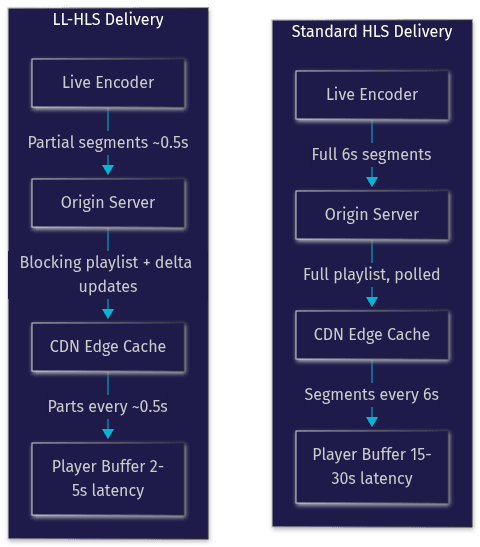
The following diagram shows how the two protocols differ at the delivery level, side by side:
When to Choose Standard HLS
Standard HLS is the right choice when scale and cost matter more than immediacy. Large-scale OTT broadcasting, on-demand video libraries, church services, corporate town halls recorded for later viewing, and any content where a 20-second delay changes nothing are all ideal HLS territory.
It is also the pragmatic choice when your audience spans older smart TVs and legacy devices, because universal compatibility means zero fallback engineering. And because request counts stay low, CDN costs scale predictably with audience size. If your viewers watch on their own schedule, or if the content is not genuinely live-interactive, the added cost and complexity of LL-HLS buys you nothing.
When to Choose LL-HHLS
LL-HLS earns its complexity when seconds matter. Live sports betting, auctions where a bid delay costs money, live shopping events with limited inventory, and interactive broadcasts where hosts respond to chat in real time all justify the latency investment.
News and sports streaming benefit because viewers comparing against radio or social media notice a 20-second lag immediately. LL-HLS brings the stream close enough to real time that the gap stops being noticeable for most content. The rule of thumb: if your viewers would change their behavior based on information arriving five seconds sooner, LL-HLS is worth evaluating. If true sub-second interaction is required, such as viewers joining the stage to speak, HTTP-based streaming of any flavor is the wrong tool.
Performance & CDN Considerations
Your CDN configuration determines whether LL-HLS actually delivers low latency in practice. Playlists must be cached for very short windows, blocking requests must pass through to the origin or be handled at the edge, and partial segments need cache rules distinct from full segments. A CDN tuned for classic HLS will silently break LL-HLS behavior.
Network variability also hits low-latency streams harder. A player holding a two-second buffer has far less room to absorb a bandwidth dip than one holding fifteen seconds, so LL-HLS players must switch renditions quickly and tolerate brief stalls. Delta updates reduce control-channel bandwidth, which helps on constrained mobile networks. Monitor live-edge delay per session, rendition switch frequency, and rebuffer ratio, because these three metrics reveal whether your LL-HLS deployment is genuinely performing or just falling back to HLS behavior with extra cost.
Implementation Checklist
Before committing to either protocol, verify four things. First, confirm your encoder supports partial segment output and the playlist tags LL-HLS requires, since encoder support is still uneven across vendors. Second, validate CDN behavior end to end: blocking requests, short playlist cache times, and correct handling of parts at the edge. Third, choose a player with proven LL-HLS support on the platforms your audience actually uses, and test graceful fallback on legacy devices.
Fourth, set up monitoring before launch. Track live-edge delay, rebuffering, and request volume against your CDN billing model so the latency win does not become a surprise invoice. Teams evaluating build-versus-buy should also benchmark managed streaming platforms, which absorb most of this checklist in exchange for platform fees.
Future Outlook (2026 and Beyond)
The streaming ecosystem is converging on CMAF, the Common Media Application Format, as the shared packaging layer for both LL-HLS and DASH-based low-latency delivery. Because CMAF lets one set of chunked media files serve multiple protocols, the marginal cost of supporting low latency continues to fall, and LL-HLS adoption is rising accordingly.
Meanwhile, the interactive end of the market is pulling in a different direction. As live shopping, live auctions, and audience-on-stage formats grow, HTTP-based streaming's seconds-level latency floor becomes the constraint, and WebRTC-based approaches like VideoSDK's Interactive Live Streaming fill the gap with sub-second delivery. Expect a two-tier future: LL-HLS for near-real-time broadcast at scale, and WebRTC-class protocols for genuinely interactive experiences.
Definitions Glossary
HLS (HTTP Live Streaming): A chunk-based streaming protocol that delivers video over standard HTTP by splitting content into multi-second segments described by a playlist file, typically adding 15 to 30 seconds of live latency.
LL-HLS (Low-Latency HLS): An Apple-designed HLS extension that publishes partial segments and uses blocking playlist requests to reduce live latency to roughly 2 to 5 seconds while remaining backward compatible.
Partial Segment (Part): A sub-second fragment of a media segment, published by LL-HLS as soon as it is encoded so players can begin playback without waiting for the full segment.
Blocking Playlist Request: An LL-HLS mechanism where the server holds a playlist request open until new media is available, eliminating the polling delay of standard HLS.
Adaptive Bitrate Streaming (ABR): A technique where the player switches between multiple quality renditions of a stream based on real-time network conditions, supported by both HLS and LL-HLS.
Key Takeaways
- Standard HLS delivers 15 to 30 seconds of latency, while LL-HLS achieves roughly 2 to 5 seconds through partial segments, blocking playlist requests, and delta updates.
- LL-HLS is backward compatible, so legacy HLS players still work, but they fall back to high-latency behavior.
- LL-HLS costs more to run because partial segments and blocking requests multiply CDN request counts, often billed per request at scale.
- Choose standard HLS for large-scale, cost-sensitive, and on-demand content; choose LL-HLS for live sports, auctions, and interactive broadcasts where seconds matter.
- For sub-second, genuinely interactive streaming where viewers can join the stage, WebRTC-based solutions like VideoSDK's Interactive Live Streaming outperform both HLS and LL-HLS.
Conclusion
The HLS vs LL-HLS decision comes down to one question: how close to real time does your audience need to be? Standard HLS remains the most compatible and cost-efficient way to reach millions of viewers, while LL-HLS buys a 5 to 10x latency reduction at the price of higher CDN costs and more demanding infrastructure. Neither protocol, however, reaches the sub-second territory that interactive formats demand. If your viewers need to speak, bid, or react in real time, explore VideoSDK's Interactive Live Streaming and the broader VideoSDK documentation, or try it free at app.videosdk.live. What are you building, a large-scale broadcast or an interactive live experience? Drop a comment, I'd love to hear which latency target you're aiming for.
Challenges and Limitations of HLS & LL-HLS
1. Technical Complexities and Implementation Costs:
Implementing LL-HLS is more complex than traditional HLS due to the additional features required for low latency, such as HTTP/2 push, partial segments, and preload hints. These enhancements necessitate careful planning, sophisticated infrastructure, and potentially higher costs, making it a more resource-intensive solution.
2. Network and Bandwidth Considerations:
LL-HLS requires a robust network infrastructure to handle the frequent transmission of smaller segments. Insufficient bandwidth can lead to buffering and degraded video quality, counteracting the benefits of low latency. Therefore, a stable and high-capacity network is crucial for effective LL-HLS deployment.
3. Compatibility Issues:
While LL-HLS is gaining support across various platforms, it remains primarily an Apple-driven technology. This can lead to compatibility issues on non-Apple devices and older hardware that does not support the latest updates. Ensuring wide compatibility requires thorough testing and potentially additional adjustments to accommodate different device.
By addressing these challenges, content creators can leverage the benefits of LL-HLS to provide high-quality, low-latency streaming experiences, enhancing viewer satisfaction and engagement.
Conclusion
In conclusion, choosing between HLS and LL-HLS depends on the specific needs of the streaming application. While HLS offers broad compatibility and robustness for VOD and non-interactive live streams, LL-HLS provides the low latency required for real-time interaction and live events. Understanding the technical differences, implementation challenges, and use cases can help content creators and broadcasters deliver optimal streaming experiences, ensuring high viewer engagement and satisfaction. As technology advances, both protocols will continue to evolve, offering even better solutions for diverse streaming needs.
Free $20 Balance for AI Voice Agents & Video Calls
FAQ